


The climate change case heard at the International Court of Justice (ICJ) in December 2024 marks a significant milestone in the history of the fight against the global warming crisis. Not only is it the largest case in the history of the World Court, but it also reflects efforts to establish a clear legal framework of responsibility for addressing climate issues, particularly regarding greenhouse gas emission reductions and assistance to affected countries.
The beginning of this historic case stems from the efforts of Vanuatu and small Pacific island nations facing threats from rising sea levels, with significant momentum from Pacific island student groups fighting climate change. This reflects the power of the younger generation in driving environmental issues and demonstrates the shared concern of nations worldwide regarding the intensifying climate crisis, particularly its impact on developing countries and small island states that are vulnerable to climate change.
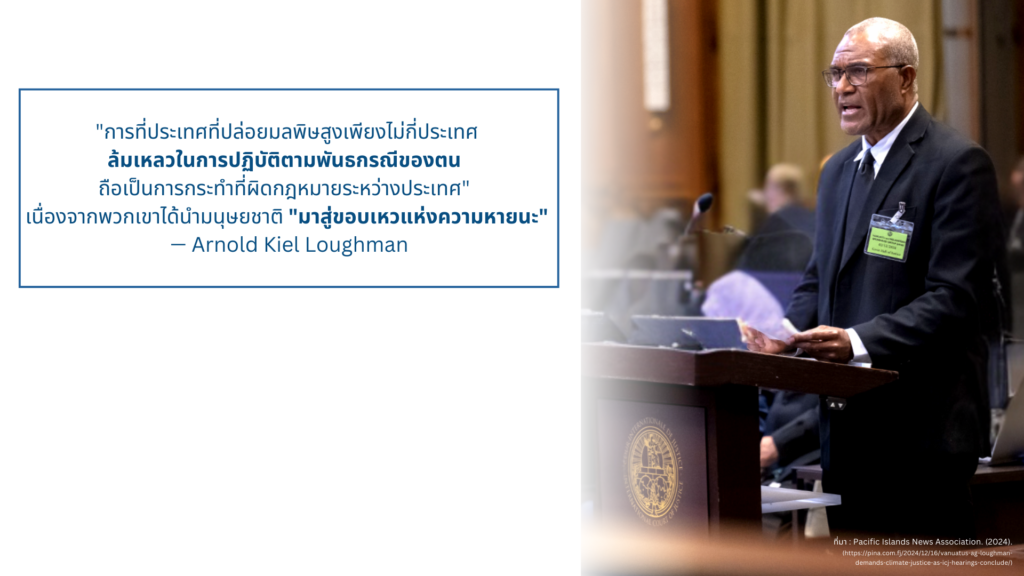
“The failure of just a few high-polluting countries to fulfill their commitments constitutes a violation of international law” as they have brought humanity “to the brink of catastrophe” – Arnold Kiel Loughman
State Responsibility: Key Legal Issues in Climate Protection
First, state obligations under international law to protect the climate system from greenhouse gas emissions, environmental stewardship for current and future generations, and the scope of responsibility for achieving established climate targets.
Second, legal consequences for states that cause damage to the climate system, particularly impacts on small island developing states, including responsibility for remedying damages to current and future populations.
Conflicts and Differing Positions
The differences in national positions reflect the challenges in creating global cooperation due to varying contexts, constraints, and needs. Finding a balance between different requirements is key to developing effective and fair solutions for all parties.
Developing Countries: Calls for Justice
- Brazil represents developing countries emphasizing the principle of “common but differentiated responsibilities,” highlighting the challenges of developing countries while addressing climate impacts.
- China, despite being a major greenhouse gas emitter, maintains its developing country status, proposing adherence to the Paris Agreement framework and calling for greater adjustment periods for developing countries.
- Small island states have specific demands for preserving maritime rights and statehood despite facing threats from territorial loss due to rising sea levels.
Developed Countries: Cautious About Binding Commitments
- The United States shows a cautious stance and rejects interpretations that would lead to legal obligations from international agreements.
- The European Union emphasizes non-confrontational cooperation approaches but does not support developing strict enforcement mechanisms.

“We are drowning” – a cry that reflects the urgent necessity of the problems small island states are facing, especially after disappointment from the COP29 agreement that set climate assistance at only $300 billion per year by 2035, which is hardly sufficient for the damages they must bear.
Anticipated Systemic Impacts
Climate change litigation is not merely a legal process but creates systemic ripple effects across legal, policy, and social dimensions, becoming a crucial turning point in confronting climate problem-solving.
- Legal Impact creates new standards for climate litigation while establishing clearer state responsibility frameworks, which will serve as an important foundation for claiming compensation for damages.
- Diplomatic and Policy Impact affects the direction of international climate negotiations
by creating pressure for countries to increase greenhouse gas reduction targets and leading to more equitable resource allocation. - Social Impact empowers climate movements, raises widespread awareness
about the urgency of the problem, and increases pressure on both government and business sectors to take more serious action.
Recommendations for Advancing Climate Problem Solutions
Addressing climate change requires international cooperation to ensure concrete and sustainable action, including developing enforcement mechanisms with clear oversight, transparent monitoring and reporting systems, and effective sanctions for agreement violations. Supporting developing countries by increasing support funds to help these countries adapt to climate change, along with technology transfer, and improving international cooperation by developing effective dispute resolution mechanisms, creating systems for information and knowledge exchange between countries, and strengthening regional cooperation.
This case may mark the beginning of a new era in fighting climate change by using law as a tool for creating change. However, success will depend on political will and international community cooperation in seriously implementing the court’s recommendations. This case is therefore not merely a legal battle but also a test of humanity’s commitment to protecting the world for future generations. Although the World Court’s ruling is only advisory without legal binding force, it represents an important step in laying the foundation for future international law development, particularly in addressing climate change.
Strategy and International Cooperation Coordination Division
National Economic and Social Development Council
References
The Guardian. (2023). ‘Beginning of a new era’: Pacific islanders hail UN vote on climate justice. Retrieved from https://www.theguardian.com/world/2023/mar/30/un-vote-on-climate-justice-pacific-island-change-crisis-united-nations-vanuatu
United Nations. (2024). Landmark climate change hearings represent largest ever case before UN world court. Retrieved from https://news.un.org/en/story/2024/12/1157671
United Nations. (2024). UN World Court concludes landmark hearings on States’ responsibility for climate change. Retrieved from https://news.un.org/en/story/2024/12/1158476
Related Documents