

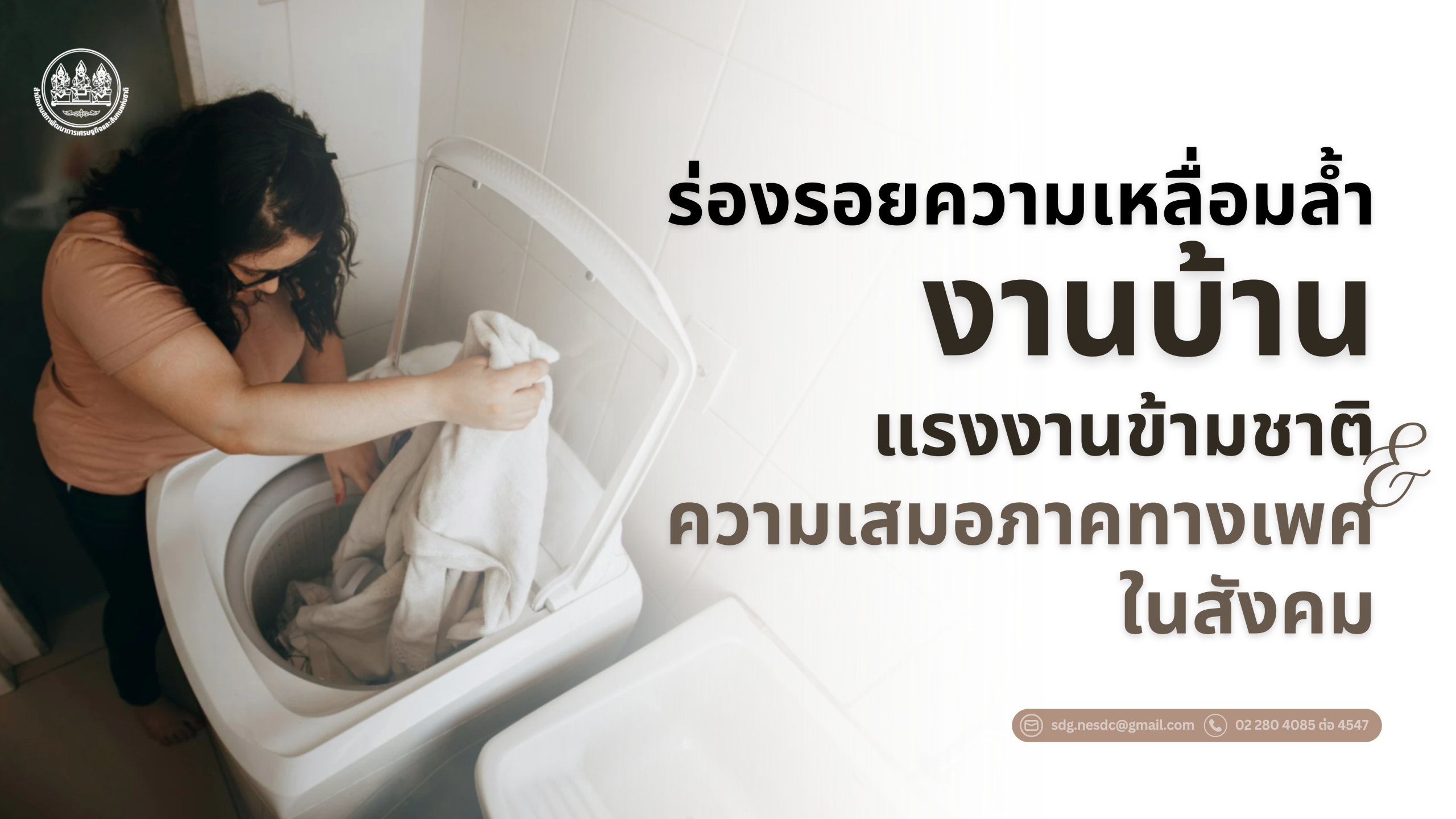
Although the world has advanced significantly in technology and economics, from the household level to the global level, gender inequality remains deeply rooted in daily life. Washing dishes, doing laundry, caring for the sick, or even accessing clean water and toilets have become indicators that reflect the inequality we are accustomed to but pay no attention to.
Laundry may seem like just a small daily household routine, but in reality, it is intertwined with personal hygiene, unrecognized labor burdens, and even economic conditions and power structures in society. This article invites exploration of laundry as a small activity that reflects social vulnerability and gender inequality subtly embedded in household work, from labor dimensions and hygiene to cultural frameworks that limit women’s roles in daily life. Laundry is not merely household work, but a window that opens to reveal gender inequality deeply embedded in families and society.
Laundry remains a burden that women bear without compensation
In a world where economic and social structures operate on principles of equality and human rights, and the term “gender equality” appears in every global forum, in daily life, laundry has become an activity that reflects gender inequality. Work that requires physical effort and time is still not included in the wage system and is still viewed as women’s natural duty. This understanding not only diminishes the value of unpaid labor but also reflects power structures that are subtly transmitted from generation to generation.

Data from the European Institute for Gender Equality (2021) shows that among the three forms of unpaid care work, household work is the activity with the highest gender inequality, followed by childcare and care for the elderly or those with chronic illnesses. Among working women, 91% spend at least 1 hour per day on household work, while only 30% of men in the same situation do the same. When examining daily time use specifically, women in the labor force spend an average of 2.3 hours per day on household work, while men spend only 1.6 hours. This gap is widest in families with children, where women bear up to 62% of the burden. This proportion not only reflects household work division patterns but also demonstrates structural inequality that has been normalized in society.
Labor imbalance in the home is not just an adult problem but begins in childhood. Many girls grow up in environments that shape them to take responsibility for household work, while boys learn to avoid these duties by imitating their fathers’ behavior. Research by Giménez-Nadal et al. (2019) indicates that parental role models are important mechanisms that transmit gender inequality in household work division from one generation to another. Even among young people aged 18-24, while the gender gap has decreased, only 19% of young men spend one hour per day cooking or doing household work, compared to 39% of young women of the same age. These figures clearly indicate that girls continue to be unpaid labor within the home. Laundry is thus one of the duties that suppresses women’s potential. The time lost to laundry doesn’t just disappear, but is exchanged for opportunities in education, income-generating work, or even rest.
Invisible labor like laundry is also a heavy burden for marginalized women and men, especially women without regular employment, temporary workers, and migrant workers. This group often lacks sufficient resources or time to hire external services, while having to take on these responsibilities unavoidably. For middle-class women, although they have the potential to hire others to do laundry, such actions transfer inequality to another group of women as hired labor, most of whom come from the lower class and lack social security.

In a society that broadly discusses rights, equality, and opportunities, laundry remains a reflection of deeply embedded and complex inequality structures. This further emphasizes that gender inequality is not distant but resides in the laundry basket we overlook every day.
Cleanliness, Hygiene, and Gender Stigma in Contemporary Culture
In many cultures worldwide, laundry and cleanliness care are not merely daily activities but activities that reflect social, gender, and caste power structures, especially in contexts related to menstruation, purity, and impurity in the public eye. Daily routines such as laundry cannot be separated from cultural and political dimensions of gender.
Data from Josephine Mylan and Dale Southerton (2018) on “The Social Ordering of an Everyday Practice: The Case of Laundry” shows that laundry in daily life is socially organized through complex mechanisms, whether through social relations, cultural conventions, domestic materiality, or institutionalized temporal rhythms. These mechanisms help explain why laundry is more than a household activity but a social practice that reflects structural inequality.

Issues of cleanliness and hygiene are also connected to menstruation. A report from UN Women (2017) on Gender Equality & Water, Sanitation and Hygiene states that taboos and stigma related to menstruation remain deeply embedded in many communities, especially in developing countries. Women are often prohibited from various activities, restricted in movement, or even forbidden from preparing food during menstruation. Beliefs about purity often cause women in some societies to face several restrictions during menstruation, such as being forbidden to do laundry or share water with others. These beliefs are not merely practices but become tools for stigmatizing women’s bodies and controlling women’s behavior, while clearly reinforcing the symbolic power that society has over female bodies.
In Indian society, work related to cleanliness, such as waste collection or laundry in public spaces, often falls to women from groups excluded by class and caste. These jobs are made dishonorable and viewed as belonging to women or the lower class. Therefore, cleanliness becomes a space of cultural power used to determine who is pure, who is impure, and who has the right to access basic state services. The image of a good woman who must strictly maintain family cleanliness still reflects burdens that have become implicit cultural rules. Laundry is thus not merely about work content but an action that expresses gender roles reinforced by cultural frameworks.
Such practices reinforce unequal power relations and lead to opportunity exclusion, from accessing health services and education to economic participation. This problem becomes more severe when there is a lack of policies that seriously prioritize menstrual hygiene, such as in many parts of the world where education systems still lack mechanisms to prepare girls for puberty, affecting the health, education, and self-confidence of many girls.
Access to safe hygiene is a basic right that remains distant for women and girls

Hygiene, safety, and the right to self-care remain matters that many women cannot access equally, especially in the context of household work like laundry that requires responsibility for washing without compensation, under unsafe conditions such as water scarcity, lack of private space, or safe equipment for laundry. Additionally, they face health risks from unclean water or exposure to chemicals without protective equipment, work that often falls to women and girls. In many areas worldwide, although washing machines, often viewed as symbols of liberation from household burdens, remain inaccessible to many women due to income limitations, living space size, and social environmental conditions.
WHO and UNICEF reports indicate that 7 out of 10 women and girls in households without piped water are responsible for water collection, with a tendency to spend more time collecting water than boys and having to travel farther. This directly impacts time for learning, play, and safety. Additionally, in the education sector, many girls cannot attend school during menstruation due to lack of clean toilets or appropriate laundry facilities at school, making them feel unsafe and ashamed, affecting long-term confidence and learning.
Designing sanitation systems without considering gender dimensions not only creates insecurity and shame but also continuously destroys the dignity of women and girls. Menstrual hygiene management should therefore be recognized as an important issue in women’s rights and as a starting point for truly integrating gender into WASH (Water, Sanitation and Hygiene) projects. Hygiene should not be a privilege for some groups but should be the minimum standard for everyone. Access to clean water, sanitation, and body care tools is the foundation of gender equality and sustainable development.
“Every step a girl takes to collect water
is a step away from learning, play, and safety”
– Cecilia Sharp, UNICEF Director of WASH and CEED
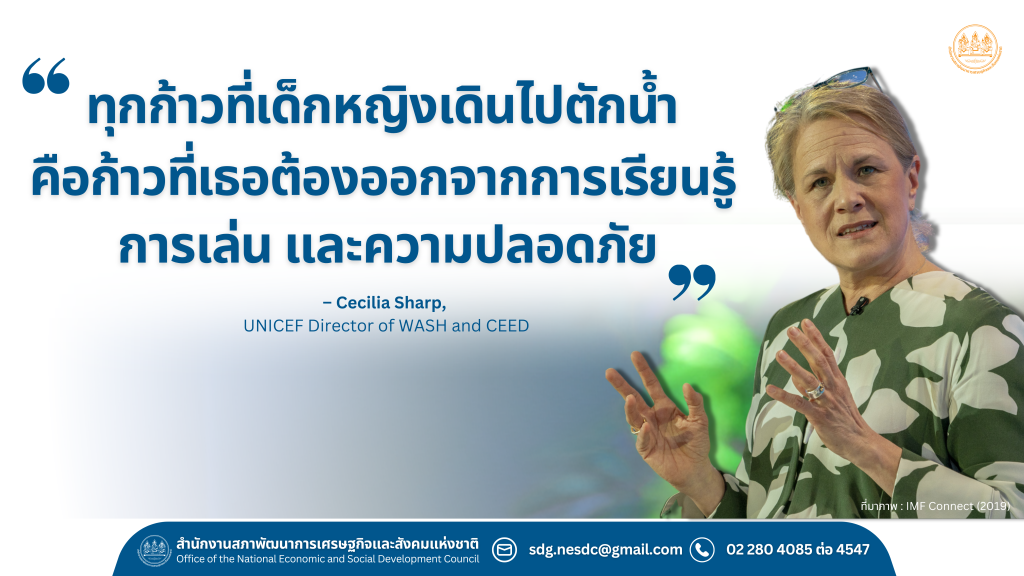
Image source: IMF Connect (2019)
When Lockdown Exposed Inequality in Family Life
The COVID-19 pandemic transformed homes into workplaces, schools, hospitals, and comprehensive care centers simultaneously, especially for women who often bear these burdens without holidays or compensation. Survey results from Eurocarers, a network of informal caregivers in Europe, indicate that household care burdens increased by an average of 17% per week, reflecting that lockdowns in many countries led to a massive increase in household work and care work, whether cooking, teaching children, caring for the elderly, or even laundry.

Many women had to work 24 hours without holidays, taking on multiple roles simultaneously. Accumulated stress, physical and mental fatigue, and domestic violence all increased visibly, especially among single mothers and those caring for family members who were ill or had special health needs. Although there were signs of change, such as some men beginning to participate more in household work, this change remained limited and could not erase the unfair burden that women bear.
School closures, working from home, and travel restrictions led to tension between paid work and unpaid care burdens, especially in families with young children. Online learning became a new burden that parents had to manage without external help, such as daycare centers, schools, or even elderly relatives, leaving almost no opportunity for work or even personal time.
Single mothers and women caring for young children were the most severely affected group, facing accumulated stress, social isolation, and reduced quality of life in the long term. Data from the European Institute for Gender Equality also revealed that life satisfaction levels of women, especially those aged 18-49, continuously declined in every wave of the pandemic.
Beyond fatigue and stress, increased time at home coupled with health problems and financial insecurity also led to increased domestic violence and child abuse, reflecting social structures that are not yet conducive to protecting vulnerable groups during crises. This pandemic thus not only affected health and the economy but also revealed structural inequality deeply rooted in household work division systems.
The Role of Thai Women in Care Work and Invisible Burdens in the Labor Sector
Unpaid care and household work remain the main burden of women in Thai society, clearly affecting opportunities to access valuable work. Data from the report Unpaid Care and Domestic Work of Thai Women and Its Impact on Decent Employment by UNDP in 2023 shows that although Thai women’s labor force participation rate is higher than other countries in the Asia-Pacific region, except Laos, Vietnam, Cambodia, and Myanmar, there are still limitations that reflect deeply rooted gender roles in Thailand’s economic and social systems.
In 2020, the labor force participation rates for men and women in Thailand were 75.4% and 59.2% respectively. The average monthly income of men and women was not very different, with men averaging 15,165 baht and women averaging 15,622 baht. However, when considering informal work burdens, especially household work and family care, it was found that women have to work more than men overall but do not receive wages for those burdens.

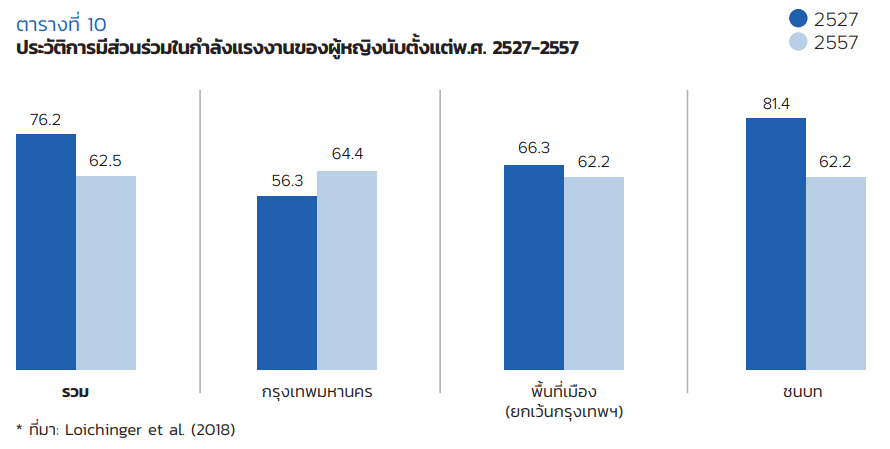
The trend of Thai women’s labor market participation has declined since the 1990 economic crisis, with overall labor participation rates dropping from 77% in 1984 to 62% in 2014. One factor is that younger women have opportunities to access higher education, so they do not enter the labor market in their late teens or early twenties because they are still in the education system. However, this change has not occurred uniformly across the country. Rural women, especially those in their late thirties, tend to leave the labor force at higher rates than average, while in Bangkok, higher-than-average employment rates were found, especially among young women who still have student status. Additionally, among women aged 24-54, the proportion of those outside the labor force who stated “housework” as their main activity increased from 11.8% to 15.6%, showing a clear trend of withdrawal from the labor market to take on home care burdens, especially in rural areas that lack accessible and affordable care services.
These care burdens become more clearly visible when considering total daily working hours. Women often have to work more than men when combining both formal work and unpaid household work, resulting in women’s total daily working hours being clearly higher than men’s.
Source: UNDP (2023)
Household Work in the Economic System
Is Shifting Burdens from Middle-Class Women to Lower-Class Women
The relationship between gender, class, and migrant labor is reflected through the role of female migrant workers from Myanmar, Laos, and Cambodia who often work as domestic helpers in middle-class households in Thailand’s major cities. Household work, which was once women’s household responsibility, is outsourced, thus becoming a process of transferring burdens from middle-class women to lower-class women. These workers often do not receive basic labor rights, whether holidays, minimum wage, or social security, resulting in their vulnerability to both economic and personal insecurity.
Civil society organizations such as the Foundation for Labor and Employment Promotion (HomeNet) and the Institute for Labor and Fair Economy (JELI) have tried to push for this group of workers to receive legal protection under labor law, such as minimum wage, maternity leave, and protection from abuse.
However, in practice, many domestic workers are still not registered in the social security system, so they cannot access basic rights such as paid maternity leave, child allowances, sick leave rights, or other basic welfare. When their rights are violated, there are almost no channels for complaints or remedies. Additionally, there is a lack of clear information and agreements between employers and employees, such as wages, employment contracts, and work scope.
The Vulnerable Status of Cross-Border Care Workers in Thailand
In Thailand’s care work system, female migrant workers, especially from Myanmar, Laos, and Cambodia, are the main group bearing care and household work burdens, mostly as informal workers. Some lack documentation, some hold temporary permits, resulting in vulnerability in both legal status and access to protection rights.
The formal labor import process, such as “Memorandums of Understanding” (MOUs), still has limitations, especially from Myanmar, which has concerns about the working conditions of workers in Thailand, making female workers from Myanmar have fewer opportunities for proper importation than workers from Laos or Cambodia.
During the COVID-19 crisis, this vulnerability became more severe when many families were economically affected, thus reducing hours or terminating domestic workers, while these workers still lacked any safety net. Many had to return to their home countries or remain in Thailand without options. Even for workers with proper documentation, they still could not access rights that formal workers should receive, such as minimum wage, clear working hours, or protection from violence and sexual harassment due to legal limitations and enforcement that does not cover informal workers.

Solutions Toward Gender Equality in Household Work
Promoting gender equality at the household level cannot rely solely on campaigns to change public attitudes culturally, but must be comprehensively considered at the structural level of the state, legal systems, including education systems and public communication. One example that clearly reflects this issue is the campaign project “Household work belongs to everyone, can be done by any gender” by the Foundation for Gender Equality Step Forward, which aims to change society’s perspective on household work roles that have long been generalized as women’s duties. Campaigns of this nature help people see alternative images different from traditional norms and open space for men to be able to take care of families without social stigma.
However, Thai government policies still cannot systematically support or expand this concept, whether in terms of labor rights, welfare, or the state’s role in managing care work that occurs in homes. Most household work is performed by women, especially in the case of paid workers such as domestic helpers or nannies, who are classified as informal workers who have not yet received appropriate protection from the country’s main labor laws.
Regarding legal issues, Thailand’s current situation still clearly reflects gaps in protecting domestic workers. Data from SDG Move in 2023 indicates that the International Labour Organization (ILO) sees that Thailand’s social protection policies do not yet cover this group of workers, most of whom are women and have vulnerable status regarding income and livelihood security. Currently, the Thai government is reviewing Ministerial Regulation No. 14 (2012)
which is a subordinate law under the Labour Protection Act B.E. 2541. This ministerial regulation has exempted domestic workers from the scope of protection under the main labor law. If amendments are made to cover labor rights, social security, and welfare protection for domestic workers, it will be an important step in restructuring the labor system to create more equality at the policy level. Therefore, legal review should aim to recognize the value of care work, not just add basic rights such as holidays or compensation, but must elevate the role of household work to be socially valuable work without being tied to traditional gender roles. Recognizing and acknowledging the value of household work is an important foundation for comprehensive and fair welfare provision.

Meanwhile, the education system should be another mechanism used to instill understanding of gender roles and the value of care work from early childhood. Educational curricula should promote concepts of gender equality in daily life, such as teaching students of all genders to learn self-care skills, care for others, and share family responsibilities, not as “women’s roles” or “men’s roles” but as “duties of society members” that require cooperation. Comprehensive Sexuality Education curricula recognized internationally may be one framework that can be adapted for use.
Alongside the education system, public communication plays an important role in communicating new meanings about household work and care work to society. The state can collaborate with media, academia, and civil society sectors in creating content and images that do not reinforce traditional gender roles, such as producing dramas, films, or advertisements that show families sharing household work among members of all genders, including openly celebrating male role models who care for children or do household work, to break down prejudices and reduce resistance to men’s new roles as “caregivers.”
In driving policies aimed at creating gender equality through recognizing the value of household work and care work, there should be monitoring and evaluation mechanisms to ensure that such policies can be actually implemented at the local level and produce concrete results. Setting specific indicators for household work and care work that reflect gender inequality in households is therefore necessary, such as the proportion of time women and men spend on unpaid care work each day, or the proportion of domestic workers entering the social security system. Additionally, the government should establish committees to monitor and review policies for protecting informal workers with clear gender dimensions, with central agencies responsible together with academia and civil society to report results to the public regularly.

Workers who do household work and care work should be recognized as having rights and voices in policies related to their own lives and work. The state should therefore systematically organize participatory processes, such as organizing consultation forums with domestic workers at local and national levels, supporting informal worker networks to be able to propose policy approaches directly to the state, or supporting women worker groups to access knowledge resources and legal tools to strengthen their power in negotiations both in the workplace and in households.
Furthermore, all policies should be based on the framework of human rights commitments that Thailand is party to, such as the Convention on the Elimination of All Forms of Discrimination Against Women (CEDAW), which in Articles 5 and 11 specifies the state’s duty to change gender role patterns in families and guarantee women’s equal right to work, as well as the Sustainable Development Goals (SDGs) Goal 5: Achieve gender equality and empower all women and girls.

Sustainable change cannot occur without integration between policy, culture, education, and public communication. Government agencies need to play a role beyond symbolic support, such as organizing family day activities, but should be promoters of attitude change through consistent learning and communication systems nationwide. In the long term, gender equality will not arise from individual behavioral changes alone but must rely on structural changes in labor laws, welfare design, education systems, and the state’s attitude in valuing all types of work, especially work that was previously overlooked as merely household duties.
Conclusion: Unlocking Household Work Toward Gender Equality
Change will not occur if society still views certain work as the inherent duty of any particular gender. Laundry, home care, or managing cleanliness in daily life is not merely a private matter for each family but is a space of power structures that exist at cultural, economic, and public policy levels.
Managing inequality embedded in household work must not stop at campaigns to change attitudes but must move through to labor systems, laws, and welfare design that truly recognizes the value of household work. These approaches not only reduce gender gaps but also open opportunities for women to access valuable work, reduce overlapping burdens, and shift roles from bearing invisible burdens to having rights to participate in the state’s economic and policy systems.
When homes are not private spaces cut off from the public, household work should not be left voiceless in public policy. Recognizing the value of household work is therefore not merely a choice for any particular family but a prerequisite for gender equality in society as a whole.
Strategy and International Cooperation Coordination Division
Office of the National Economic and Social Development Council
References
European Institute for Gender Equality. (2021). Gender differences on household chores entrenched from childhood. Retrieved from https://eige.europa.eu/publications-resources/toolkits-guides/gender-equality-index-2021-report/gender-differences-household-chores?language_content_entity=en
European Institute for Gender Equality. (2021). Unpaid care workloads and social isolation affect well-being. Retrieved from https://eige.europa.eu/publications-resources/toolkits-guides/gender-equality-index-2021-report/unpaid-care-workloads-and-social-isolation-affect-well-being?language_content_entity=en
Hfocus. (2019). Campaign ‘Housework is for Everyone, Can be Done by All Genders’ Promotes Equality, Reduces Domestic Violence. Retrieved from https://www.hfocus.org/content/2019/12/18192
IMF Connect. (2019). Capacity Development: Building Institutions and Beyond. Retrieved from https://www.imfconnect.org/content/imf/en/annual-meetings/calendar/open/2019/04/10/capacity_developmentbuildinginstitutionsandbeyond_138062.html?display=none
Josephine Mylan and Dale Southerton. (2018). The Social Ordering of an Everyday Practice: The Case of Laundry. Sociology, 52(6), 1134–1151. https://www.jstor.org/stable/26558758
Natetida Bunnag. (2564). How much should household work be valued in monetary terms When women worldwide continue to be responsible for most household work. Retrieved from https://www.sdgmove.com/2021/03/09/gender-inequality-domestic-care/
Praewpan Sirilurt. (2023). ILO Points Out Thai Social Protection Policies Do Not Yet Cover Workers Doing ‘Domestic Work’. Retrieved from https://www.sdgmove.com/2023/07/11/ilo-domestic-workers-thailand/
UN Women. (2017). Gender Equality & Water, Sanitation and Hygiene. Retrieved from https://www.unwomen.org/sites/default/files/Headquarters/Attachments/Sections/News%20and%20events/Stories/2018/Expert-Group-Meeting-on-gender-equality-and-water-sanitation-and-hygiene-Report-2017-12-en.pdf
UNDP. (2023). Thai Women’s Unpaid Care and Domestic Work and the Impact on Decent Employment. Retrieved from https://www.undp.org/thailand/publications/thai-womens-unpaid-care-and-domestic-work-and-impact-decent-employment
WHO. (2023). Women and girls bear brunt of water and sanitation crisis – new UNICEF-WHO report. Retrieved from https://www.who.int/news/item/06-07-2023-women-and-girls-bear-brunt-of-water-and-sanitation-crisis—new-unicef-who-report
WHO. (2025). Health inequities are shortening lives by decades. Retrieved from https://www.who.int/news/item/06-05-2025-health-inequities-are-shortening-lives-by-decades
World Bank. (2019). Water Supply, Sanitation, and Hygiene (WASH) Poverty Diagnostic Initiative. Retrieved from https://www.worldbank.org/en/topic/water/publication/wash-poverty-diagnostic
Related Documents