


The ocean is filled with diverse life forms, including seaweed, which is a natural resource that still awaits tremendous human utilization and development potential. Seaweed is part of the ecosystem that maintains the abundance of seas and water bodies, serving as shelter and food sources for various aquatic animals. This extends to terrestrial life, including humans, whether in economic development, creating social and cultural equality, and playing an important role in reducing the impacts of global warming. Additionally, it supports the role of women in coastal communities. However, questions may arise about the benefits and harms that may result from seaweed being abundant in nature to the point of imbalance, or as an alternative food source for humans that plays a role in absorbing waste in the sea and toxic gases from the world in a sustainable and safe manner for consumption. This article will discuss the benefits and pollution from marine seaweed, raising questions about seaweed bloom situations that affect ecosystems, and collaborative approaches to solving problems for the sustainability of marine ecosystems.
Seaweed: Ocean Alternatives
Data from the Department of Marine and Coastal Resources classifies marine seaweed into 4 groups based on pigment characteristics in tissues: 1. Green seaweed 2. Brown seaweed 3. Red seaweed 4. Blue-green seaweed. Seaweed can grow in coastal areas, lakes, and water bodies. It is estimated that seaweed has been recorded in East Asian cultures since ancient times. Knowledge of using each type of seaweed has been passed down from generation to generation, such as in Japan, where seaweed is often used as an important component of daily food, adapted into various forms. Currently, there are no international food standards (Codex Alimentarius) that establish safety standards for food made from marine seaweed or other types of seaweed. However, seaweed continues to receive significant attention in Europe, North America, and Asia, with many people turning to seaweed farming as a profession due to global warming affecting traditional fisheries, whether fishing or aquaculture, resulting in reduced yields. Additionally, seaweed farms serve as part of the ecosystem that functions to sequester carbon and cycle nitrogen, treat nutrients or waste from animals, and help develop the economy and society in vulnerable coastal areas.
Seaweed has been utilized and has been part of society for a long time, used as a food component or alternative food, and as an occupational choice for coastal communities to combat global warming that affects traditional livelihoods.
Primary Roles of Seaweed for Terrestrial Life
Economic Benefits of Seaweed Seaweed is used as part of the human and animal food industry, fertilizers for the agricultural sector. It is also used as a component of dietary supplements, cosmetics, green chemicals, bioplastics, construction materials, and clothing. Promoting seaweed research and development will lead to products that further drive and create industrial sector growth. Additionally, the rapidly growing marine aquaculture industry from seaweed cultivation can create employment for millions of people worldwide.
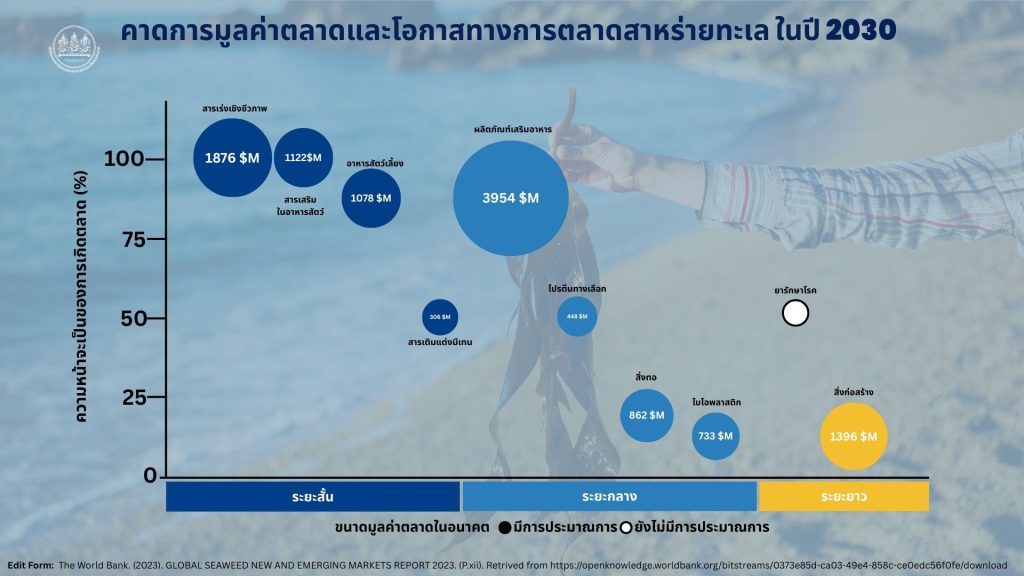
Source: The World Bank. (2023).
According to a 2024 UNCTAD report, the latest estimate of the global seaweed market overview is approximately $17 billion USD, with new applications or innovations of seaweed creating increasingly greater market value. According to a 2023 World Bank report, it is estimated that by 2030, the seaweed industry market value will reach as much as $11.8 billion USD. In the biocatalyst market, livestock feed, pet food, and methane-reducing additives added to animal feed, the value will increase to $4.4 billion USD by 2030, while the dietary supplement market, alternative proteins, bioplastics, biomaterials, and fibers can have an increased value of up to $6 billion USD by 2030. This reflects that seaweed can be developed and researched for industrial applications in various sectors. The seaweed industry can grow continuously and may become an alternative food source in the future, as seaweed may help solve food and nutrition security issues if there are additional studies and research on the benefits, toxins, or residues in each type of seaweed to build public confidence in consumption.
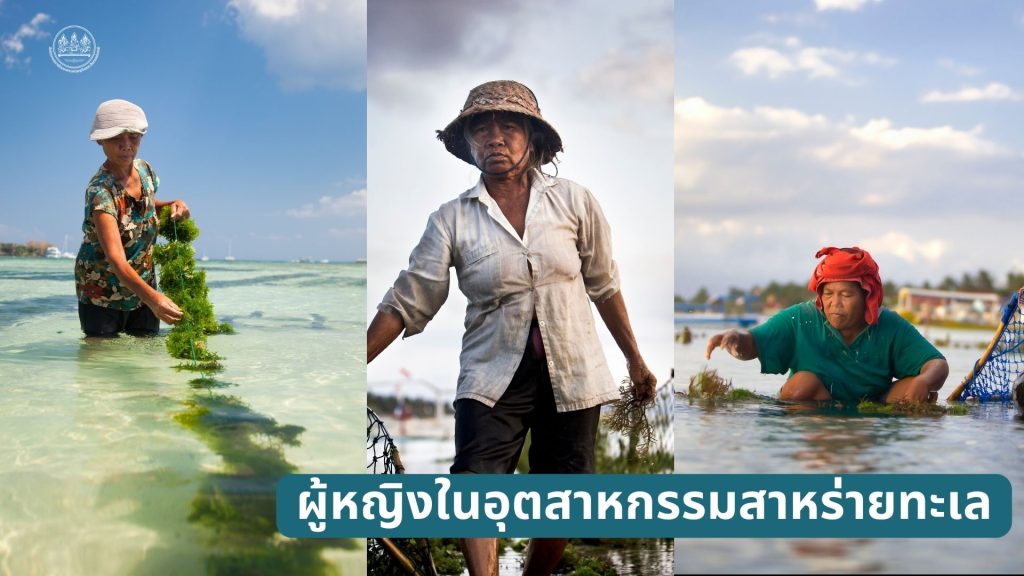
Benefits of Seaweed in Creating Economic Growth in Local Communities Seaweed creates suitable ecosystems for tourism, generating income for coastal communities, such as diving, fishing, and tourism-related activities. Additionally, marine seaweed plays a role in distributing income to local communities, particularly increasing women’s economic roles. Currently, women have increasingly important roles in the seaweed industry. It is found that over 40% of start-up companies worldwide have women as business owners in operations, demonstrating the potential for driving the economy and gender equality in the seaweed industry.
Social and Cultural Benefits of Seaweed Seaweed makes people aware of their locality, have relationships with nature, create identity, and the way of life of coastal communities and indigenous peoples worldwide, such as seaweed harvesting culture or catching aquatic animals in seaweed habitats, all of which are part of coastal community culture. Additionally, seaweed is used in national foods, medicine, clothing, knowledge, arts, various ceremonies, and as gifts for important events in South Korea and Japan, and is an important part of the society and traditional culture of local communities that create bonds and beliefs of people with their locality.
Impacts of Abnormal Growth of Marine Seaweed
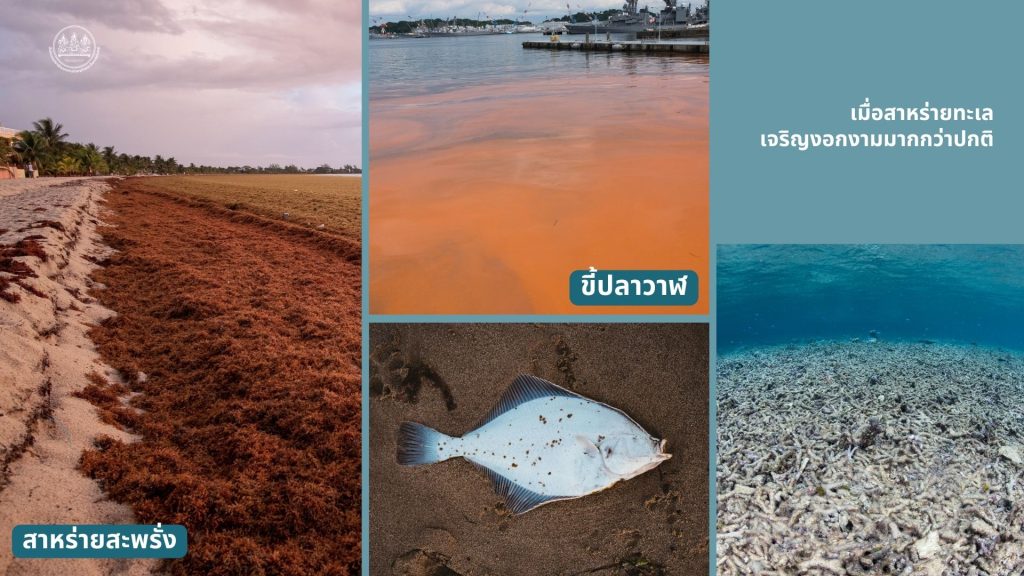
Although seaweed can be utilized in various forms and has tremendous benefits for both marine ecosystems and terrestrial ecosystems, if there is an excessive amount of seaweed in the ecosystem, it will cause ecosystem imbalance, affecting public health and the economic system tremendously, such as the phenomenon of seaweed blooms, which has important causes from human activities, such as the use of chemical fertilizers in agriculture, wastewater from industrial and household sectors that discharge wastewater into natural water sources, resulting in rapid growth of phytoplankton and seaweed in freshwater sources, including coastal areas, causing water pollution worldwide. Seaweed blooms greatly affect ecosystems when seaweed dies and sinks to the ocean floor. If there is too much seaweed, it will cause water sources to experience oxygen depletion and create a phenomenon called “Dead Zone” or areas in oceans or water sources with very low oxygen levels, making it impossible for life to survive in such areas, causing mass death and migration of aquatic animals, resulting in tremendous changes to marine ecosystems. The seaweed bloom phenomenon has another name called “Red Tide” (Red Tide) or “Whale Excrement”, caused by rapid growth of certain microorganisms or plankton that change the color of seawater, resulting from variations in ecosystems and chemical properties of water sources, affecting human health by causing seafood contamination. Additionally, seaweed used for consumption may contain heavy metal contamination, which will affect long-term health, including economic conditions and tourism that are directly affected by water deterioration, reduced numbers of aquatic animals, continuing to affect local fishermen and ecosystems in the area.
Thailand’s Marine Seaweed Processing Industry
Future Food Policy by the Ministry of Agriculture and Cooperatives promotes the production, research and development of varieties, processing and marketing of marine seaweed and freshwater seaweed in the country under the Blue Economy approach. It focuses on collaborative development and research with local communities and applies modern technology combined with Thai wisdom to elevate high-value agriculture, increasing income for the country and local communities, reducing imports and creating food security while sustainably reducing global warming problems. Currently, Thailand can concretely promote the utilization of seaweed through cooperation from multiple sectors in joint development and research, such as research and development of blue-green seaweed in the biodiesel project by Khun Jiamjit Boonsam, the Alginaw biofertilizer production project by the Center of Excellence for Seaweed of the Institute for Scientific and Technological Research of Thailand in collaboration with PTT Public Company Limited. Additionally, many companies have turned to developing commercial seaweed, such as the seaweed cage cultivation project by the Worldview Climate Foundation in collaboration with fishing communities in Krabi Province.
Conclusion
Marine seaweed plays an important role in both marine ecosystems and terrestrial ecosystems, contributing to economic development from community level to national level. However, when global warming and human activities affect seaweed growth patterns, causing ecosystem imbalance, creating pollution in coastal areas and toxic gases affecting marine life and ecosystems. Continuous study and monitoring of the benefits and impacts of marine seaweed is therefore an important approach to solving or controlling seaweed quantities to create sustainable ecosystem balance. Reducing the discharge of wastewater or chemicals from households into natural water sources, industrial plants should have efficient wastewater treatment systems, with serious guidelines and laws for punishment. It can be said that developing marine seaweed and reducing the impacts from marine seaweed requires cooperation from multiple sectors, whether entrepreneurs, researchers, processing innovation developers, government sector, private sector, local communities, to international organizations that play important roles in driving policies to reduce seaweed impact problems and create ecosystem balance. If seaweed ecosystems are balanced, seaweed will create tremendous benefits for the environment and people, and will also benefit marine ecosystems and serve as shelter for various aquatic animals, and be an important economic source for local communities sustainably.
Strategy and International Cooperation Coordination Division
Office of the National Economic and Social Development Council
References
Fabrice Robinet. (2025). Green gold beneath the waves: How seaweed – and one man’ s obsession – could save the world. Retrieved from https://news.un.org/en/story/2025/06/1164131_gl=1*1x8jm0w*_ga*
MjA1NjY4NjczLjE3NDYxNTY4NjU.*_ga_TK9BQL5X7Z*czE3NDk0MzI0ODMkbzgkZzEkdDE3NDk0MzU3NDEkajYwJGwwJGgw
Jenny Howard. (2023). What exactly is a red tide—and how does it affect humans?. Retrieved From https://www.nationalgeographic.com/environment/article/red-tides
John Barry Gallagher. (2022). Kelp won’t help: why seaweed may not be a silver bullet for carbon storage after all. Retrieved From https://theconversation.com/kelp-wont-help-why-seaweed-may-not-be-a-silver-bullet-for-carbon-storage-after-all-178018#:~:text=At%20present%20it’s%20thought%20seaweed,fight%20to%20stop%20climate%20change
Julia Jacobo. (2025). Why scientists are concerned over the record amount of seaweed in the Caribbean. Retrieved from https://abcnews.go.com/International/scientists-concerned-record-amount-seaweed-caribbean/story?id=122533091
Sophie Corrigan, Elizabeth J. Cottier-Cook, Phaik-Eem Lim, Juliet Brodie. (2025). THE STATE OF THE WORLD’S SEAWEEDS 2025. Retrieved from https://globalseaweedprotect.org/wp-content/uploads/2025/05/State-of-the-Worlds-Seaweeds_FINAL_DOI.pdf
The World Bank. (2023). Global Seaweed New and Emerging Markets Report 2023. Retrieved from https://www.worldbank.org/en/topic/environment/publication/global-seaweed-new-and-emerging-markets-report-2023
Thiraphon Singlor. (2021). Ocean Rainforest Seaweed Farm Helps Reduce Global Warming, Maintains Ocean Health for Human Health and Strong Pig Health. Retrieved from https://www.sdgmove.com/2021/04/23/ocean-rainforest-seaweeds-kelp-cc-mitigation-healthy-foods-and-feeds/
United Nations. (2024). An Ocean of Opportunities: The Potential of Seaweed to Advance Food, Environmental and Gender Dimensions of the SDGs: United Nations Conference on Trade and Development. Retrieved From https://unctad.org/system/files/official-document/ditcted2024d1_en.pdf
United Trade & Development. (2024). Seaweed holds huge potential to bring economic, climate and gender benefits. Retrieved From https://unctad.org/news/seaweed-holds-huge-potential-bring-economic-climate-and-gender-benefits
Department of Fisheries, Ministry of Agriculture and Cooperatives. (2025). Department of Fisheries…Supports Agricultural Sector Upgrade with BCG Model, Promoting “Marine Seaweed” as a Model for Creating Value-Added Products, Creating Opportunities for Communities to Jointly Develop Grassroots Economy Towards Strength and Sustainability. Retrieved from https://www4.fisheries.go.th/index.php/dof/news_local/1210/238999
Ministry of Agriculture and Cooperatives. (2022).“Ministry of Agriculture” Accelerates Implementation of “Future Food Policy”. Retrieved from https://www.moac.go.th/news-preview-441391792779
Thairath Plus Editorial Team. (2022). When ‘Marine Seaweed’ May Not Be a Sustainable Path to Combat Carbon. Retrieved from https://plus.thairath.co.th/topic/naturematter/101532
Mangrove Forest Resource Conservation Division. (2013). Seaweed: Miraculous Plants with Multiple Benefits. Retrieved from https://newweb.dmcr.go.th/detailLib/740
Khadkanat Chuenwong-arun and Naphatradanai. (2020). Eutrophication Phenomenon. Retrieved from https://ngthai.com/science/30735/eutrophication/
Siamrath Online. (2025). Promoting “Green Gold Seaweed” to Elevate High-Value Agriculture, Push to Global Markets. Retrieved from https://siamrath.co.th/n/620614
Related Documents