



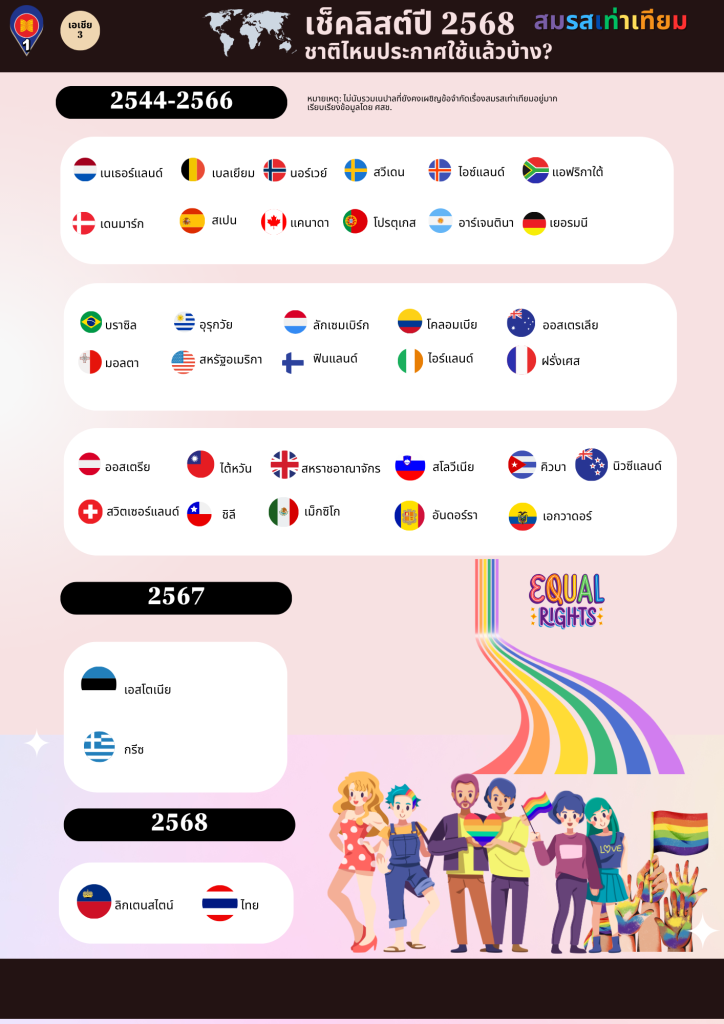
After a long struggle and advocacy movement, on January 23, 2025, the Act Amending the Civil and Commercial Code (No. 24) B.E. 2567, commonly known as the “Marriage Equality Law,” officially came into effect. This makes Thailand the first country in the ASEAN region and the third country in Asia to have laws supporting marriage for people with diverse sexual orientations and gender identities (LGBTQ+). This represents a significant step demonstrating sustainable change in one dimension of Thai society’s movement toward becoming a society that truly respects rights and equality, with awareness of diversity and acceptance of love in all forms.
The enforcement of this law grants rights to people of all gender identities to register marriages equally under the law by adjusting language and definitions in legal documents to be more gender-neutral, such as changing “husband-wife” to “spouse” or adjusting from “male-female” to “person” to not limit the gender and identity of anyone who wishes to register marriage.
The word “marriage” or “matrimony” is not just an expression of love for many couples, but this word represents the creation of a stable foundation between two people. Marriage equality law has granted various rights to spouses, such as joint decision-making regarding property, child care, and inheritance rights as legal heirs, rights to manage the other party’s life during illness and emergencies, etc. These were limitations that people in the LGBTQIA+ community had to face for a long time.
We would like to invite everyone to explore the rights and protections that should be received from the marriage equality law (latest amendment), its impact on the economy and society, as well as legal challenges and international development policy (Sustainable Development Goals SDGs) in understanding issues of gender diversity.
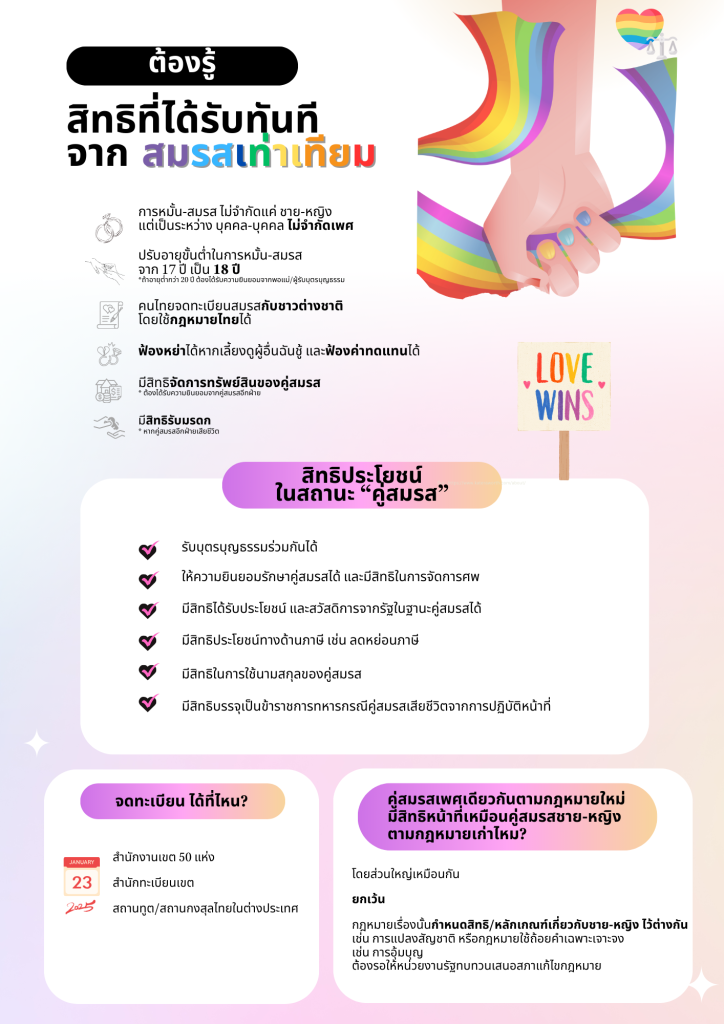
Fundamental Rights That Take Effect Immediately After Marriage Equality Law Enforcement
- Right to Engagement
- Marriage equality law stipulates that “both parties” can be engaged and must be 18 years of age or older (Section 1435).
- Engagement is complete when the “engager” delivers or transfers property as engagement gifts to the “engaged party” as evidence of intention to marry.
- Right to Marriage
- Marriage can be performed when both parties are 18 years of age or older, but in cases where there are reasonable grounds, the court may permit marriage before that age (Section 1448).
- Marriage can only be performed when two people consent to be spouses and must openly demonstrate such consent before the registrar, and the registrar must record such consent (Section 1458).
- Persons wishing to register marriage with foreign nationals can register marriage under Thai law. Marriage with foreign nationals can be performed within Thailand by registering marriage at district offices or district offices in Bangkok, or performed abroad at Thai embassies or Thai consulates general in foreign countries.
- Right to Divorce
- When the law recognizes the right to marriage, the law also recognizes the right to divorce for people with diverse sexual orientations and gender identities (Sections 1516 (1) and (10)) by amending language to be gender-neutral, such as changing from “person who commits adultery against husband/wife” to person who commits adultery against “spouse” to accommodate adultery issues and cases where spouses cannot have sexual relations. One can file for divorce if either party supports “another person” and can sue for compensation from the adulterer without gender-based conditions.
- สิทธิด้านทรัพย์สิน
- Spouses can jointly manage property, inherit as legal heirs, and manage the other party’s property in necessary cases.
- If it is personal property, one spouse can manage their own property as usual, but marital property is jointly owned and must be managed together. Sale or management of marital property requires consent from the other spouse.
- สิทธิรับบุตรบุญธรรมร่วมกัน
- Spouses can jointly adopt children, allow adopted children to use the spouse’s surname, and care for children as equal parents, provided they are at least 15 years older than the adopted child (Section 1598/26, first paragraph).
- สิทธิด้านสุขภาพและการจัดการในยามฉุกเฉิน
- Spouses can sign consent for medical treatment on behalf of each other, including having rights to manage the other party’s remains. The National Health Act B.E. 2550, Section 8, establishes principles for consent in medical treatment. In cases where patients are not in a condition to receive health information for treatment decisions, legal heirs must be notified first, and spouses are also legal heirs under the law. Additionally, in the Mental Health Act B.E. 2551, Section 21, third paragraph, it is stipulated that in cases where patients lack capacity to consent to treatment, spouses, parents, descendants, etc., can provide written consent on behalf of the patient.
- State Benefits and Welfare for ‘Spouses’
- Spouses can receive benefits from social security and medical expenses as spouses as stipulated by law under the Social Security Act B.E. 2533, such as death compensation, funeral expenses, relief funds, child allowances, old-age pensions or benefits.
- Right to Civil Service Appointment
- In cases where spouses die from combat or duty performance, children, spouses, or parents of military officers who died due to combat or duty performance may receive rights to appointment as military officers, employees, or staff in Ministry of Defense agencies under the Military Personnel Act B.E. 2521, Section 10/1.
- Tax Benefits
- Spouses can receive spouse tax deduction of 60,000 baht (Section 47 (1)(b) Revenue Code) and money received as gifts from spouses, limited to 20 million baht per tax year, is not included in personal income tax calculations (Section 42 (27) Revenue Code).
- สิทธิในการใช้นามสกุลของคู่สมรส
- Can change to use either party’s surname, use original surname, or use spouse’s surname as middle name.
Comparison Table of Civil and Commercial Code Amendments Regarding Marriage
| Original Civil and Commercial Code | Act Amending the Civil and Commercial Code (No. 24) B.E. 2567 | |
| Engagement-Marriage | Male-Female | Person-Person |
| Minimum age for engagement-marriage (in cases of engagement/marriage under 20 years of age, parental consent is required) | 17 years | 18 years (consistent with the Convention on the Rights of the Child) |
| Marriage with foreigners under Thai law | Possible between “male and female” | Possible between “two persons” |
| Joint adoption | Possible between “male and female” | Possible between “two persons” |
| Right to inherit spouse’s estate as legal heir (in cases without a will) | Possible between “male and female” | Possible between “two persons” |
| Right to use spouse’s surname | Possible between “male and female” | Possible between “two persons” |
| Consent for medical treatment when spouse is unable to give consent | Possible between “male and female” | Possible between “two persons” |
| Tax benefits such as personal income tax deductions | Possible between “male and female” | Possible between “two persons” |
| Prohibitions on Marriage Registration | Prohibition of polygamy; prohibition of marriage with mentally incapacitated persons or persons declared incompetent by court; prohibition of marriage with blood relatives; prohibition of adoptive parents marrying adopted children | |
Economic Stimulus Impact
It cannot be denied that when people have greater access to rights, better economic conditions often follow. This may lead to new businesses and increased foreign investment partnerships due to confidence that Thailand recognizes the rights and identity of sexually diverse groups, such as the emergence and growth of counseling and family planning businesses for sexually diverse groups, leading to employment of related personnel and benefiting matchmaking businesses, wedding businesses, wedding dress rental businesses, hotels, restaurants, and the tourism industry. Research on Economic Impact of Marriage Equality Law on Thailand’s Tourism Industry conducted by Agoda in partnership with Access Partnership assessed the economic opportunities Thailand will receive from marriage equality law enforcement, stating that “enforcement of such law will help attract LGBTQIA+ tourists from around the world with a market value of over 200 billion US dollars per year. Thailand is expected to attract up to 4 million additional tourists per year, generating up to 2 billion US dollars in additional tourism revenue in the first 2 years after the law takes effect.” The enforcement of marriage equality law not only promotes gender rights and equality but also has positive effects on Thailand’s economy and tourism.
Social Impact
Research Report on Mental Health and Well-being of Sexually Diverse Children and Youth in Thailand (Save the Children Thailand Foundation, 2023) by Save the Children Thailand Foundation in collaboration with Thammasat University and Srinakharinwirot University indicates that this change not only helps sexually diverse couples receive legal rights but also creates positive impacts in various dimensions of society as follows:
Reducing Mental Health Problems in LGBTQI+ Children and Youth
The above report found that enforcement of marriage equality law will help create a more friendly and safe environment for LGBTQI+ children and youth, enabling them to express their identity more openly. Previously, they faced various forms of violence, social pressure, and gender-based discrimination, resulting in depression, anxiety, and even self-harm behaviors.
Creating Stability in Family Relationships in All Forms
Marriage equality law recognizes many rights, such as children in LGBTQI+ families receiving property and inheritance protection in case of unexpected events with guardians, or in medical decision-making according to law. This results in children who are the nation’s future growing up with quality due to good and stable family environments, regardless of parents’ gender identity factors, with law providing equal care and protection. Additionally, the law helps increase access to credit and property ownership, as spouses can use joint borrowing rights to purchase real estate. Data from the Real Estate Information Center, Government Housing Bank (REIC) found that among those wanting to buy housing, 4.9% are LGBTQ+ groups, resulting in social benefits, creating stability in family relationships. LGBTQI+ spouses are more confident in planning their family’s future due to having guarantees for married life, and opening opportunities for sexually diverse couples to adopt children may help reduce the problem of homeless children in another way.
Next Steps for Gender Equality
Extending Marriage Equality Law with Amendments to other Laws
Currently, although the law is in effect, there are many things that all sectors must work together on. It should be noted that this amendment to the Civil and Commercial Code does not cover cases where laws specifically stipulate family and inheritance matters, or other laws that stipulate different rights, duties, legal status, and other matters related to husband-wife. Spouses who register marriage under marriage equality law may not immediately receive those rights. Marriage equality is only the first step toward gender equality. The next consideration is how to continue from marriage equality law or amend other related laws concerning family rights recognition and create awareness and understanding about such laws to achieve true gender rights and equality, responding to people’s rights to the fullest extent. There are still many laws affected by Civil and Commercial Code amendments, creating problems in interpreting provisions related to parent-child relationships, kinship relationships, and children in cases where not all legal provisions have been amended to be free from gender status ties, such as not having the right to give birth through surrogacy legally, as Section 19 requires artificial insemination to be performed on “women with legal husbands” and Section 21 sets important conditions for surrogate pregnancy to be performed by “legal husband and wife.” Another issue concerns adopted children under the care of sexually diverse couples who are still limited in various rights and welfare from government agencies and Social Security Office, which mostly stipulate only for children born from spouses who are legitimate children, causing adopted children to receive only rights from birth parents. This issue still requires reconsideration as it may prevent children from receiving appropriate rights and cause various negative impacts at both family and social levels. Thai law still has matters that need adjustment to align with Thailand’s diversity and change legal language to be gender-neutral. This step may be an example of gender equality recognition that makes rights and duties no longer limited by a person’s gender.
Reviewing the Concept of “Gender Equality” in the Context of SDGs
Dr. Warisa Ongsupankul, lecturer at the Faculty of Law, Thammasat University, stated that “in the current era, gender equality stipulated in SDG 5 Gender Equality focuses only on achieving equality between genders and enhancing the role of women and girls, which may not cover groups with gender diversity who experience discrimination based on gender identity, sexual orientation, and gender expression that do not conform to social norms, different from discrimination that women and girls experience due to their sex/gender.” This raises questions about the interpretation of “gender” in SDG 5 “gender equality”. Should there be consideration to review the equality concept used in determining gender equality policy frameworks to achieve more effective, comprehensive, and multi-dimensional equality in line with global changes, according to the concept of “leaving no one behind”?
Conclusion
The amendment of the Civil and Commercial Code Act No. 24 reflects Thailand’s elevation of human rights that transcends cultural and traditional thinking frameworks that once excluded love in forms different from traditional frameworks. It signals increased openness to gender diversity at a structural level that reduces inequality gaps. Although marriage equality law is an important step for Thailand in global development agenda according to set intentions and benefits the country’s economy and society, creating understanding and acceptance at cultural and social levels must continue. Changes in status and receiving various rights from the above law still have issues requiring preparation and continuous implementation after the law takes effect: (1) reviewing related laws and preparing government operations readiness in registration, documents, certificates, and related data; (2) considering interconnected issues resulting from increased rights for sexually diverse couples, such as surrogacy and adoption issues; (3) preparing business readiness to accommodate sexually diverse groups; (4) creating understanding, respect for rights, and approval from each party regarding gender diversity for society; (5) budget preparation.
Strategy and International Cooperation Coordination Division
National Economic and Social Development Council
References
Access Partnership. (2024). Economic Impact of Marriage Equality on Thailand’s Tourism Industry. In Access Partnership (Access Partnership). https://www.agoda.com/press/marriage-equality-report-Thai.pdf
iLaw. (2020, July 7). #Marriage Equality: Survey of Legal Principles and Draft Act Amending Civil Law on Marriage. Retrieved February 10, 2025, from https://www.ilaw.or.th/articles/4317
iLaw. (September 24, 2024). #Marriage Equality : Opening New Civil Law Amendment – Person-Person Can Marry, Not Limited to Male-Female. https://www.ilaw.or.th/articles/43563
Ojanen, T. T., Freeman, C., Kittiteerasack, P., Sakunpong, N., Sopitarchasak, S., Thongpibul, K., Tiansuwan, K., & Suparak, P. (2023).
Mental health and well-being of children and youth with diverse SOGIESC in Thailand. Save the Children Thailand. https://resourcecentre.savethechildren.net/document/study-report-mental-health-and-well-being-of-children-and-youth-with-diverse-sogiesc-in-thailand/
SDG Move Team. (n.d.). SDG Updates | Overlapping and Multiplying: Unraveling Layers of Violence That LGBTQI Must Face. SDG Move. https://www.sdgmove.com/2023/06/28/sdg-updates-gender-equality-lgbtqi/
“Marriage Equality Law” Drives Thailand Toward SDG 5 Gender Equality Goal, Increases Tourist Revenue Dramatically! – SD PERSPECTIVES LIFESTYLE SUSTAINABILITY . (n.d.). SD PERSPECTIVES LIFESTYLE SUSTAINABILITY. https://www.sdperspectives.com/next-gen/26442-thailand-marriage-equality-law-sdgs-5/
Next Steps for Thai Society After Marriage Equality Law. (November 22, 2024). Pridi Banomyong Institute PRIDI BANOMYONG INSTITUTE : Pridi.or.th. https://pridi.or.th/th/content/2024/11/2202
List of 37 Countries Worldwide That Passed Marriage Equality Laws, Valuing Everyone’s Love. (June 15, 2024). Amarintv. https://www.amarintv.com/lifestyle/trendy/64805
Pralongyuth Phongnoi. (January 24, 2025). ‘Marriage Equality’ Another Hope to Help Stimulate Thai GDP Growth by Additional 0.3% per Year for 2 Years. THE STANDARD. https://thestandard.co/wealth-in-depth-equal-marriage-
Narongkorn Manochanpen. (January 23, 2025). Marriage Equality 2025: Which Nations Have Already Declared Implementation. THE STANDARD. https://thestandard.co/equal-marriage-2025/
Back to News & ArticlesRelated Documents