


Behind effective medical treatment and continuous health technology development lies a fundamental factor that is often overlooked: “electrical power” that is stable and sufficient to support the functioning of healthcare systems. This article invites exploration of a reality that many may never have considered—that healthcare systems in many areas around the world still face electrical limitations, which are not only significant barriers to quality medical care but have also become a silent threat endangering the lives of many patients. When electricity is inaccessible, hospitals cannot function at full capacity, and patients’ lives are at risk. This is not merely a technical problem but a structural issue that reflects true inequality in healthcare access.
When healthcare facilities worldwide still lack access to electricity, challenges that reflect gaps in the global healthcare system
In an era when medical technology is advancing rapidly, many healthcare facilities must operate amid electrical uncertainty. This situation is not only an obstacle to medical treatment but also a threat to patients’ lives, particularly in low- and middle-income countries where electricity is a determining factor of “life and death.”
Ventilators, vaccine refrigerators, surgical equipment, and emergency communication systems all depend on electricity. The World Health Organization (WHO) states that nearly 1 billion people in low- and middle-income countries still rely on healthcare facilities that lack stable electricity, making standard medical treatment more difficult to achieve. Vaccines may deteriorate due to refrigerator failures, diagnostic equipment becomes unusable, and emergency surgeries must be halted. This medical inequality in the modern era clearly demonstrates that while the world advances with medical innovations capable of extending patients’ lives by decades, the most basic treatment fails simply due to lack of electricity. The determining factor for treatment quality today is no longer just the sophistication of equipment, but also the stability of electricity that enables such equipment to function effectively.
The stark inequality between urban and rural areas reveals a public health gap that cannot be ignored. While regional hospitals in major cities can rely on stable electrical systems with backup generators and automatic power supply systems, health stations in remote areas struggle with temporary power sources. This situation is particularly severe in South Asia and sub-Saharan Africa, where approximately 12% and 15% of healthcare facilities respectively still lack stable electricity. This disparity reflects inequality in healthcare access—the more remote the area, the greater the lack of basic infrastructure, making public health systems unable to operate at full efficiency.
“Access to electricity in healthcare facilities can make the difference between life and death”
– Dr Maria Neira
When electricity doesn’t reach, healthcare services aren’t comprehensive reflects the fragility of healthcare systems in many areas worldwide, particularly in developing countries where energy systems cannot yet comprehensively and stably support public health services. When electricity fails, treatment falters. Many medical devices cannot function without power, whether ventilators, heart pumps, electric beds, or vaccine storage refrigerators that require precise temperature control, especially in intensive care units, delivery rooms, or during surgery. The report “Energizing Health: Accelerating Electricity Access in Health-Care Facilities” points out that investing in stable electricity access in healthcare facilities is not merely about infrastructure but is an investment in human life that impacts the sustainability of the overall healthcare system. If healthcare facilities cannot use medical equipment continuously, they cannot deliver effective treatment to patients.
Designing electrical systems in healthcare facilities: Creating flexible electrical systems in changing environments
As healthcare facilities worldwide continue to face challenges in electricity access, designing electrical systems that are flexible and capable of supporting climate change adaptation is a crucial approach that can sustainably address these problems. Amid rapidly changing climate conditions that increase pressure on healthcare facilities, creating highly flexible electrical systems not only helps healthcare facilities manage electricity adequately under normal circumstances but also enables them to effectively handle emergency situations, such as natural disasters or events that cause power outages from primary energy sources.
The use of decentralized renewable energy such as solar power systems and batteries for energy storage is one of the effective approaches to addressing electricity shortage problems. Solar power systems connected to batteries can provide continuous energy when electricity from primary sources fails or in areas unable to access electricity from the main grid, enabling healthcare facilities in remote or rural areas to provide continuous and uninterrupted patient care. This not only helps reduce long-term costs and expenses but also reduces dependence on diesel fuel for generators, which is a high-cost energy source with environmental impacts, through the use of clean renewable energy.
Having stable and sustainable electrical systems in healthcare facilities not only solves electricity shortage problems but also prepares for climate change adaptation and other risks that may arise. Investment in decentralized renewable energy helps increase healthcare system flexibility and benefits population health in the long term. It also lays the foundation for healthcare systems to adapt and support future changes sustainably. Electrical system design in healthcare facilities should therefore consider stability, flexibility, and quality of life for patients facing energy uncertainty and rapidly changing climate conditions.
Meanwhile, upgrading energy systems in healthcare facilities aligns with national energy conservation policies, particularly the enforcement of the Ministerial Regulation Determining Types or Sizes of Buildings and Building Design Standards for Energy Conservation B.E. 2563 (2020), which is an important tool for promoting energy-efficient building design. This regulation requires large buildings with areas of 2,000 square meters or more to comply with standards called Building Energy Code or BEC, which clearly covers healthcare facilities as one of the 9 building types under this regulation’s scope. These include theaters, hotels, service establishments, healthcare facilities, educational institutions, offices or workplaces, department stores, condominiums, and assembly buildings. For healthcare facilities, design that meets BEC standards is not only legal compliance but also a crucial mechanism that directly helps strengthen energy security for healthcare systems.
BEC criteria focus on reducing energy consumption in various building systems including building envelope systems, electrical lighting systems, air conditioning systems, renewable energy use, water heating equipment, and overall building energy consumption. Building envelope systems consider heat transfer values through walls and roofs, such as OTTV (Overall Thermal Transfer Value) and RTTV (Roof Thermal Transfer Value), which help reduce air conditioning system loads. Electrical lighting systems control lighting power density values or LPD (Lighting Power Density) to provide adequate lighting without excessive energy consumption. Air conditioning systems must select high-efficiency equipment appropriate for actual use, reducing energy consumption without affecting patient and staff comfort. Renewable energy use such as installing solar panels or energy storage systems is promoted as part of sustainable building energy system design. Water heating equipment such as boilers or heat pumps must be efficient and energy-saving. Finally, overall building energy consumption is assessed holistically to ensure buildings use energy within acceptable standards.
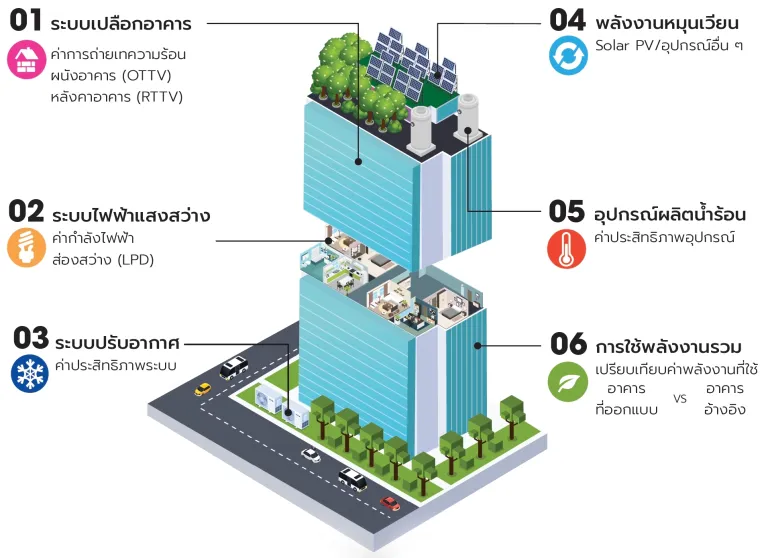
Source: Department of Alternative Energy Development and Energy Conservation (2022)
Electrical system design in healthcare facilities is therefore not merely about technology or machinery placement, but about laying the foundation for health security at a structural level that connects with environment, economy, and society. Adopting renewable energy combined with design that complies with BEC criteria is a crucial approach to creating healthcare systems with high resilience, capable of withstanding impacts from disasters, climate change, and future energy system uncertainties.
Universal health coverage will truly occur when there is accessible and adequate electricity
Universal health coverage is a fundamental right that everyone should receive, without being limited by geographical or economic constraints. However, what many overlook is electricity, which is a crucial factor in making universal health coverage truly achievable. In remote areas or in low- and middle-income countries, access to stable and adequate electricity helps healthcare facilities provide efficient and continuous medical services. To ensure quality and adequate health services, investment in improving electrical systems in healthcare facilities is necessary, particularly in areas where electricity access remains problematic. World Bank data reveals that approximately $4.9 billion USD in investment is needed to develop stable electrical systems in healthcare facilities, which not only helps healthcare facilities provide quality services but also strengthens healthcare system sustainability and fully meets public needs.
Developing healthcare systems to provide continuous and comprehensive services requires starting with stable infrastructure, particularly electricity access in healthcare facilities—not just to make equipment function, but to ensure patients’ hope is not extinguished simply due to lack of power. Investment in electrical infrastructure is the foundation of truly guaranteeing health rights. If we want universal health coverage to truly occur in all areas, we must start with the question of whether our healthcare facilities have electricity?
Strategy and International Cooperation Coordination Division
Office of the National Economic and Social Development Council
References
WHO. (2023). Close to one billion people globally are served by health-care facilities with no electricity access or with unreliable electricity. Retrieved from https://www.who.int/news/item/14-01-2023-close-to-one-billion-people-globally-are-served-by-health-care-facilities-with-no-electricity-access-or-with-unreliable-electricity
WHO. (2023). Electricity in health-care facilities. Retrieved from https://www.who.int/news-room/fact-sheets/detail/electricity-in-health-care-facilities
Department of Alternative Energy Development and Energy Conservation. (2022). Requirements of Energy Conservation Building Law BEC. Retrieved from https://bec.dede.go.th/requirements-of-the-law/
Related Documents