If we view the ocean merely as a natural resource or tourist destination, we may overlook its true significant role. The blue imperative: understanding interactions between the ocean, climate and economy report by the Centre for Economic Transition Expertise (CETEx) in 2024 highlights that the ocean is the vital heart of global economic and climate balance. This article explores the concept of the Blue Economy, which is not merely about utilizing marine resources, but also encompasses sustainable management to ensure the ocean can maintain its abundance while supporting the global economy simultaneously.
The ocean is a key factor in controlling climate and climate change
The ocean is not only an important reservoir of water, heat, and carbon for the world, but also helps create stability for the global climate system. The ocean is the world’s largest carbon sink and absorbs carbon dioxide (CO2) in quantities greater than forests worldwide. Approximately 25% of carbon emissions from human activities released since the Industrial Revolution have been absorbed by the ocean. The ocean plays a crucial role in mitigating the impacts of climate change. It also helps absorb excess heat from increased greenhouse gas emissions in the atmosphere, where ocean temperatures over the past 140 years have increased by up to 1 degree Celsius, with some areas experiencing increases of up to 3 degrees Celsius.
The ocean does not only help absorb carbon and heat, but also includes the distribution of heat globally through ocean currents, which are important in controlling temperature distribution in various areas and controlling the circulation of water and nutrients essential for global biological production. The heat and carbon absorbed in the ocean act as catalysts for long-term impacts such as glacier melting, sea level rise, ocean heat waves, and ocean acidification that may lead to severe changes in marine ecosystems and coastal human life.
The ocean serves as both the world’s resource treasury and waste repository. Human life on this planet raises the question: “Is the ocean being used as a ‘resource treasury’ or a ‘waste bin’?” The key challenge is maintaining balance between utilizing the ocean as a resource source and protecting the ocean from impacts that may destroy ecosystems, as human activities create significant impacts on marine and coastal ecosystems.
Blue Economy: A New Concept for a Sustainable World
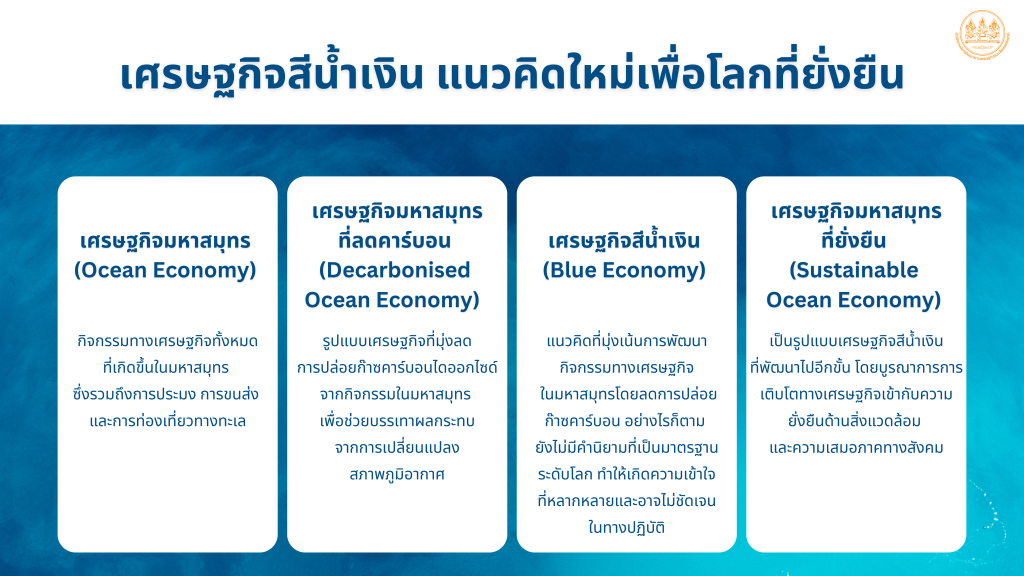
In today’s world where climate change and environmental problems are intensifying, the concept of Blue Economy has become a topic of great interest. However, this term still lacks a universally accepted definition, making its meaning ambiguous and requiring new review. This report proposes new definitions to create clearer understanding of various related concepts as follows:
- Ocean Economy encompasses all economic activities occurring in the ocean, including fisheries, transportation, and marine tourism.
- Decarbonised Ocean Economy is an economic model
that aims to reduce carbon dioxide emissions from ocean activities to help mitigate climate change impacts. - Blue Economy is a concept that focuses on developing economic activities
in the ocean while reducing carbon emissions. However, this term still lacks a global standard definition, leading to diverse and potentially unclear understanding in practice. - Sustainable Ocean Economy is an advanced form of blue economy that integrates economic growth with environmental sustainability and social equity.
“Global and national economies
have concrete connections and significant implications with ecosystem services provided by the ocean.”
The ocean is more than a vast expanse separating continents. For thousands of years, the ocean has served as both a resource source and economic medium that has nurtured human civilization, from providing food and energy to supporting trade and intercontinental transportation. This importance has not diminished over time but has multiplied in the era of globalization where economies at all levels inevitably depend on the ocean.
The concept of ocean economy was therefore defined to describe all economic activities related to oceans and coasts, covering both traditional sectors such as fisheries, tourism, and transportation, as well as new sectors emerging from modern innovation and technology. A World Bank report in 2023 stated that the ocean economy is valued at approximately 1.5 trillion US dollars and is expected to increase to 3 trillion US dollars by 2030, reflecting the tremendous growth potential of industries utilizing the ocean. Without proper management, this could cause damage to marine ecosystems. Problems of overfishing, uncontrolled tourism, and marine pollution are factors threatening ecosystem balance and may create long-term economic impacts. Therefore, creating a blue economy does not mean merely seeking benefits from the ocean, but is the integration of economic growth in harmony with environmental sustainability and social equity to ensure the ocean continues to function as a stable and sustainable economic pillar of the world.
Invisible Problems Beneath the Surface: International Politics and the High Seas
“The lack of governance structures and enforcement mechanisms for the high seas raises questions about the sustainability of economic activities and equitable sharing of benefits from this area” reflects the problem hidden beneath the surface: the lack of clear and effective governance frameworks for high seas areas, leading to challenges in controlling economic activities and issues of equity in resource use.
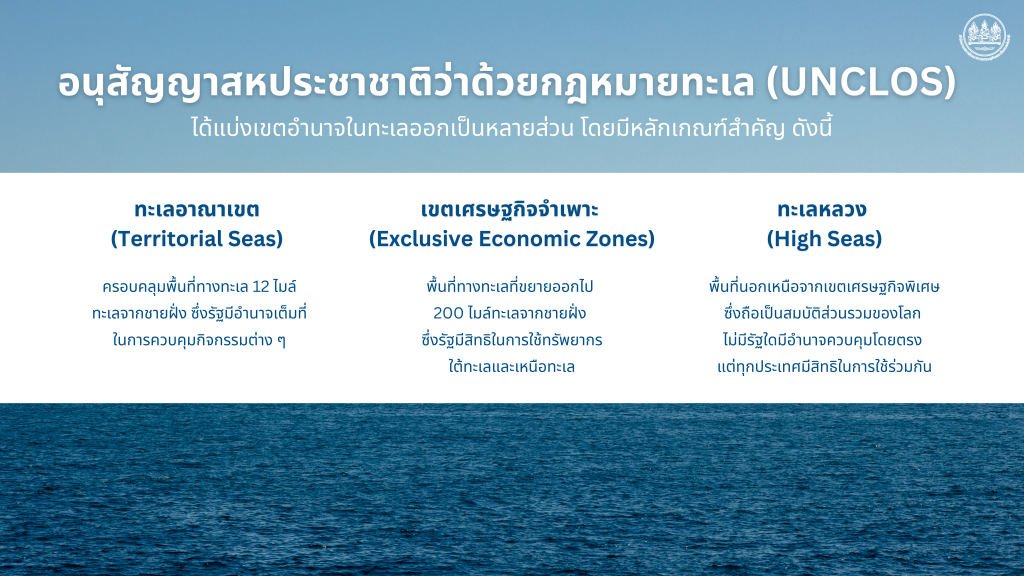
The ocean is a boundless open space, yet this vastness creates governance challenges. The lack of effective control mechanisms may lead to unsustainable resource utilization. The organization of regulations in the high seas through the United Nations Convention on the Law of the Sea (UNCLOS) established in 1982, which is a legal framework defining the rights and duties of coastal states in controlling waters adjacent to coasts, including conducting various activities such as fisheries, commercial marine energy development, mining, and scientific research. UNCLOS divides maritime jurisdiction into several parts with important principles as follows:
- Territorial Seas cover marine areas 12 nautical miles from the coast, where states have full authority to control various activities.
- Exclusive Economic Zones (EEZs) are marine areas extending 200 nautical miles from the coast, where states have rights to use underwater and above-water resources.
- High Seas are areas beyond exclusive economic zones, considered common heritage of mankind, with no state having direct control authority, but all countries have rights to shared use.
The high seas present governance challenges as no country has full jurisdiction, making economic activities in this area such as deep-sea mining, industrial-scale fishing, and international shipping potentially impact the environment and resource sustainability. Although the United Nations Convention on the Law of the Sea (UNCLOS) serves as an important governance framework, it lacks effective enforcement mechanisms for managing high seas resources. Therefore, additional agreements have been proposed, such as the Agreement on Biodiversity Beyond National Jurisdiction (BBNJ) or the High Seas Treaty, signed in 2023. This treaty focuses on conservation and sustainable use of high seas resources, representing a significant step aligned with the goals of the Kunming-Montreal Global Biodiversity Framework, which aims to protect 30% of the world’s land and sea areas by 2030.
Threats from Human Activities to the Ocean
Ocean economy focuses on short-term economic benefits, often neglecting long-term environmental impacts. Decision-making that prioritizes immediate profits may result in rapid depletion of marine resources and damage to ecosystems.
The ocean faces not only climate change but also bears the impacts from human activities that are part of the rapidly growing ocean economy. Agriculture, which is the main food production source for humans, has unintentionally created problems when soil is washed into the sea, carrying chemicals and contaminated sediments to the ocean, directly impacting corals, marine animals, and sea plants. Marine pollution has become a bigger problem as humans increasingly rely on plastics. Plastic waste dumped into the sea without proper management has created impacts on ocean life, with many marine animals trapped in plastic waste or unknowingly ingesting microplastics into their bodies. Overfishing is another serious risk, as increasing demand for seafood causes marine resources to be exploited beyond limits. Meanwhile, aquaculture, although viewed as a solution to meet increasing demand, may lead to water contamination, habitat destruction, and ecosystem changes if not properly managed. Additionally, the emergence of new economic activities such as deep-sea mining represents the latest threat, where risks associated with extracting resources from the seabed may lead to marine environmental degradation at levels difficult to restore.
Solutions Beyond Paper Policies
Amid the climate crisis and rapidly expanding economic activities in the ocean, sustainable management of marine resources is a challenge requiring more than writing policies on paper, considering economy, environment, and society simultaneously.
- The new form of blue economy focuses on sustainability, recognizing the interconnections between ocean, climate, and society, where all stakeholders, including the public, need to be part of joint efforts.
- Overfishing, habitat destruction, marine pollution, and climate change impacts are problems that cannot be solved alone. Creating international cooperation frameworks that comprehensively cover transboundary ocean management is therefore key, which should align with international agreements on marine conservation.
- Control of marine industries must be specific to each sector, with stakeholders and various agencies needing to integrate their work together to ensure management moves in the same direction and is effective.
- Financial sector participation to provide funding support for sustainable ocean economy
with the financial sector playing a role in ocean-related negotiation forums, while supporting capacity-building projects to increase understanding of risks and investment opportunities
related to marine resources. - New financial instruments such as blue bonds are funding mechanisms for marine conservation and insurance products covering ocean-related risks.
- Governments should play a proactive role in monitoring and mitigating unequal impacts
from marine economic activities, especially on vulnerable coastal communities, which are the groups most affected. - Supporting small island developing states through financial assistance, capacity building,
and technical support to strengthen resilience and flexibility to effectively cope with occurring changes.
8 Important Steps Toward Sustainable Thai Seas
Thailand is beginning important steps in developing marine economy with a new approach called “Blue Economy Zone”, which is not limited to utilizing marine resources but also means visionary management toward an economic system that grows in balance with nature. Behind this concept are 8 important steps that will lead the country toward long-term sustainable seas.
Step 1: Study feasibility before taking action The starting point of all change is asking whether it is truly feasible. The Department of Public Works and Town & Country Planning is responsible for preparing a feasibility study for establishing blue economy zones to assess area suitability in various dimensions, whether economic, natural resources, or urban planning potential.
Step 2: Seek policy-level support When study results clearly indicate area potential, project agencies will present the project to the Cabinet to seek approval for declaring blue economy zones.
Step 3: Comprehensive impact assessment Before development, it is necessary to know completely what impacts there will be on environment, society, and economy through preparing Strategic Environmental Assessment (SEA) reports according to legal requirements, ensuring projects proceed without leaving problems behind.
Step 4: Create organizations to lead change After receiving Cabinet approval, the government will issue Prime Minister’s Office regulations to establish the Blue Economy Zone Development Office and allocate operational budgets. This new agency will be the center for driving blue economy approaches in all dimensions.
Step 5: Establish legal foundations The established office will lead in drafting the Blue Economy Zone Act covering 4 key elements: sustainable resource use control, coordination of cooperation between marine activities, opening space for stakeholder participation, and integration of plans and agencies into unity.
Step 6: Push legislation into the legislative system The refined draft law will be brought into the parliamentary consideration process for promulgation according to legal procedures, transforming policy approaches into concrete enforcement frameworks.
Step 7: Establish new area management systems When the law takes effect, the Blue Economy Zone Development Office will be responsible for developing blue economy zone area management mechanisms, requiring integrated work in functional, spatial, and policy dimensions for maximum efficiency.
Step 8: Field operations for concrete results When everything is ready, area operations will begin. The Blue Economy Zone Development Office will be the main leader in developing infrastructure, areas, and activities in blue economy zones in accordance with sustainable development principles that do not leave nature and people behind.
In a world facing global warming, marine ecosystem degradation, and economic uncertainty, this report highlights the urgent need to create balance between economic development and marine environmental conservation. Awareness and adaptation to the interconnections between ocean, climate, and economy will be key to creating a sustainable future. This article invites us to view the ocean with a new perspective that is not merely a vast body of water, but a resource-rich source full of opportunities if properly managed. The ocean will be able to support both ecosystems and economy to grow together stably and sustainably.
Strategy and International Cooperation Coordination Division
National Economic and Social Development Council
References
Centre for Economic Transition Expertise. (2024). The blue imperative: understanding interactions between the ocean, climate and economy. Retrieved from https://cetex.org/publications/the-blue-imperative-understanding-interactions-between-the-ocean-climate-and-economy/
Dialogue earth. (2025). To save our ocean, we need a sustainable blue economy. Retrieved from https://dialogue.earth/en/ocean/to-save-our-ocean-we-need-a-sustainable-blue-economy/
London School of Economics and Political Science. (2024). What is the blue economy? Retrieved from https://www.lse.ac.uk/granthaminstitute/explainers/what-is-the-blue-economy/
UNESCO. (2023). With the “High Seas Treaty” on biodiversity signed, what do we need to do next? Retrieved from https://www.unesco.org/en/articles/high-seas-treaty-biodiversity-signed-what-do-we-need-do-next
Office of the National Science and Technology Development Agency. (2021). Thailand’s Blue Economy: How to Achieve Marine Sustainability. Retrieved from https://researchcafe.tsri.or.th/sustainability/
Related Documents