


When sustainability is not an option, but the heart of modern business The business world in the 21st century has completely transformed, when measuring organizational success is not solely based on profit figures but also includes the impact organizations have on society and the environment. This article will explore a case study of Singha Estate Public Company Limited that reflects a significant transformation through the GREEN Mission concept that integrates sustainable development into business strategy. Lessons from this leading organization demonstrate how creating balance between business returns, transparency, and social responsibility is possible in an era where sustainability is not an option, but a vital core for long-term sustainable growth.
Significant steps toward sustainability with global vision: Adopting SDGs as a compass for sustainable development Singha Estate has emerged as an interesting example of adopting the Sustainable Development Goals (SDGs) as a compass for operations. This case study reflects the establishment of a strong foundation through three main pillars: economy, society, and environment. Importantly, the adoption of good governance principles as a crucial foundation for driving the organization, along with creating systematic stakeholder engagement mechanisms, reflects that sustainable success must arise from the participation of all sectors.
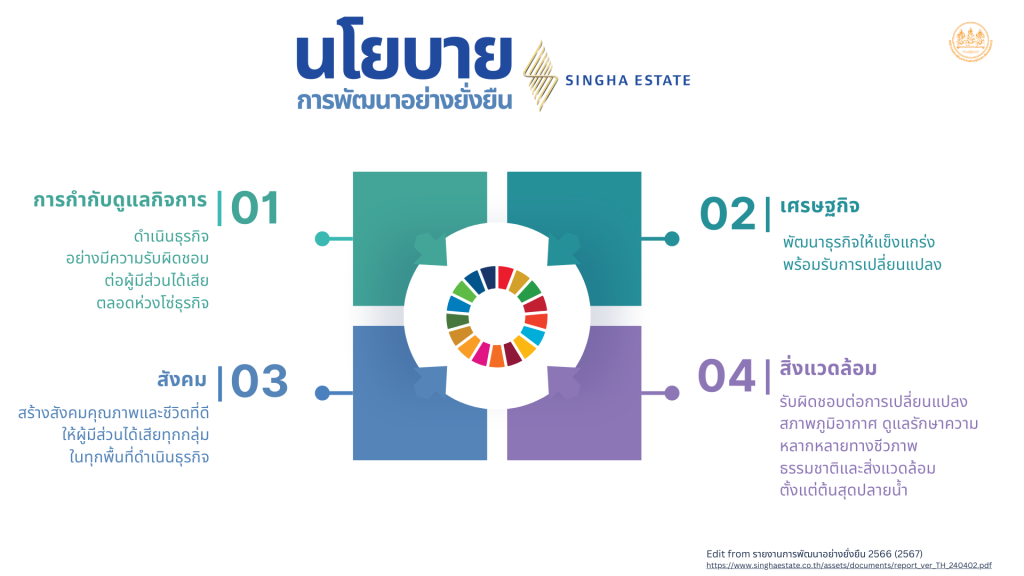
Governance leads the way: Driving the economy toward sustainability Singha Estate has integrated good governance principles into all dimensions of business operations, from efficient supply chain management to community economic development through employment policies and support for local products. Transparent and responsible operations help improve the quality of life of local communities and contribute to driving the national economy, reflecting that business growth and sustainable development can move forward together in balance.
Creating quality society: Connecting all sectors toward sustainable development Singha Estate has presented a new perspective on social development that emphasizes comprehensive participation by integrating social policies into organizational strategy, from developing the quality of life of stakeholders to preserving local cultural heritage, reflecting a modern business model that prioritizes growth alongside sustainable social development.
Integrating real estate development with sustainable environmental conservation Singha Estate has integrated environmental conservation concepts through policies that comprehensively cover managing impacts on ecosystems – land, water, and air – while promoting concrete approaches to natural resource conservation and restoration to create balance between business development and environmental preservation for future generations. Key policies include:
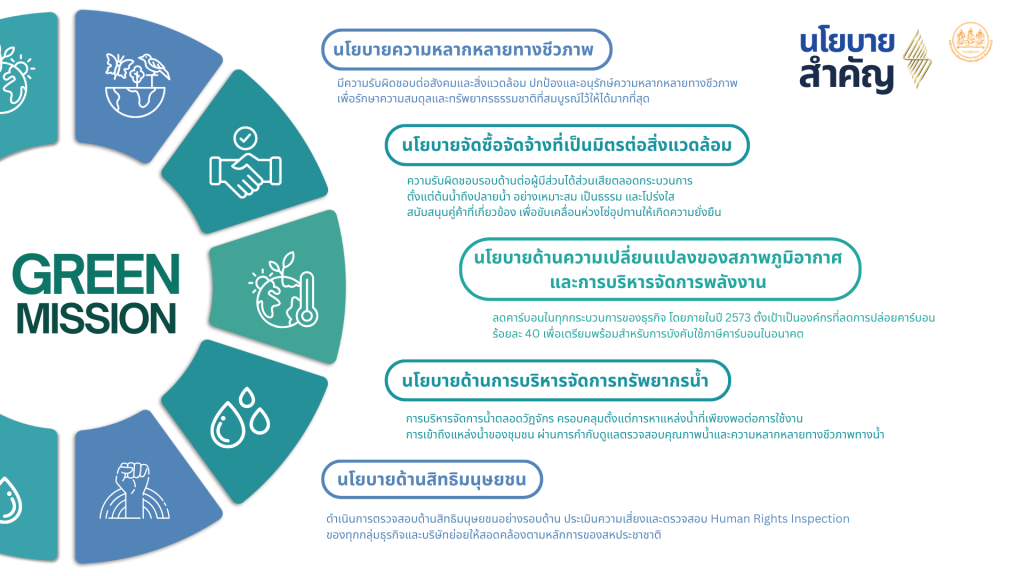
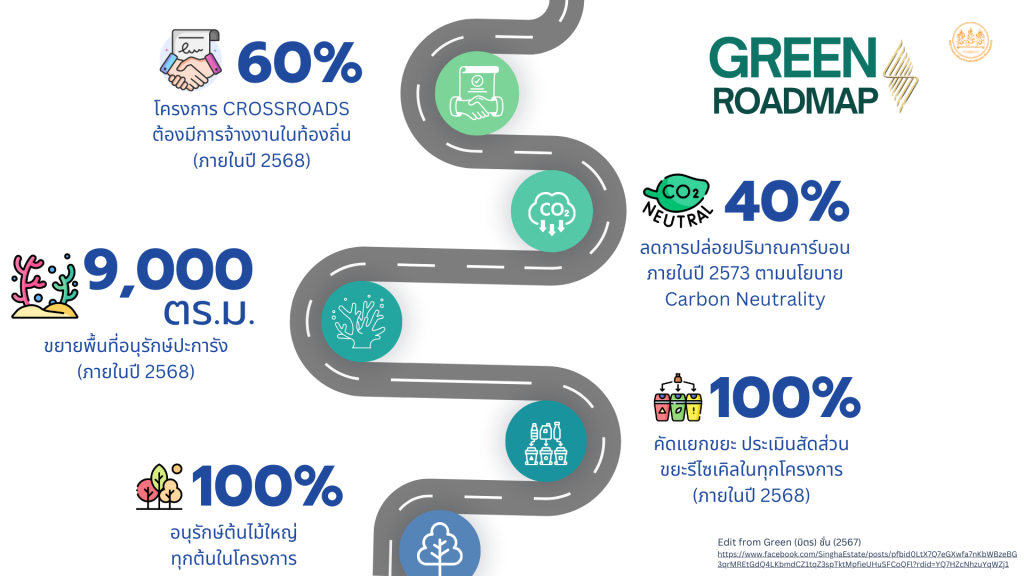
Singha Estate, green real estate leader: Driving comprehensive environmental programs toward sustainability goals Singha Estate demonstrates the elevation of operational standards through a Green Roadmap that covers environmental operations including biodiversity conservation, green procurement throughout the supply chain, while setting challenging goals to reduce carbon emissions by 40% by 2030, alongside efficient water resource management and elevating operations according to international human rights standards, demonstrating commitment and vision in elevating Thai real estate development standards to global sustainability.
Success from commitment to development for a sustainable world Amid the intensifying global climate change crisis that has pushed the business sector to undergo major transformation, this case study will demonstrate concrete success from organizational commitment to creating change through operations covering economic, social, environmental, peace and institutional dimensions, as well as development partnerships. This serves as an example showing that business operations in the current era can generate profits alongside environmental preservation and social development sustainably, leaving no one behind.
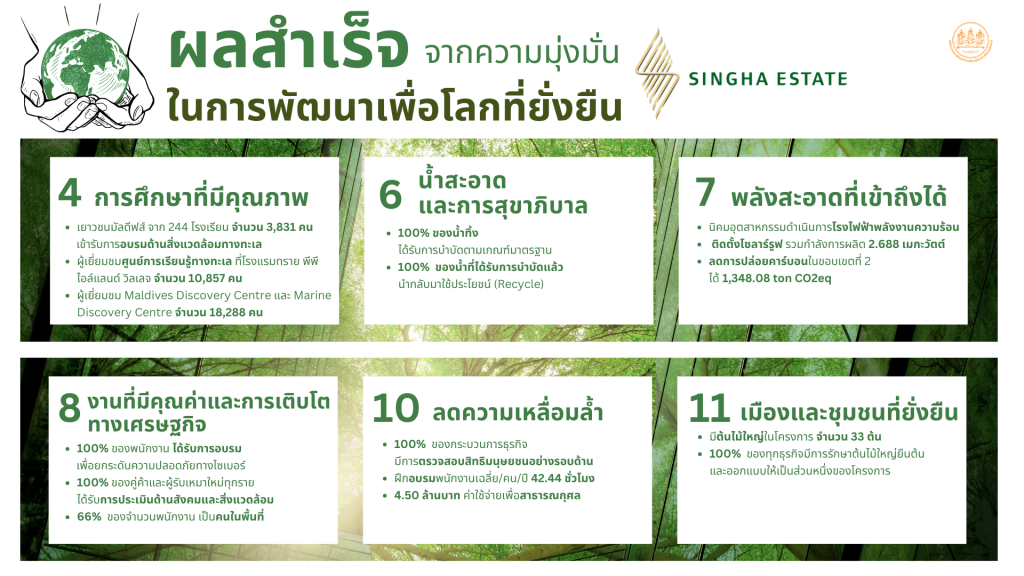
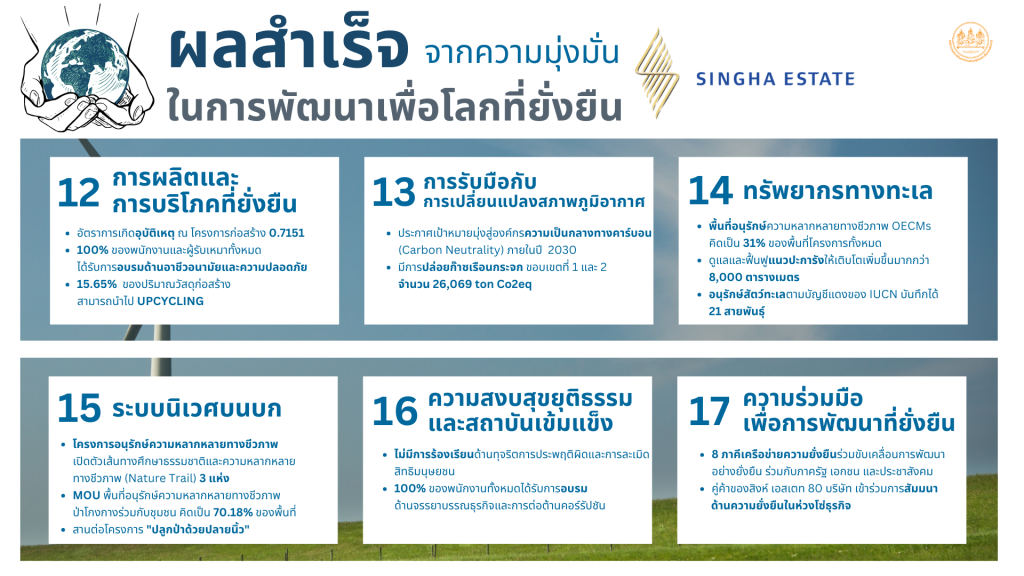
Success from elevating economic dimensions: Aiming toward carbon neutrality organization by 2030, with greenhouse gas emissions in Scope 1 and 2 totaling 26,069 ton CO2eq, and implementing various measures to reduce greenhouse gas emissions, such as installing solar roofs in industrial estates and creating cooperation with government, private sector, and civil society in driving sustainable development, with 80 partner companies participating in sustainability seminars in the business chain, reflecting that these actions not only help reduce environmental impact but also strengthen sustainability for communities and the economy in the long term.
Success from elevating social dimensions: Steps toward creating shared value for sustainability Elevating social dimensions as a core element of business operations that creates balance between business growth and social development concretely as follows: (1) Leading education and creating environmental awareness about marine environments on the largest scale in the Maldives that will lead to long-term behavioral change (2) Systematic human resource development, enhancing employee capabilities and creating local employment opportunities, and (3) Community and social development through integrating nature conservation concepts while elevating safety standards to cover both employees and contractors reflecting responsibility that extends throughout the value chain.
Success from elevating environmental dimensions: Significant steps in environmental conservation Demonstrating commitment to environmental conservation and sustainable development through various projects with clear positive environmental impact as follows: (1) Water management – the company has treated all wastewater according to standards and reused 100% (2) Biodiversity conservation with biodiversity conservation areas (OECMs) accounting for 31% of total project area and caring for and restoring coral reefs to grow more than 8,000 square meters, and (3) Waste management and recycling – Singha Estate has reduced unnecessary construction materials and upcycled construction materials at 15.65% of total construction materials. These actions reflect commitment to environmental conservation and sustainable development.
Success from elevating peace and institutional dimensions: Commitment to promoting peace and justice with 100% of all employees trained in business ethics and anti-corruption. Additionally, there were no complaints regarding fraud, misconduct, and human rights violations, reflecting the company’s intention to create a transparent and fair work environment, which is a crucial foundation for building confidence and trust from both employees and stakeholders.
Success from elevating development partnership dimensions: Creating cooperation with government, private sector, and civil society in driving sustainable development with 80 partner companies participating in sustainability seminars in the business chain, reflecting the importance of working together to achieve sustainable goals and creating strong cooperation networks, which is a crucial foundation for long-term sustainable development.
Steps of sustainable development From implementing sustainable development plans in economic, social, and environmental aspects, Singha Estate showed clear results in 2023 with greenhouse gas emission control figures of 26,069 tons CO2eq in Scope 1 and 2, while expanding biodiversity conservation areas (OECMs) from 25% to 31% of project area, and increasing coral reef restoration area from 5,000 to 8,000 square meters compared to 2022. This development occurred through cooperation between government, private sector, and civil society, reflecting the elevation of environmental operational standards to drive sustainable development concretely.
In a world where sustainable development has become a significant organizational challenge, learning through Singha Estate’s experience demonstrates that organizational development that not only focuses on profit but also creates positive impact on society and the environment is a feasible approach that can create sustainable long-term business value.
Strategy and International Cooperation Coordination Division
Office of the National Economic and Social Development Council
References
Singha Estate. (2567). Sustainability Report 2023. Retrieved from https://investor.singhaestate.co.th/th/document/sustainability-reports
Singha Estate. (2024). Green (Friendly) Measurement – Mission for Balanced and Sustainable Diversity of Singha Estate Retrieved from https://shorturl.asia/hQN0j
Related Documents