


- The Beginning of the Fight Against PM 2.5
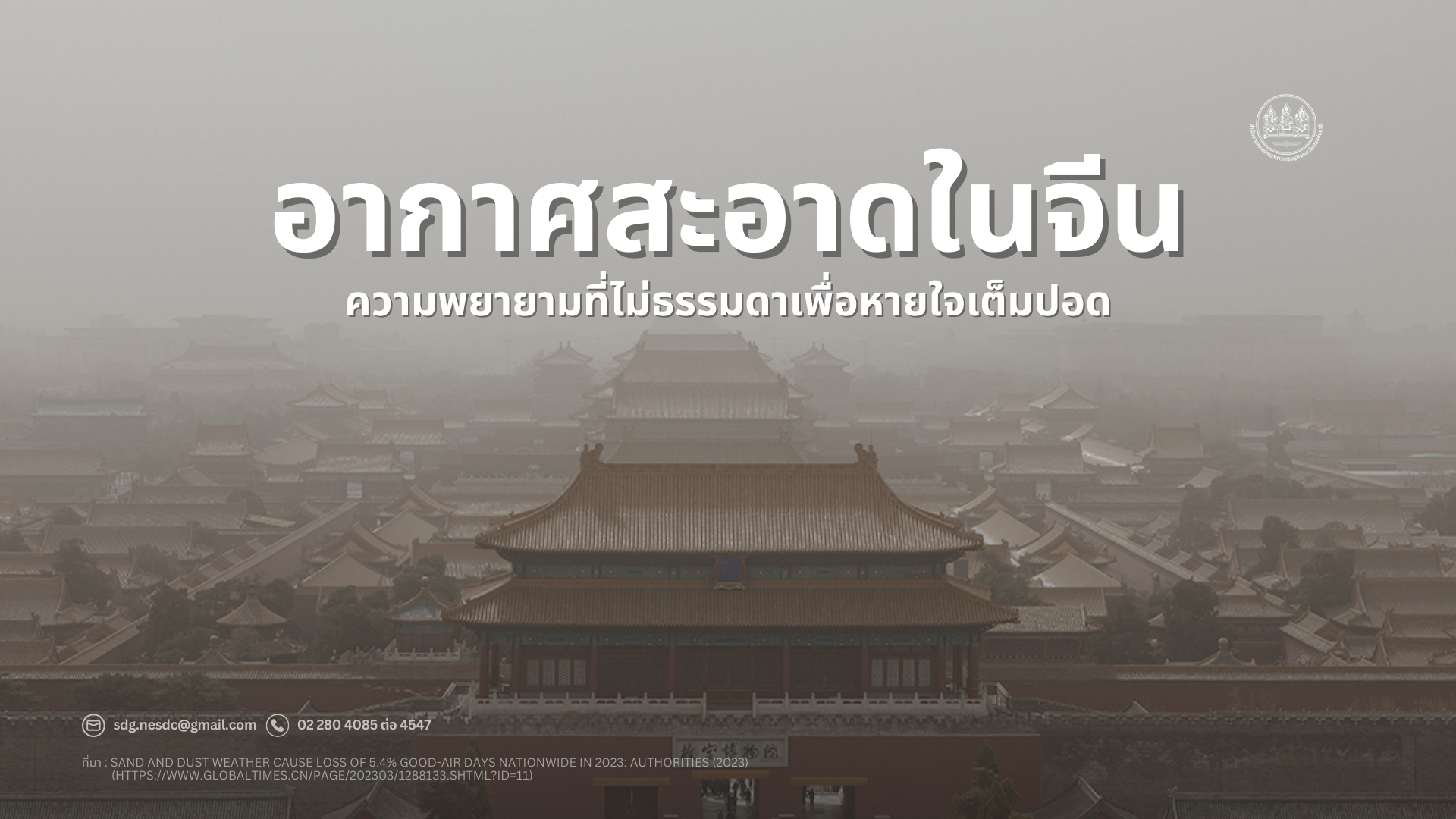
In early 2013, Beijing experienced one of the most severe air pollution events in its history, with particulate matter levels reaching 500-600 micrograms per cubic meter (µg/m³), which exceeded the World Health Organization (WHO) standard of 25 µg/m³ by nearly 20-24 times. This situation had widespread impacts on people’s daily lives, leading to airport service suspensions, school closures, and increased respiratory patients in hospitals.
“Airpocalypse” is a crisis phenomenon of air pollution coined from the combination of “Air” and “Apocalypse,” reflecting the severity of air pollution situations with widespread impacts, particularly in China during 2013, which became a crucial turning point in recognizing the dangers of PM 2.5 particles smaller than 2.5 microns. With physical characteristics that can penetrate directly into the respiratory system and bloodstream, this results in risks of respiratory diseases, heart disease, and lung cancer. Beyond health impacts, this crisis also affects the overall ecosystem, being a significant factor that increases the severity of greenhouse effects and climate change, leading to environmental policy reviews and air pollution control measures in many countries worldwide facing similar problems.
- Nearly Three Decades of Fighting Pollution
China began seriously fighting air pollution in 2013 through air pollution control plans with clear targets and measures to reduce PM 2.5 dust and various air pollutants as follows:
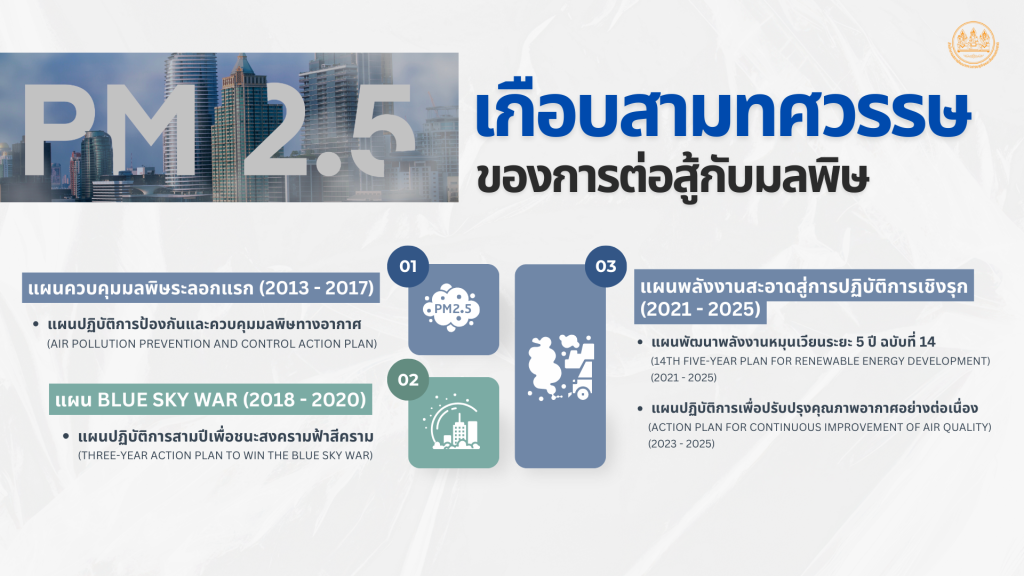
First Wave Pollution Control Plan (2013-2017)
Air Pollution Prevention and Control Action Plan China used a budget of 1.7 trillion yuan to implement measures to reduce PM 2.5 dust in major urban areas by 25% between 2013 and 2017 through key measures including: limiting coal use in industrial and household sectors, closing over 2,000 factories that exceeded pollution standards, promoting clean energy and natural gas, and controlling private vehicle use. This resulted in Beijing’s average PM 2.5 levels decreasing to 58.8 µg/m³ in 2017.
Blue Sky War Plan (2018-2020)
Three-Year Action Plan to Win the Blue Sky War focused on structural problem-solving by declaring special pollution control zones in 28 northern cities, converting household heating systems to natural gas, developing the world’s largest electric mass transit system, and relocating heavy industries from urban areas. This resulted in Beijing’s average PM 2.5 levels decreasing to 37.5 µg/m³ in 2020.
Clean Energy to Proactive Operations Plan (2021-2025)
14th Five-Year Plan for Renewable Energy Development (2021-2025) China began implementing the 14th Five-Year Renewable Energy Development Plan in 2021, targeting to increase the proportion of wind and solar energy to 20% of total energy by 2025, while implementing air pollution reduction measures through electric mass transit system development and carbon capture, utilization, and storage (CCUS) technology in the industrial sector, along with expanding green areas and developing electric mass transit systems.
- Current Problem-Solving Measures
The Chinese government has designed and implemented comprehensive measures across all dimensions to concretely reduce PM 2.5 levels through 5 key measures as follows:
- Energy Reform China aims to increase the proportion of wind and solar energy to 20% of total energy production by 2025 to reduce dependence on coal, which is the main source of PM2.5 dust and greenhouse gases.
- Industrial Pollution Control China strictly regulates pollution emissions from industrial factories
with rigorous monitoring and punishment of violators, including closing factories that exceed pollution standards. - Transportation Revolution China promotes electric mass transit systems, limits private vehicle use
in major cities, and supports electric vehicle (EV) use, including hydrogen energy, to reduce pollution emissions from vehicles. - Modern Technology Application China applies carbon capture, utilization, and storage (CCUS) technology
in the industrial sector to reduce greenhouse gas emissions. Additionally, large-scale air purifiers are installed in public areas to improve air quality in major cities. - Increasing Green Areas China expands green areas through reforestation and creating public parks in major cities, which helps reduce temperature, absorb particulate matter, and increase carbon storage capacity.
- Tangible Success and Remaining Challenges
Tangible Success China has demonstrated clear progress in fighting air pollution. From the Airpocalypse crisis in 2013 with PM2.5 levels soaring to 500-600 µg/m³ on some days, which was nearly 20-24 times higher than the World Health Organization (WHO) standard at that time (WHO standard before 2021 set daily average at 25 µg/m³), the situation has completely turned around. Currently, in 2024, Beijing has average PM 2.5 levels reduced to 30-35 µg/m³ and has up to 290 days of good air quality.
Note : มาตรฐาน WHO ที่เปลี่ยนไป
ก่อนปี 2021 : WHO กำหนดค่าเฉลี่ยรายปีไว้ที่ 10 µg/m³ และค่าเฉลี่ยรายวันไว้ที่ 25 µg/m³
ปี 2021 : WHO ปรับปรุงแนวทางคุณภาพอากาศ โดยลดค่าเฉลี่ยรายปีลงเหลือ 5 µg/m³ และ ค่าเฉลี่ยรายวันเหลือ 15 µg/m³
- Lessons Learned for Thailand
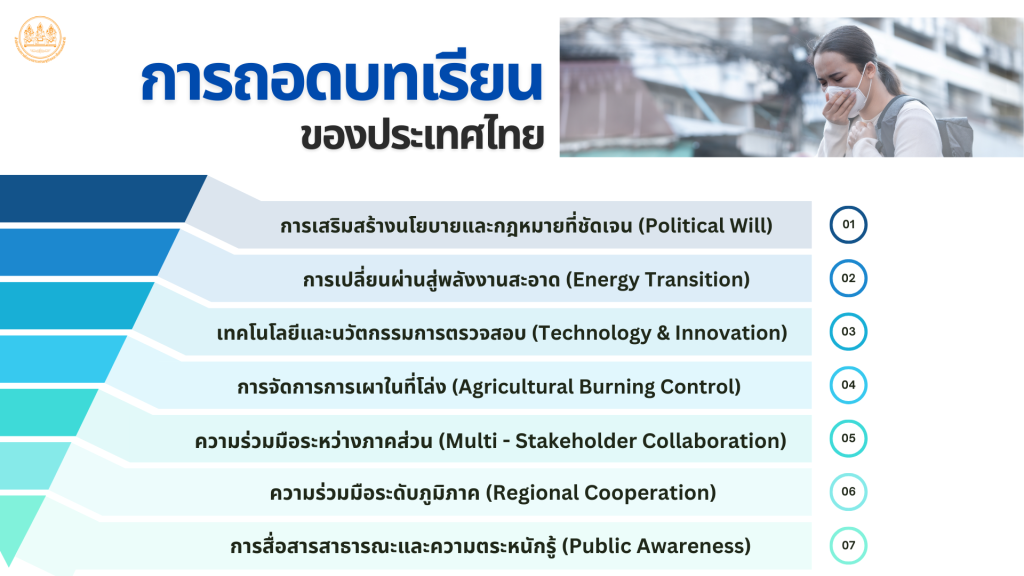
Learning from China’s success in air pollution management has opened new perspectives for Thailand in developing approaches to solve chronic dust pollution problems. Thailand has adapted these lessons to fit the Thai social context across economic, social, and environmental dimensions as follows:
1. Strengthening Clear Policies and Laws (Political Will)
Developing specific legal frameworks for air pollution, as currently using the Enhancement and Conservation of National Environmental Quality Act (No. 2) B.E. 2561 (2018) which has limitations in managing air pollution, especially PM 2.5 dust, making it necessary to develop more effective legal frameworks and management mechanisms.
Civil society has made important proposals for drafting a Clean Air Act that sets PM 2.5 dust standards with clear penalties for pollution sources, alongside establishing an integrated PM 2.5 problem-solving committee chaired by the Prime Minister to enable collaboration among all sectors and have authority for rapid and decisive policy decisions. Research by Zhang et al. (2019) shows that strict law enforcement can reduce pollution in China by 30-40% within 5 years, reflecting that having strong legal mechanisms and management is a crucial factor in sustainably solving air pollution problems.
2. Transition to Clean Energy (Energy Transition)
The Ministry of Energy has the Power Development Plan B.E. 2561-2580 Revision 1 (Power Development Plan: PDP) as the master plan for the country’s electricity generation, concerning long-term electricity procurement for 15-20 years, targeting to increase the proportion of renewable energy, promote solar energy, wind energy, and biomass energy, with increased installation of Solar Rooftop and Solar Farm, such as the Sirindhorn Dam Hybrid Floating Solar Cell.
Environmental organizations (Greenpeace Thailand) have made important proposals to cancel all new coal power plant construction plans and accelerate the closure of old coal power plants, as well as promote electric vehicle use through tax support measures.
3. Monitoring Technology and Innovation (Technology & Innovation)
Technology is used in air quality management, including air quality monitoring networks with installation of low-cost sensor air quality monitoring devices and public participation in air quality monitoring in areas. Air quality monitoring systems and warning systems and applications by the Pollution Control Department have installed Air Quality Index (AQI) monitoring stations nationwide, using sensor technology to measure PM 2.5 and various pollutant gases, and developed the “Air4Thai” application as the main platform for providing real-time air quality information.
The Thailand Development Research Institute (TDRI) has proposed integrated budget allocation to create cooperation in preventing and reducing PM 2.5 dust problems to support the systematic use of technology and innovation in solving PM2.5 dust problems and strengthen sustainable management.
4. Open Burning Management (Agricultural Burning Control)
Creating incentives and supporting farmers to adopt environmentally friendly agricultural waste management methods through various measures including financial support measures through organic farming projects without burning by the Ministry of Agriculture and Cooperatives, providing assistance or low-interest loans to farmers who stop burning and switch to rice straw plowing or composting methods, and legal measures under Section 220 of the Criminal Code B.E. 2499 (1956), setting maximum fines of 140,000 baht or imprisonment not exceeding 7 years.
The Thailand Development Research Institute (TDRI) has proposed policies to reduce open burning in agriculture and forestry sectors including subsidizing farmers to adjust areas for machinery use instead of burning, researching alternative crops and creating new occupations, with successful case studies from the Pid Thong Lang Phra Foundation in Nan Province, as well as creating mandatory carbon markets to encourage farmers to plant forests to sell carbon credits, which requires government support in setting carbon tax policies and systematic management.
5. Multi-Stakeholder Collaboration
Creating cooperation among various sectors through establishing funds and cooperation networks to solve problems in an integrated manner, including the Environmental Fund under the Enhancement and Conservation of National Environmental Quality Act B.E. 2535 (1992), which is a financial mechanism that creates incentives for all sectors including government agencies, local administrative organizations, state enterprises, private sector, and private environmental organizations to participate in environmental protection and conservation based on the polluter pays principle, emphasizing participation from all sectors from policy level to community level to jointly solve air pollution problems sustainably.
6. Regional Cooperation
Thailand is one of the ASEAN member countries that signed the ASEAN Agreement on Transboundary Haze Pollution (AATHP) in B.E. 2545 (2002) to prevent and solve transboundary haze problems in the ASEAN region, especially from forest fires and open burning, but still lacks strict enforcement mechanisms, making transboundary haze problem-solving not fully successful.
Environmental organizations (Greenpeace Southeast Asia) have called for ASEAN leaders to jointly establish transboundary pollution laws, especially from burning in forest and agricultural industrial areas, to supervise and punish companies that cause pollution both domestically and across borders.
7. Public Communication and Awareness
Concepts have been adapted to fit the Thai social context by using platforms easily accessible to the public, such as the Pollution Control Department (PCD) Line Official Account for air quality alerts and recommendations for PM2.5 self-protection. Additionally, Facebook Live and the Air4Thai website are used to report real-time air quality information, as well as integrating air pollution knowledge into educational curricula, which will help create awareness from childhood, serving as an important foundation for sustainably solving air pollution problems.
- Conclusion
Thailand has learned from the experiences of many countries in managing air pollution problems for adaptation, especially from China in terms of policy integration and multi-dimensional operations, including political will integration, technology investment, and cooperation from all sectors to create a clean and sustainable air environment. Energy and environmental experts confirm that transitioning to clean energy is a key strategy in reducing carbon dioxide and PM 2.5 dust emissions.
Although developing countries face challenges in balancing economic growth with environmental conservation, China’s lessons have shown that economic development alongside environmental protection can be pursued simultaneously if there is integrated planning and implementation, considering the long-term benefits of the country and people.
Strategy and International Cooperation Coordination Division
National Economic and Social Development Council
References
AirVisual (IQAir). (2021). 2020 World Air Quality Report. Retrieved from https://www.iqair.com/
dl/pdf-reports/world-air-quality-report-2020-en.pdf?srsltid=AfmBOooJ4gsZDRObEYFy3XXhHW7UvvVKx2bZHMcX1r0H8crnyqEAS8dc
AQICN. (n.d.). Beijing air pollution: Real-time air quality index (AQI). Retrieved from https://aqicn.org/city/beijing/
Centre for Research on Energy and Clean Air. (2025). Analysis: Record surge of clean energy in 2024 halts China’s CO2 rise. Retrieved from https://energyandcleanair.org/analysis-record-surge-of-clean-energy-in-2024-halts-chinas-co2-rise/
Dialogue Earth. (2023). New air pollution control plan released. Retrieved from https://dialogue.earth/en/digest/new-air-pollution-control-plan-released/
Global Times. (2023). Sand and dust weather cause loss of 5.4% good-air days nationwide in 2023: authorities. Retrieved from https://www.globaltimes.cn/page/202303/1288133.shtml?id=11
Greenpeace Thailand. (2564). Coal Phase-out for Just Transition in Thailand.
Retrieved from https://www.greenpeace.org/thailand/publication/21396/climate-coal-phase-out-coal-thailand-report/
Greenpeace Thailand. (2023). Greenpeace to ASEAN Leaders: Urgently Address Transboundary Haze Problem. Retrieved from https://www.greenpeace.org/thailand/press/27500/no-time-to-waste-act-on-transboundary-haze/
National Development and Reform Commission. (2022). Notice on issuing the “14th Five-Year Plan for Renewable Energy Development.” Retrieved from https://www.ndrc.gov.cn/xxgk/zcfb/ghwb/202206/t20220601_1326719.html?code=&state=123
Policy watch. (2024). Cabinet Approves Outstanding Subsidy Payment EV 3.0 Towards Regional Hub. Retrieved from https://policywatch.thaipbs.or.th/article/economy-107
Smith School of Enterprise and the Environment. (2024). The air we breathe: lessons from Beijing’s airpocalypse. Retrieved from https://www.smithschool.ox.ac.uk/news/air-we-breathe-lessons-beijings-airpocalypse#:~:text=Throughout%202013%2C%20air%20pollution%20levels,an%20aerial%20attack%20on%20Beijing
Thairath. (2025). What Methods Did China Use to Solve PM 2.5 Air Pollution, Turning Foggy Cities into Clear Sky Cities. Retrieved from https://plus.thairath.co.th/topic/naturematter/105113
The State Council of the People’s Republic of China. (2018). Notice of the State Council on issuing the Three-Year Action Plan for Winning the Blue Sky Defense Battle. Retrieved from https://www.gov.cn/zhengce/content/2018-07/03/content_5303158.htm
The State Council of the People’s Republic of China. (2023). Notice of the State Council on issuing the “Action Plan for Continuous Improvement of Air Quality.” Retrieved from https://www.gov.cn/zhengce/content/202312/content_6919000.htm
The State Council of the People’s Republic of China. (2023). Notice of the State Council on issuing the “Action Plan for Continuous Improvement of Air Quality.” Retrieved from https://www.gov.cn/zhengce/content/202312/content_6919000.htm
World Health Organization. (2021). New WHO Global Air Quality Guidelines aim to save millions of lives from air pollution. Retrieved from https://www.who.int/news/item/22-09-2021-new-who-global-air-quality-guidelines-aim-to-save-millions-of-lives-from-air-pollution
World Health Organization. (2021). WHO global air quality guidelines: particulate matter (PM2.5 and PM10), ozone, nitrogen dioxide, sulfur dioxide and carbon monoxide. Retrieved from https://www.who.int/publications/i/item/9789240034228
Xinhua. (2025). Beijing achieves record-breaking 290 days of good air quality in 2024. Retrieved from https://english.news.cn/20250102/b06f080b0a1c47709021af77d56fcb4b/c.html
Zhang, Q., et al. (2019). Drivers of improved PM2.5 air quality in China from 2013 to 2017. Retrieved from https://www.pnas.org/doi/10.1073/pnas.1907956116
Pollution Control Department. (2021). Enhancement and Conservation of National Environmental Quality Act (No. 2) B.E. 2561 (2018). Retrieved from https://www.pcd.go.th/laws/11068/
Public Relations Department. (2025). Burn-Free Agriculture Project: Towards Sustainable Agriculture. Retrieved from https://www.prd.go.th/th/content/category/detail/id/31/iid/356829
Ministry of Energy. (2020). Power Development Plan B.E. 2561-2580 Revision 1. Retrieved from https://www.erc.or.th/th/power-development
Electricity Generating Authority of Thailand. (2564). Sirindhorn Dam Hybrid Floating Solar Cell – World’s Largest! Commercial Power Supply Started, EGAT Ready to Continue 15 Projects Nationwide, Showcasing Clean Energy Leadership Potential in Response to Global Trends. Retrieved from https://www.egat.co.th/home/20211102-pre01/
Thailand Environment Institute Foundation. (2024). ASEAN Agreement on Transboundary Haze Pollution (AATHP). Retrieved from https://www.tei.or.th/th/activities_us_detail.php?eid=2845
Thailand Development Research Institute (TDRI). (2023). Limitations in Solving PM2.5 Problems. Retrieved from https://tdri.or.th/2023/03/pm2-5-thailands-solutions/
Regional Environmental Office 14. (2568). Did You Know That Burning Grass and Waste is Illegal. Retrieved from https://epo14.pcd.go.th/th/news/detail/172139
Related Documents