


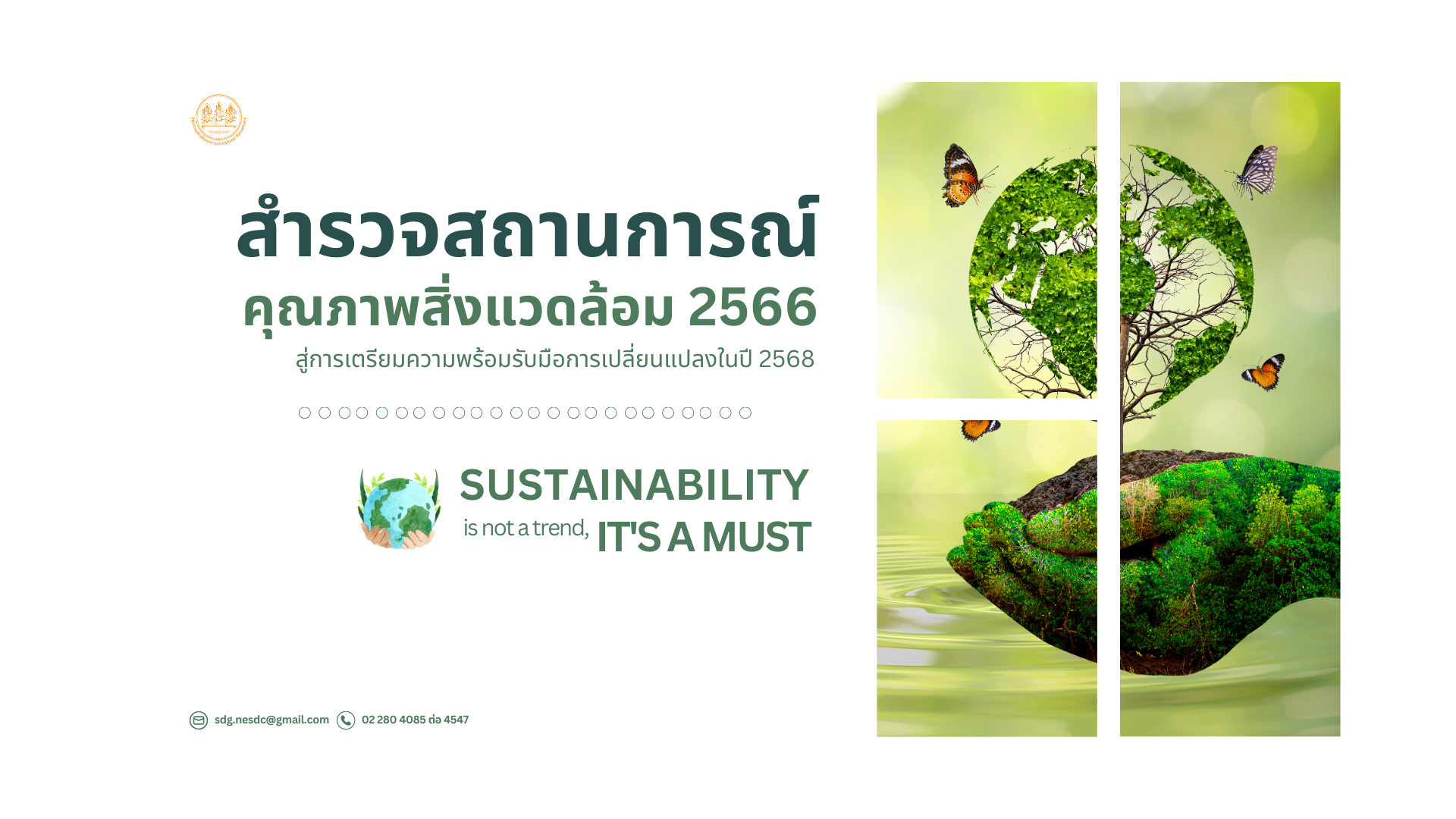
From the Environmental Quality Situation Report 2023 published on September 12, 2024, by the Office of Natural Resources and Environmental Policy and Planning, Ministry of Natural Resources and Environment, reflects environmental challenges that impact quality of life, ecosystems, and the country’s resource security. This requires cooperation and integration from all sectors for effective and sustainable environmental problem management.
“Sustainability is not a trend, it’s a must” reflects the urgent need to care for and restore the world’s environment, particularly in the Thai context where the country continues to face ongoing challenges in environmental quality amid intensifying climate change, disaster risks, and pollution problems that affect ecosystems and people’s quality of life. This article will explore Thailand’s environmental quality situation overview, analyze trends, impacts, and solutions that all sectors should collaborate on.
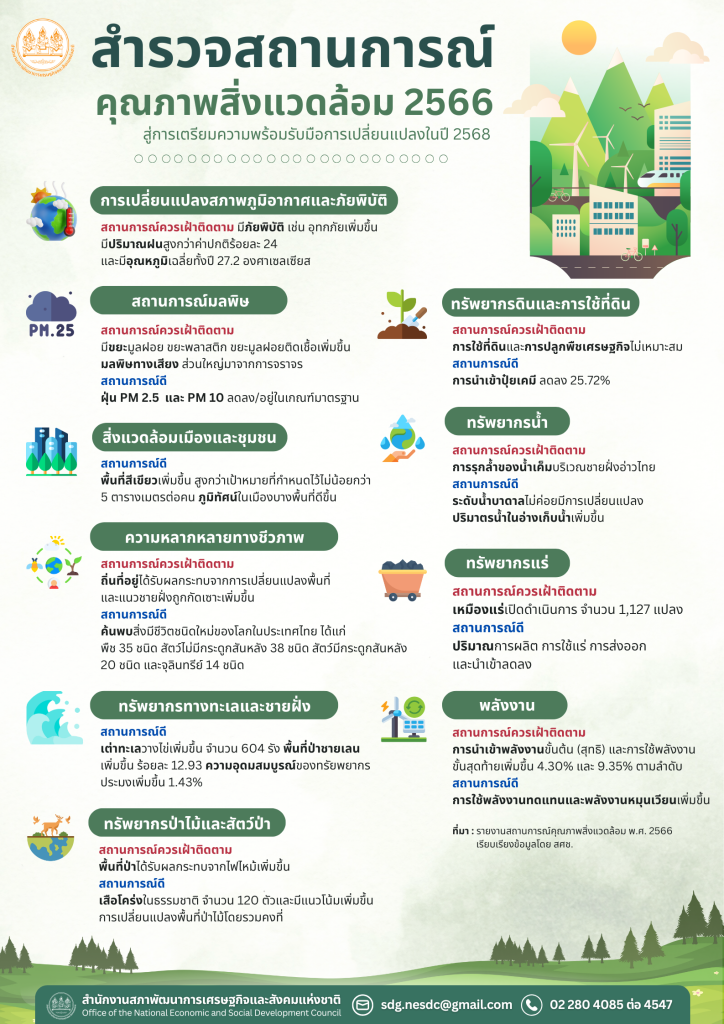
Climate Change and Disaster Situation Global average temperature has increased by 1.15 ± 0.13 degrees Celsius. In 2022, the annual average temperature was 27.2 degrees Celsius, 0.1 degrees above normal, while greenhouse gas emissions, particularly in the energy sector, increased by 1.50% compared to the previous year. Additionally, average total rainfall was 2,011.9 millimeters, 24% above normal, and sea level rose by 10 millimeters, resulting in natural disasters. From October 2021 to January 2023, 164 geological disasters occurred, an increase from 2021, mostly floods and landslides, directly impacting public health with illness or death from weather-related diseases. To sustainably address climate change and disaster management, there should be risk management through developing early warning systems, effective disease surveillance and prevention, and creating awareness and participation from all sectors in problem-solving.
Pollution Situation Due to urban expansion and increased vehicles on roads causing noise and air pollution. In 2022, although overall air quality showed improvement trends with annual averages of PM10 and PM2.5 particulate matter not exceeding standards, the industrial sector also releases pollution from production processes into the environment, along with open burning, resulting in risks of hearing loss and various diseases such as respiratory diseases. To sustainably manage pollution requires cooperation from all sectors, with the government needing to establish clear policies and measures such as pollution emission control, promoting clean energy use, and increasing green spaces, while the private sector must improve production processes to be environmentally friendly, including urgently addressing transboundary pollution through international cooperation to establish joint measures for controlling pollution sources.
Solid Waste, Hazardous Waste, and Infectious Waste Situation has increased due to changing consumption patterns. In 2022, there were 25.70 million tons of solid waste, an increase of 2.88% from the previous year, of which approximately 2.83 million tons or 11% was single-use plastic, with only 38.13% properly disposed of. Meanwhile, waste management still lacks efficiency, impacting public health and quality of life, with deteriorating ecosystems and environment. To sustainably address waste management, there should be appropriate waste management technology, creating incentives for businesses to reduce packaging use, and creating public awareness and participation that will lead to sustainable waste management.
Urban and Community Environmental Situation Due to expansion of community areas, urban infrastructure, and industrial sectors, clearly impacting urban and community environments. Although there have been improvements to urban landscapes and increased green spaces, with values higher than the country’s target of no less than 5 square meters per person, which will help reduce air pollution and improve people’s quality of life, emphasis should be placed on enforcing pollution control laws, restoring green areas, and promoting renewable energy use. Additionally, there should be public awareness creation and participation in environmental care.
Biodiversity Situation Due to uncontrolled resource consumption and natural resource degradation, resulting in biodiversity loss with some animal species at risk of extinction, impacting ecosystem balance. There are 999 threatened plant species, representing 9.08% of classified plant species, including 676 and 302 threatened vertebrate and invertebrate species respectively. Although extinction risk for vertebrates shows a declining trend compared to 2015. To sustainably address biodiversity issues, there must be natural area conservation, restoration of destroyed ecosystems, promotion of sustainable natural resource use such as environmentally friendly agriculture, sustainable fisheries and forest management, as well as creating awareness and promoting participation in ecosystem conservation and restoration.
Marine and Coastal Resources Situation Due to deteriorating seawater quality from waste discharge and severe coastal erosion, affecting rare marine animals, but there are positive signs with sea turtles laying 604 nests, an increase from 2021, fishery resource abundance increased by 1.43%, seagrass beds and coral reefs in relatively good condition, and mangrove forest areas increased by 12.93%. To sustainably address marine and coastal resource issues, there should be mangrove conservation, coral reef restoration, and creation of natural barriers to reduce coastal erosion, increase biodiversity, and strengthen ecosystem resilience to climate change.

Forest and Wildlife Resources Situation Forest areas account for 31.57% of the country’s area, and over the past 10 years, forest areas have changed little. Forest encroachment shows a declining trend although still found extensively in the northern region. For wildlife, there is good news with 120 tigers found and an increasing trend, but there are still problems with illegal wildlife trade through online channels that are difficult to control. Key challenges continue to come from infrastructure development and increasing demand for land for housing and agriculture. To sustainably address forest and wildlife resource issues, there must be strict law and policy enforcement, technology development for forest fire management, forest resource restoration, and cooperation among all sectors for efficient conservation and restoration.
Soil Resources and Land Use Situation Due to degradation from both natural causes and inappropriate land use, with economic crops planted in unsuitable areas covering 11.36 million rai, and severe to very severe soil erosion showing an increasing trend. However, there are positive signs with chemical fertilizer imports, reflecting chemical use and residue, decreasing by 25.72% from the previous year. To sustainably address soil resource issues, there must be soil conservation, improvement of degraded soil, and reduction of chemical use in agriculture, including data integration and cooperation between agencies in creating resource databases and promoting sustainable agriculture.
Water Resources Situation Due to infrastructure development that obstructs water flow, lack of forest and wetland area management, El Niño and La Niña phenomena, and saltwater intrusion along the Thai coast, impacting life and property risks from floods. To sustainably address water resource issues, there must be restoration and conservation of forest areas, watersheds, and natural water sources, along with creating international cooperation in transboundary water resource management.

Mineral Resources Situation Due to demand in the energy sector, construction industry, and production requiring large amounts of mineral resources, leading to increased mining operations with 1,127 active mining plots, impacting air pollution and public health, biodiversity loss, and economic impacts due to high restoration costs. To sustainably address mineral resource issues, there must be development of environmentally friendly mining technology, promotion of cost-effective mineral resource use, and cooperation from all sectors for efficient management.
Energy Situation Due to energy demand, primary energy imports (net) and final energy consumption increased by 4.30% and 9.35% respectively, affecting energy security and global warming. To sustainably address and manage energy issues, there must be support for renewable energy use and investment in clean energy, efficient and cost-effective energy use, and promotion of public-private cooperation such as clean energy investment and renewable energy power plant construction for sustainable and efficient energy management.
Environmental Quality Situation Survey: Challenges and Opportunities for Sustainable Development
The environmental quality situation in the past year demonstrates significant changes, both issues that remain challenges requiring solutions and issues showing progress, which are opportunities for sustainable development to create balance between conservation and long-term utilization of natural resources.
Environmental Challenges Requiring Vigilance that impact natural resources and people’s quality of life, including climate change continuing to cause various disasters, increasing solid waste, plastic waste, and infectious waste problems, noise pollution from traffic, as well as habitats of living organisms being threatened by coastal erosion, saltwater intrusion and increasing wildfires, inappropriate land use and mining operations still active in as many as 1,127 plots, and increasing energy consumption. These various issues create concern and reflect the urgent need for efficient and sustainable resource management planning.
Opportunities for Sustainability are clearly evident in many issues showing good development, such as visibly improved air quality from PM 2.5 and PM 10 dust levels decreasing to standard levels, consistent with increased urban green spaces exceeding the minimum target of 5 square meters per person, discovery of new species in Thailand including plants, animals, and microorganisms, confirming biodiversity and natural resource abundance, increased sea turtle nesting to 604 nests, mangrove forest area expansion of 12.93%, and increased fishery resource abundance reflecting ecosystem recovery, while reduced chemical fertilizer imports by 25.72% help reduce environmental impact. Expanded renewable energy use is also an important step in reducing fossil fuel dependence. All of this reflects steady progress toward sustainable development goals.
Preparing for Changes in 2025
From Thailand’s natural resources and environmental situation facing multiple challenges, integrated cooperation is needed to address urgent short-term problems such as solving PM2.5 dust problems alongside establishing long-term measures for electronic waste management, strengthening agricultural sector immunity, and promoting sustainable consumption. Additionally, Thailand has prepared Thailand’s SDG Roadmap connecting with all 3 levels of national plans, along with creating monitoring and evaluation mechanisms and cooperation with network partners, reflecting commitment to elevating the country’s development toward sustainability and becoming a low-carbon society in the future.
“SDGs are the aspiration of people worldwide to improve the quality of life of the global population Driving SDGs means taking action to improve people’s quality of life. If sustainable development goals are driven
at the local level throughout the country and around the world, it will improve the quality of life of the global population as well.”
– Professor Emeritus Dr. Rachata Rachatanavin
Strategy and International Cooperation Coordination Division
Office of the National Economic and Social Development Council
References
Office of Natural Resources and Environmental Policy and Planning. (2024). Environmental Quality Situation Report 2023. Retrieved from https://www.onep.go.th/book/soe2566/
International Health Policy Program (IHPP), SDG Move Research and Support Center, and Puey Ungphakorn School of Development Studies, Thammasat University (2023). Thailand Sustainable Development Report from Inter-sectoral Learning Exchange Forum for Thailand’s Sustainable Development 2023. Retrieved from https://www.sdgmove.com/2023/12/22/tsdf-sustainable-report-2566/
Office of the National Economic and Social Development Council. (2021). Thailand’s Sustainable Development Goals Progress Report 2016-2020. Retrieved from https://sdgs.nesdc.go.th/exhibitions/brightleapforward2021/report2016-2020/
Related Documents