
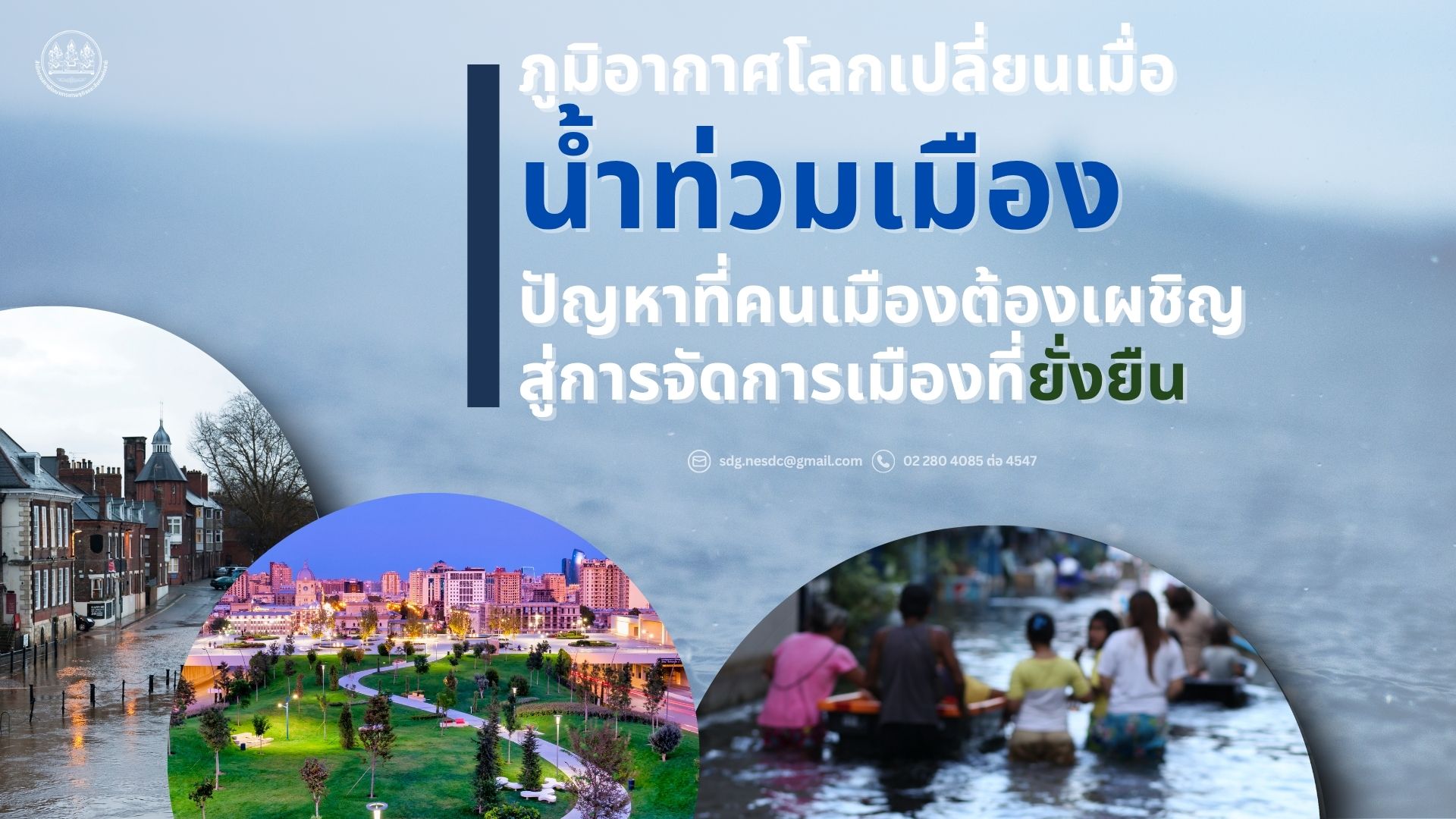
Flooding is a condition that the world is currently facing, especially in urban areas. The impacts of urban flooding are becoming increasingly severe and widespread due to urban expansion and intensifying global warming. Currently, flooding is considered one of the most frequent disasters and is most closely linked to climate change. Weather conditions are becoming more variable and severe, resulting in rising sea levels due to melting glaciers. If cities do not have effective response measures or fail to address problems at their core, this will result in recurring flood problems, and the severity of flooding may intensify further, with damage potentially increasing tenfold by 2050 . Many cities around the world have attempted to adapt and develop their cities to reduce impacts on urban residents and create sustainable urban ecosystems capable of coping with changing environments.
Causes and Characteristics of Urban Flooding
Urban flooding severity and causes vary according to geographical location, terrain characteristics, or ineffective water management systems. For example, in 2005, New Orleans experienced flooding due to Hurricane Katrina. In 2011, Bangkok experienced flooding because the Chao Phraya River water management system could not accommodate the increased water levels in the city. In 2021, Jakarta experienced flooding due to continuous heavy rainfall. These events have affected hundreds of lives.
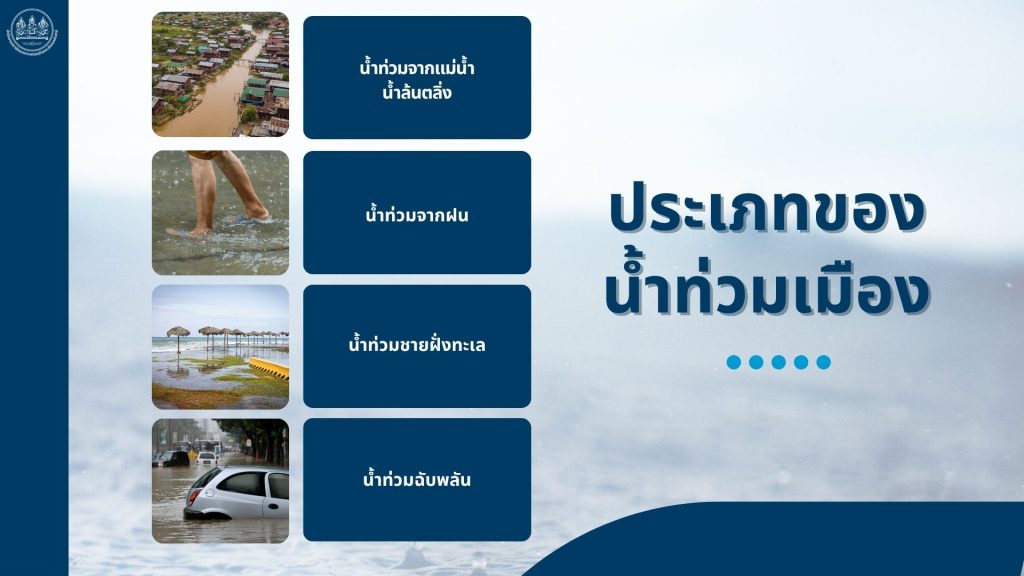
The causes and characteristics of urban flooding have important variables including geographical differences with varying elevations. This can be observed in Bangkok, which is a low-lying coastal area with a basin-like topography, making it prone to waterlogging. Besides different terrain characteristics, local monsoons, natural disasters occurring in the region, as well as water management efficiency and urban development patterns, effective waste management all affect the severity, duration, and patterns of urban flooding. The Urban Flood Risk Handbook: Assessing Risk and Identifying Interventions prepared by The World Bank classifies urban flooding into 4 types:
1. River flooding or overflow caused by ineffective water capacity and flood protection during high discharge periods, resulting in overflow flooding into urban areas.
2. Pluvial flooding caused by insufficient urban drainage system capacity during the rainy season
resulting in flooding in urban areas.
3. Coastal flooding caused by storm surge flooding low-lying areas during storms, resulting in urban flooding.
4. Flash flooding caused by sudden water rise due to heavy rainfall from adjacent highland areas or overflow from dams or dam failures.
Impacts of Urban Area Flooding
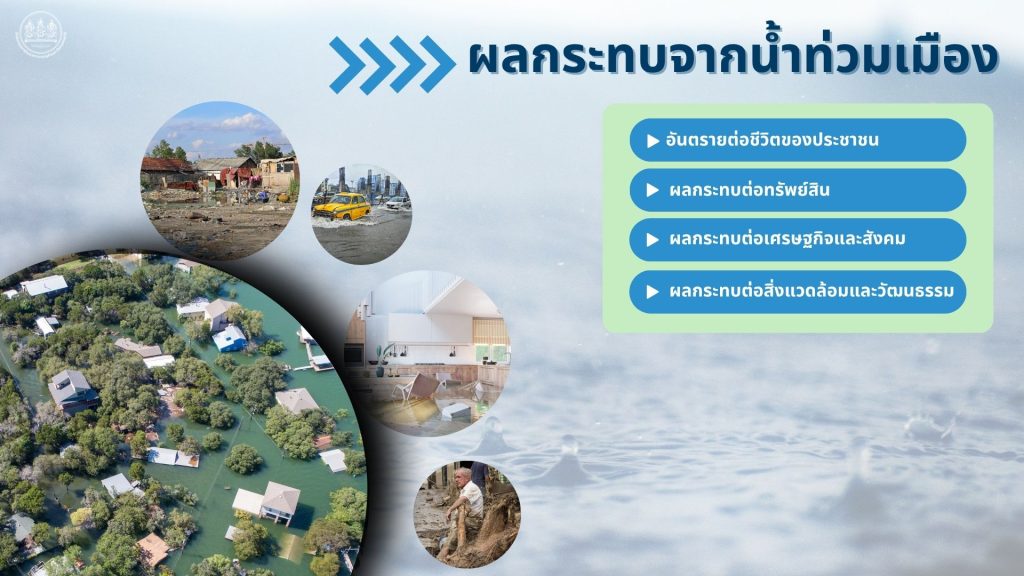
The impacts of urban flooding, the level of damage or severity, depend on the differences in location and diverse activities in urban areas that may affect the resulting damage, causing the following impacts:
1. Danger to public life may cause injury or health impacts from flooding with severe water flow rates, and impacts on residential areas where people are forced to evacuate due to severe and prolonged flooding.
2. Property impacts occurring directly to structures such as houses, markets, schools, public utilities, and various infrastructure such as bridges, or impacts on agricultural products and industrial sectors, various factories.
3. Economic and social impacts causing economic activities to halt, such as loss of energy sources, clean water storage being affected, difficult and limited area access, job losses, and increased food shortages.
4. Environmental and cultural impacts including toxic substance leaks affecting the environment, such as oil, and damage to historical sites or cultural areas.
The direct impacts of urban flooding that are clearly visible include damage to structures and housing. In the context of Bangkok, another clear impact is the effect on public health due to contaminated floodwater in urban areas, which often contains pollutants that affect people in the long term.
Sponge Cities: Successful Models for Urban Development in Low-lying Areas
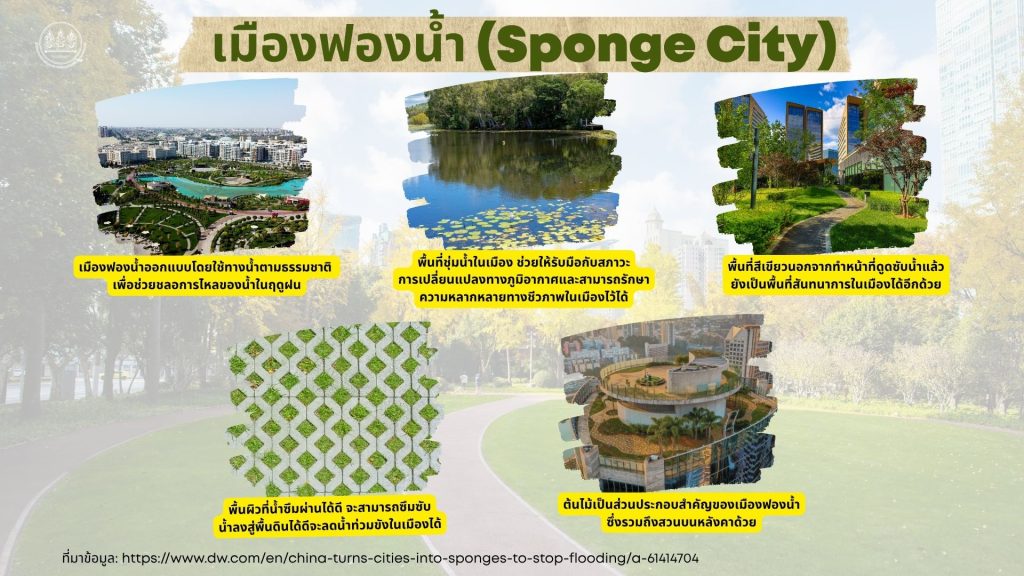
Sponge cities are an urban development concept for sustainable city management, based on the principle of integrating Green Infrastructure with Grey Infrastructure and Blue Infrastructure, combining engineering and non-engineering approaches. Green infrastructure development is a nature-based solution approach, utilizing the capacity of green areas to store water and slow down water flow intensity to make urban flood risk management easier, such as mangroves, forest areas, small shrubs, or including green roof gardens. Grey Infrastructure involves construction in the form of structures or installation of equipment or tools, such as reservoirs, embankments, drainage pipes, water pumps, and underpasses. Blue Infrastructure refers to infrastructure using water elements, such as retention ponds and wetlands.
Sponge cities can solve problems from urban areas that cannot absorb water, which causes flash floods or waterlogging. Creating cities using environmental design approaches, such as wetlands and rain gardens, serves as a system to slow flash floods from storm rain. Installing permeable areas designed to absorb, store, and drain rainwater into the ground, or converting it for rainwater reuse, is another method that can preserve groundwater.
Wuhan City in China is considered a city that has successfully transformed into a sponge city. During the heavy rainfall event in the 2020 rainy season, considered the heaviest rainfall of the century lasting 42 days, Wuhan was able to cope without experiencing severe flooding like other cities in the southern provinces, and not as severe as past events. Wuhan demonstrated success in controlling flooding and urban waterlogging, transforming from a low-lying city below the Yangtze River flood level with long monsoon seasons, which was one of the cities with waterlogging problems, water pollution from urbanization affecting sewage and stormwater drainage systems that were mixed and incorrectly connected, causing impacts on wastewater management and allowing sewage to be discharged into urban canals, becoming polluted and foul-smelling water sources. Additionally, there were problems with excessive groundwater pumping and urban heat island phenomena. These problems were addressed through efficient urban management, developing water management and flood prevention systems based on ecosystem-conscious urban planning design, such as creating 166 lakes to store water during floods. Wuhan adopted principles of building grey infrastructure for flood prevention and water control, such as constructing embankments to prevent external water from flooding in, repairing pipes and water pumps to maintain efficient drainage. Green and blue infrastructure helped reduce waterlogging by reducing water volume through infiltration and storage, reducing stormwater drainage and pressure in urban drainage pipes. Wuhan’s sponge city project also used non-engineering strategies for management, implementing management measures focusing on regular maintenance of pipes and pumping stations, and emergency status alerts to enable citizens to cope with disasters, reducing loss of life and property.
Copenhagen following the heavy rainfall event in 2011, Copenhagen developed an urban flood management plan called the Cloudburst Management Plan, which is another example of a sponge city. This project aims to address flooding from heavy rainfall and variable weather conditions from global warming by creating a network of permeable streets, green spaces, retention ponds, underground reservoirs that store rainwater or divert water. Streets were improved using the “Blue-Green” concept, where streets become waterways for water to flow through, draining excess water to designated water storage areas such as parks or ponds for temporary water storage. These green areas become recreational spaces during dry seasons for relaxation and activities for urban residents, creating value for the city and adding green spaces and biodiversity to urban areas. This is coupled with creating giant underground tunnel systems to accommodate rainwater volume and enhance the capacity of stormwater drainage systems separate from sewage pipes.
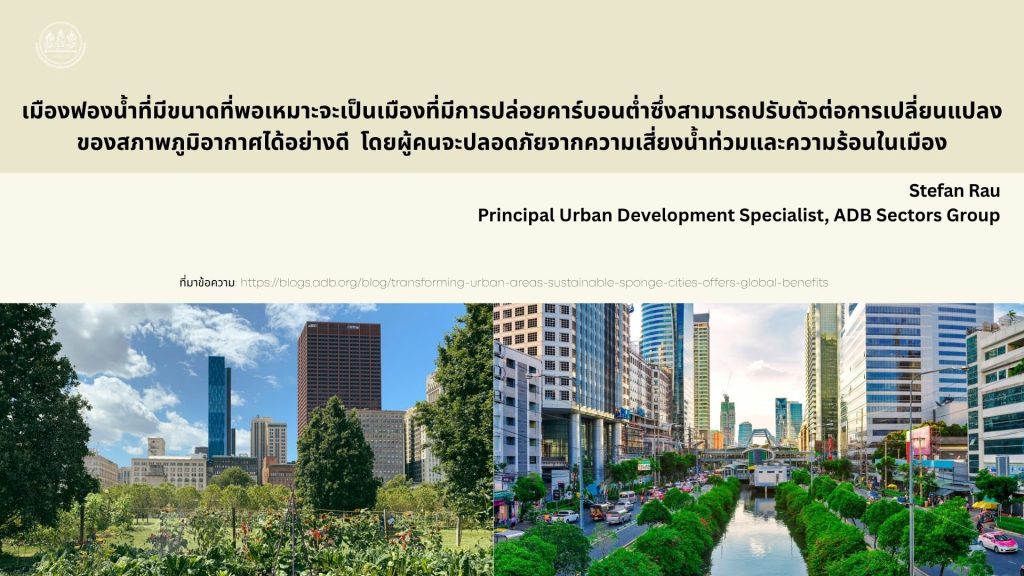
Sponge cities represent a form of sustainable urban development alongside gradually addressing flood problems based on nature combined with efficient urban infrastructure systems for water management to reduce urban flood risks, and creating green spaces or forest areas for cities that, besides addressing waterlogging problems, also help reduce heat problems and provide mental health benefits for urban residents.
Examples of Sponge City Implementation in Thailand
Bangkok and surrounding areas frequently experience urban flooding due to heavy rainfall events and high tides from storm surge, combined with waste management problems and inefficient drainage systems, resulting in widespread urban waterlogging that significantly impacts urban life. Bangkok has therefore implemented the Green Bangkok 2030 project, a policy to increase green spaces in Bangkok, aiming to increase green space to 10 square meters per person by 2030, including increasing public green spaces accessible within 400 meters and increasing urban tree canopy, and the million tree planting project for trees to care for the city. Moreover, green spaces will function as water absorption areas, helping prevent soil erosion and slowing water flow into the city.
The Ministry of Interior through the Department of Public Works and Town & Country Planning has included sponge city development in the national policy plan, identifying 9 target areas for sponge city development, comprising 1 National City: Bangkok, and 8 Regional Cities: Nonthaburi, Chiang Mai, Phitsanulok, Khon Kaen, Nakhon Ratchasima, Pattaya, Phuket, and Hat Yai. This is currently in the public consultation phase for the national policy plan preparation. Once completed, it will be presented to the National Urban Planning Policy Committee to implement this national policy plan for concrete urban development.
The Office of the National Economic and Social Development Council in collaboration with the Asian Development Bank (ADB) is preparing a draft framework for sponge city design guidelines for Thailand for urban resilience, focusing on participating cities: Phra Nakhon Si Ayutthaya Municipality, Phitsanulok Municipality, Khon Kaen Municipality, Surat Thani Municipality, and Bangkok to present draft concept proposals for developing sponge city concepts more suitable to each city’s potential and readiness. Investment feasibility will be considered from project proposals to lead to concrete program/project development.
Conclusion
Creating Bangkok or other cities in multiple provinces as sustainable sponge cities may require high initial investment costs, but in the long term, these cities will become environmentally sustainable, creating good quality of life for urban residents. Sponge city design not only reduces urban waterlogging problems but also enables people to live with higher quality of life, reducing health problems, water and air pollution, urban heat problems, and creating a positive city image that can attract tourists. Implementing sponge cities as models for developing various cities in Thailand may require adapting successful urban development approaches or plans to suit the context, problems, and complex conditions of each province. Developing cities into sponge cities requires cooperation and support from multiple sectors, including government, private sector, civil society, academics, local government organizations, or stakeholders participating in collaborative city design that is appropriate in terms of physical aspects, impacts, or benefits and costs for sustainable cities.
Strategy and International Cooperation Coordination Division
National Economic and Social Development Council
References
Celeste Barragan. (2024). Sponge Cities Explained. Retrieved from https://urbandesignlab
.in/sponge-cities-explained/?srsltid=AfmBOoq945eNwt7w5Mjw9ns6bsqOcxho6
eZuqGgfTGGAzUPmi-y5SyKF
The World Bank. (2023). Urban Flood Risk Handbook: Assessing Risk and Identifying Interventions. Retrieved from https://documents.worldbank.org/en/publication/documents-reports
/documentdetail/099080123151036528/p1744620efe1180a20bc1b0ce287e74ff91
UN Thailand. (2022). Causes and Impacts of Climate Change. Retrieved from https://thailand.un.org/en
World Bank Group. (2025). Technical Deep Dive on Urban Flood Management: Leveraging Infrastructure and Nature-Based Solutions for Flood Management. Retrieved from https://www.worldbank.org/en/programs/tokyo-development-learning-center/tdd/urban_flood_management
World Bank Group. (2025). Urban Flood Management in a Changing Climate ~Global and Japanese insights from Technical Deep Dive on Urban Flood Management~. Retrieved from https://www.worldbank.org/en/programs/tokyo-development-learning-center/tdd/urban_flood_management_in_a_changing_climate_March2025
Yunyue Peng, Kate Reilly. (2021). Using Nature to Reshape Cities and Live with Water: An Overview of the Chinese Sponge City Programme and Its Implementation in Wuhan. Retrieved from https://growgreenproject.eu/wuhan-sponge-city-programme-achieving-harmony-among-people-water-city/
Decharat Sukkamnerd. (2025). Developing Nonthaburi City as a Sponge City. Retrieved from https://think.moveforwardparty.org/article/urban-development/4586/
Thansettakij. (2024). Bangkok Sponge City: A Way of Survival and Coexistence with Rainwater. Retrieved from https://www.thansettakij.com/climatecenter/environment/600992
Thansettakij. (2024). Watch for “Rain bomb” in Bangkok: Sudden Heavy Rainfall. Retrieved from https://www.thansettakij.com/climatecenter/607147
Spring News. (2024). Academics Point Out Worsening Global Warming Causes “Cloudburst” Phenomenon. Retrieved from https://www.springnews.co.th/keep-the-world/climate-change/853514
Spring News. (2024). Getting to Know ‘Rain Garden’: How the US Uses It to Prevent Flooding. Retrieved from https://www.springnews.co.th/keep-the-world/sustainable/852446
Office of the National Economic and Social Development Council. (2024). NESDC Workshop No. 1 “Designing Prototype Sponge Cities for Thailand for Urban Resilience” under the support of the Asian Development Bank (ADB). Retrieved from https://www.nesdc.go.th/ewt_news.php?nid=15950&filename=index
National and Regional Planning Bureau, Department of Public Works and Town & Country Planning, Ministry of Interior. (2025). (Draft) National Policy Plan. Retrieved from http://www.nsplan2580.info/backoffice/uploadFiles/2025-02-21/3c5572ddefc1f5fcc3652e1771d4c4ba1415a29d.pdf
Sumet Ongkittikul. (2024). Building New Cities to be Climate Resilient. Retrieved from https://tdri.or.th/2024/10/tdri-ac-2024-session3/
Athijet Mongkolsol. (2023). Talking with Urban Planners: Why Does “Bangkok” Experience Recurring Floods? Retrieved from https://www.thaipbs.or.th/now/content/1534
Oranicha Plianpakdee. (2024). ‘Sponge City’ Concept for Flood Management in Major Cities Worldwide. Retrieved from https://ngthai.com/environment/74901/sponge-city/
Related Documents