


Amid increasingly severe waves of climate change, the shipping industry that drives over 80% of global trade is facing comprehensive pressure to adapt urgently, to become a concrete part of reducing environmental impact. A critical turning point occurred when the International Maritime Organization (IMO) adopted the goal of net-zero carbon by 2050 – marking the first time the world has a legally enforceable framework at the international level specifically for reducing greenhouse gas emissions from maritime transport. This major transition is happening while maritime trade continues to struggle to recover from various impacts, with global seaborne cargo transport growing only 2.4% in 2023, which is a positive signal after contraction in 2022, clearly reflecting the fragility of this industry sector.
Global shipping networks must now cope with new obstacles that are no longer just monsoons or natural storms, but also include risks arising from strategic tension points such as the Suez Canal and Panama Canal, which are being affected by geopolitical conflicts and climate crises. Particularly droughts that reduce water levels, limiting the number of ships that can pass through each day. When cargo transport is delayed and costs increase, shipping route diversions not only add time and costs but also impact the entire supply chain system, including food security, energy supply, and economic stability of many countries worldwide, especially vulnerable country groups, including small island developing states and least developed countries that have few alternatives for sourcing goods or changing transport channels.
The Review of Maritime Transport 2024 report by the United Nations Conference on Trade and Development (UNCTAD) clearly reflects this situation while calling for urgent measures to strengthen the resilience of the shipping sector in all dimensions, whether it be accelerating the development of sustainable and resilient infrastructure, promoting the use of alternative energy and carbon-reducing technologies, as well as addressing the problem of non-transparent ship registration, which is an obstacle to transparency and sustainability in the global trade system.
“Building sustainable and resilient maritime transport
and preparing for the future of global supply chains
is not merely an option, but a strategic necessity”
— Rebeca Grynspan
This article will explore the future of the global shipping industry facing a critical turning point amid pressures from climate crisis, advancing technology, and global economic volatility, particularly when the International Maritime Organization (IMO) adopts the goal of net-zero carbon emissions by 2050, which is a development that is reshaping the direction of maritime transport and affecting the security of economic systems and supply chains worldwide.
IMO Advances Toward New Regulations with Real Enforcement to Reduce Greenhouse Gas Emissions from Ships
The International Maritime Organization (IMO) is moving beyond declarations of intent toward establishing binding regulations to address greenhouse gas emissions from maritime transport, with the long-term goal of Carbon Neutrality by 2050, which means reducing greenhouse gas emissions to the minimum level until reaching a point where all emissions can be offset. This transformation arises from amendments to MARPOL Annex VI measures in the International Convention for the Prevention of Pollution from Ships, which covers the prevention of air pollution from ships. The new draft regulations were approved at the 83rd meeting of the Marine Environment Protection Committee (MEPC) on April 7-11, 2025, and are prepared for formal adoption in October before taking effect in 2027.

Source: IMO (2025)
These new measures will cover only large commercial vessels exceeding 5,000 Gross Tonnage (GT), which means ships with internal volume exceeding 500,000 cubic feet, measured not by weight but by the total usable space within the ship, including engine rooms, cargo holds, and passenger compartments. Ships of this size are the main force of international transport and account for approximately 85% of total emissions from the maritime transport sector. The core of the Global Fuel Standard is to require qualifying ships to reduce the intensity of emissions per energy used (Global Fuel Intensity: GFI) using well-to-wake[1] calculation methods. If any ship emits above the specified threshold, it must offset excess emissions through the use of surplus units, which can be obtained from ships emitting below the threshold or from pre-accumulated units, as well as Global Economic Measures through contributions to the IMO Net-Zero Fund. Meanwhile, ships using clean technology or near-zero emissions will receive financial benefits, which is a key mechanism for promoting clean energy innovation. Additionally, the International Maritime Organization has established a two-level target structure: Base Target and Direct Compliance Target so that each ship receives assessment according to appropriate criteria and can compare performance at the international level.
[1] The well-to-wake calculation method is one of the greenhouse gas emission measurement standards that covers the complete life cycle of energy, from production source to actual use.
The latest amendments to MARPOL Annex VI measures in the International Convention for the Prevention of Pollution from Ships will be added to Chapter 5 of the convention and will be binding on ships from all 108 member countries, which are countries that register and oversee almost all large commercial vessels in the world, with a combined proportion of more than 97% of global seaborne cargo transport volume in terms of deadweight tonnage or Dead Weight Tonnage (DWT)[2]. The International Maritime Organization’s new policy also aligns with the 2023 greenhouse gas reduction strategy aimed at promoting clean technology and just transition. Mr. Arsenio Dominguez, Secretary-General of the International Maritime Organization, stated during the closing of MEPC 83 that approving this draft is “a significant step in global cooperation to address climate change” and demonstrates that the International Maritime Organization is taking serious action according to its commitments.
[2] Deadweight tonnage or Dead Weight Tonnage (DWT) refers to the maximum capacity that a ship can carry cargo without affecting navigation safety, not the ship’s weight, but the actual transport capacity.
Carbon Reduction and the Turning Point of the Maritime Transport Industry
Maritime transport may not be the largest culprit on the global warming stage, but it cannot be denied that it is responsible for 3% of total global greenhouse gas emissions, which is a notable figure when the world is urgently moving toward energy transition. Despite calls to reduce carbon in the transport sector, the transition to clean energy is still full of obstacles, including high ship upgrade costs, uncertainty about future fuels, and low rates of old ship scrapping.
In 2023, the global commercial fleet grew 3.4%, which, although higher than global trade growth during the same period, still did not reach historical average levels. Entering early 2024, the overall picture of transition to clean fuel use remains in its initial stages. Only 14% of new carrying capacity can immediately use alternative fuels, while another 50% has potential for conversion but has not yet taken serious action. Additionally, in new ship production, East Asia remains the main hub of the global industry, with China, Japan, and South Korea together producing 95% of new ships in the entire market, and in the past year, China was able to become the leader in production capacity delivery for the first time. Although the fleet continues to expand, volume growth still cannot compensate for delayed environmental adaptation. If the industry continues at the same pace, it may face increased costs from delayed improvements, as well as stricter government control measures and pressure from customers who have turned to prioritize sustainability as the main factor in service selection. These factors are becoming key variables that will determine long-term competitiveness.
To drive the industry toward serious carbon reduction pathways, UNCTAD has proposed key approaches including investment in alternative fuel technology, establishing strong regulatory frameworks, and allocating economic incentive measures to stimulate low-carbon shipbuilding and improve old ships for greater efficiency.
New Risks of Shipping in a Changing World
Global shipping today faces new risks that are more complex from both geopolitical problems and climate change that affect the stability of international trade and add challenges to global supply chains. One significant risk is disruption of important shipping routes, causing route changes that require more time and higher costs than before. Route blockages such as the Suez Canal and Panama Canal force cargo transport through longer routes like the Cape of Good Hope, which increases shipping distances and transport costs including fuel costs, insurance premiums, and ship charter rates, while also increasing greenhouse gas emissions from maritime transport with longer distances. For example, the 89% increase in Cape of Good Hope voyages increased global ship carrying capacity demand by 3% and container ship demand by 12%, making international trade more difficult and resulting in instability in various regions such as tensions in the South China Sea affecting long-term cargo transport. Maritime cargo transport thus faces challenges in maintaining supply chain stability and global economic security.
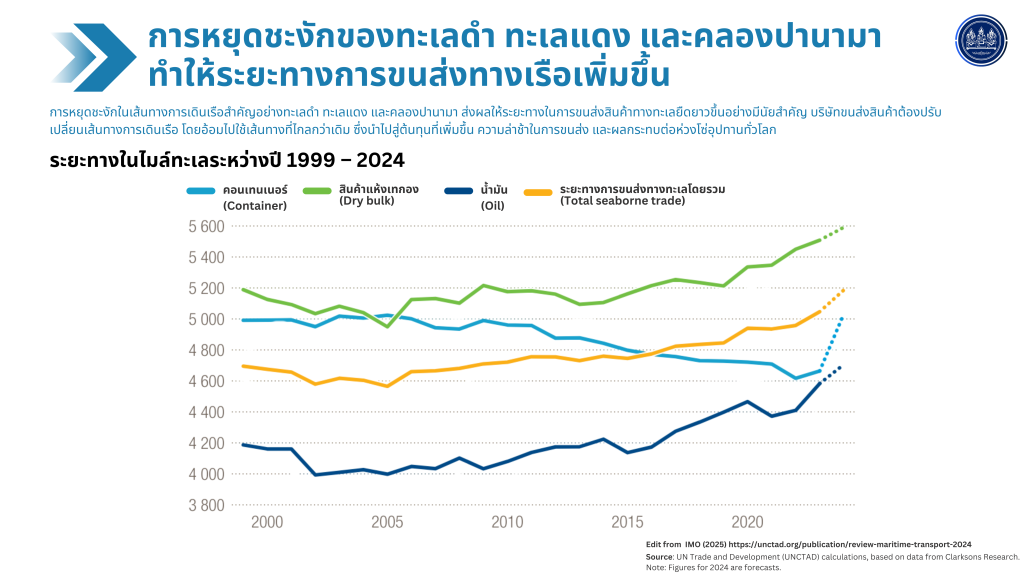
Source: UNCTAD (2024)
To manage risks arising from shipping and impacts from geopolitical conflicts and climate change, particularly strengthening international cooperation to create resilience and stability in global supply chains, UNCTAD has proposed key approaches including investment in resilient infrastructure, diversification of shipping routes, increased international cooperation, support for intraregional trade, as well as support for developing countries that are small islands and least developed countries.
IMO Net-Zero Fund and Efforts to Create Fairness in Transition
In a world where transition to clean energy is an unavoidable necessity, the International Maritime Organization has advanced to create a new mechanism called the IMO Net-Zero Fund to create fairness in addressing greenhouse gas emission reduction in the shipping sector. The heart of this fund is to use money from collecting fees based on the pollution emission levels of each ship to support various sectors involved in the transition. Fund revenues will be allocated with specific goals to reward ships that emit low levels of greenhouse gases, which incentivizes businesses to adopt more clean technology, support research and development, infrastructure, and green innovation especially in developing countries that still have limitations in resources and technology, promote technology transfer and personnel training to strengthen each country’s capacity in line with the International Maritime Organization’s greenhouse gas reduction strategy, and importantly help mitigate economic impacts on vulnerable countries such as small island developing states and least developed countries that may be affected by increased transition costs.
Establishing the IMO Net-Zero Fund is not merely creating a new funding source, but also reflects the concept of climate justice that recognizes the differences in each country’s capacity to face change. This is one of the International Maritime Organization’s important efforts to make maritime pollution reduction comprehensive, equitable, and leave no one behind.
A New Wave of Inflation May Be Forming from the Middle of the Ocean
In mid-2024, global economic recovery faced pressure from rapidly rising maritime transport costs, whether from port congestion, changed shipping routes, and increased operating costs, becoming new pressure reflected through global commodity prices, showing that a new wave of inflation may be forming from the middle of the ocean. For example, the Shanghai Containerized Freight Index (SCFI) increased more than double compared to late 2023, resulting from longer journeys, increased fuel consumption, and insurance premiums that surged with shipping route risks. What is concerning is the ripple effect from costs that are pushing global consumer goods prices upward. UNCTAD estimates that if the situation continues through 2025, global commodity prices will increase an average of 0.6% from transport costs alone, with small island developing states facing price increases of up to 0.9% by 2025, and in processed food categories where costs may surge up to 1.3%, which not only undermines purchasing power but also signals long-term food security risks.
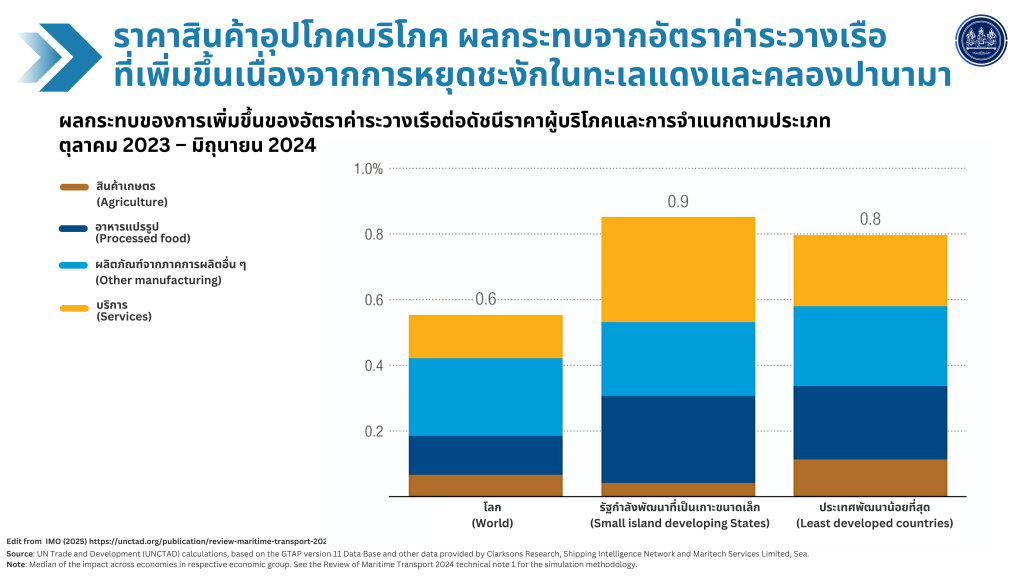
Source: UNCTAD (2024)
From January to July 2024, several international shipping routes began sending clear warning signals that costs were continuously rising, such as the Shanghai-South America route with average costs reaching $9,026 USD per TEU[3], the highest figure since September 2022. This is not the only route affected; the Shanghai-South Africa route also increased nearly 3 times to $5,426 USD per TEU, while the Shanghai-West Africa route jumped 137% to $5,563 USD per TEU, the highest level since August 2022. These increased costs are not just figures in operators’ ledgers, but are being reflected through commodity prices that consumers encounter in shops, supermarkets, and local markets worldwide. When transport costs rise, producers inevitably pass these burdens to the final destination: consumers.
[3] TEU stands for Twenty-foot Equivalent Unit, referring to a measurement unit for container volume with a length of 20 feet, which is the standard in the maritime transport industry.
To cope with pressure from rising maritime transport costs, UNCTAD has proposed key approaches including upgrading cargo transport data monitoring systems for accuracy and timeliness to better understand international cost market dynamics, while proposing that governments use targeted policy measures to help mitigate impacts on particularly vulnerable countries. It also emphasizes promoting global cooperation to strengthen supply chains, reduce cost volatility, and create a global trade system resilient to crises, as well as building regional international cooperation to help reduce dependence on long-distance transport routes and open pathways for intraregional trade growth amid uncertainty.
Sustainable Solutions Lie in Investment in Technology and Port Infrastructure
Port improvement and trade facilitation are key factors that help shipping industry operations maintain efficiency amid increasing challenges, particularly reducing port congestion and increasing cargo transport efficiency. Digital technology development such as Blockchain and Artificial Intelligence (AI) has played important roles in managing ship berthing and helping port management become more efficient, reducing waiting time for berthing and increasing cargo tracking accuracy, enabling handling of higher transport volumes while reducing climate risks that affect port operations.
To achieve sustainable adaptation and cope with risks from climate change, UNCTAD has proposed key approaches including developing climate-resilient infrastructure, investing in digital technology and expanding domestic passenger terminals to distribute workload and increase cargo transport efficiency. Promoting public-private cooperation is also another important mechanism for creating port system resilience to withstand pressure from natural disasters and future uncertainties. Accelerating structural improvements thus not only helps reduce costs and increase competitiveness, but also serves as an important foundation for maintaining supply chain continuity amid unpredictable changes.
The Shipping Industry on the Path to Sustainability
When the International Maritime Organization (IMO) officially announced adoption of the goal of net-zero carbon emissions by 2050, the direction of the global shipping industry changed permanently. Long-distance travel with fossil fuels is about to become history. Although there are no rigid requirements for what each country must do, with clear timeframes and challenging goals, no one can ignore this change. What everyone is watching is no longer just the number of ships or volume of cargo that can be transported, but the actual carbon reduction rate in each ship, every shipping route, and every related port. The future of this industry will no longer be measured by speed or size, but will be measured by the ability to adapt to net-zero goals that everyone knows are unavoidable. Shipping is thus no longer just logistics infrastructure, but is becoming an important arena for energy innovation and truly the heart of the world’s structural transition.
Strategy and International Cooperation Coordination Division
Office of the National Economic and Social Development Council
References
IMO. (2025). IMO approves net-zero regulations for global shipping. Retrieved from https://www.imo.org/en/MediaCentre/PressBriefings/pages/IMO-approves-netzero-regulations.aspx
IMO. (2025). Marine Environment Protection Committee (MEPC 83) – Closing remarks. Retrieved from https://www.imo.org/en/MediaCentre/SecretaryGeneral/Pages/MEPC-83-Closing-remarks.aspx
UNCTAD. (2024). Review of Maritime Transport 2024. Retrieved from https://unctad.org/publication/review-maritime-transport-2024
United Nations. (2023). Global shipping poised to get new emissions-fighting strategy. Retrieved from https://news.un.org/en/story/2023/07/1138317
United Nations. (2025). Countries reach historic deal to cut shipping emissions. Retrieved from https://news.un.org/en/story/2025/04/1162176
Related Documents