
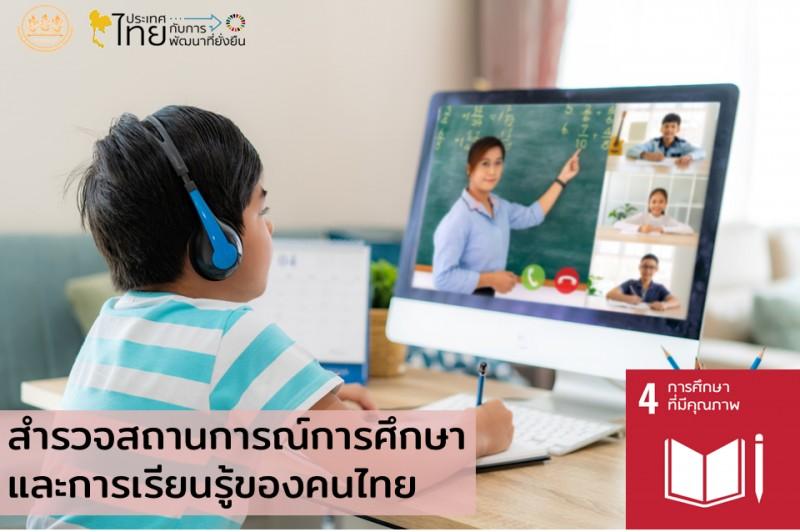

Education is a crucial component in national development. Universal access to education helps elevate economic growth, bridge social gaps, create equity, and reduce inequality in all dimensions. Sustainable Development Goal 4 therefore focuses on ensuring that boys and girls can access education from early childhood to secondary education free of charge, have equitable access to quality higher education, and that people of all ages receive opportunities to access appropriate and equal vocational skills training.
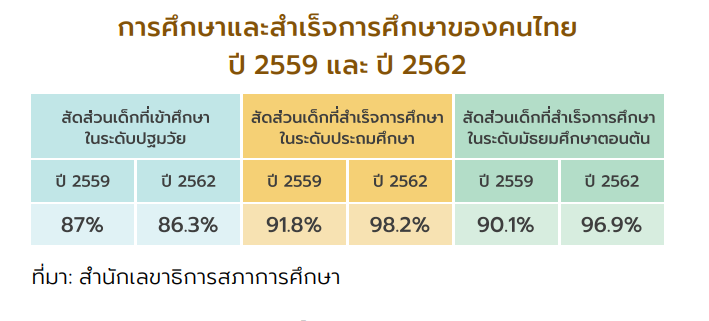
Overall, access to education and educational attainment among Thai people has shown an upward trend, with the proportion of children entering early childhood education increasing from 84.7% in 2016 to 86.3% in 2019. At the primary and lower secondary education levels, completion rates increased from 91.8% and 90.1% in 2016 to 98.2% and 96.9% in 2019, respectively. Additionally, gender equality in educational access in Thailand has improved, as reflected by the Gender Parity Index (GPI), which has shown positive trends across all educational levels since 2016.
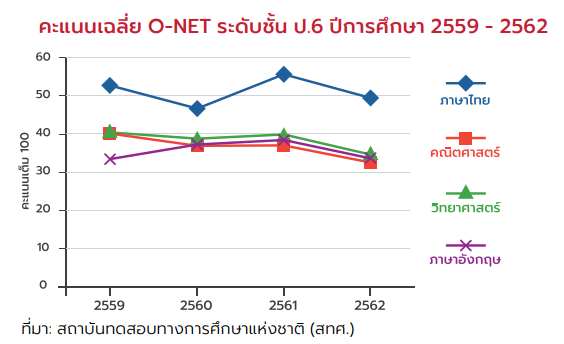
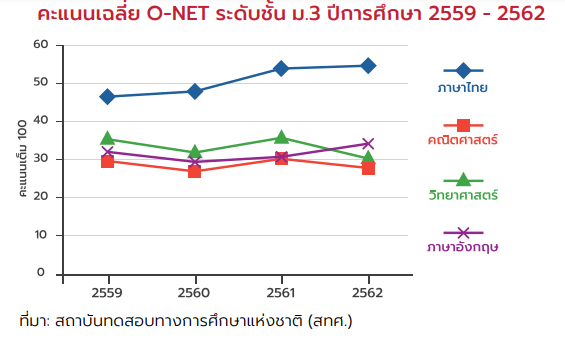
However, educational achievement among Thai children has shown a declining trend, as evidenced by the Ordinary National Educational Test (O-NET) scores. In 2019, the average scores for Grade 6 primary and Grade 3 secondary students were below 50 points in almost all subject areas. Grade 6 primary students showed declining average scores in all subjects compared to 2016, while Grade 3 secondary students showed improved average scores in Thai and English but declined in mathematics and science.
Educational inequality is also a result of disparities in other dimensions, such as limitations in accessing educational infrastructure and information technology, geographical remoteness, and economic inequality, which remain causes of “dropping out of school,” leading some children to become disconnected from education and potentially fall out of the education system entirely. The COVID-19 pandemic has also impacted children and youth from low-income families, who face higher costs from online learning, as well as learning loss in social and academic skills.
To address these issues and enhance access to quality education, the government has promoted educational opportunities for all age groups through programs supporting educational expenses from kindergarten through basic education, programs expanding opportunities for persons with disabilities, lifelong development programs, and programs creating opportunities and reducing educational inequality at the local level.
Additionally, efforts have been made to develop education systems, curricula, and teaching materials to be modern and high-quality, such as STEM Education to enhance analytical thinking and problem-solving skills for learners, programs promoting research activities for learning processes based on research, and programs elevating management through educational innovation zones to create flexibility for educational institutions in developing curricula that align with the economic, social, and cultural environment of their localities. Furthermore, information technology has been integrated into teaching and learning to align with the 21st-century context, such as establishing Thai MOOC as a platform supporting lifelong learning for both school-age and out-of-school individuals to accommodate reskilling/upskilling according to the rapidly changing global dynamics, including educational innovations necessary during the COVID-19 pandemic.
For future educational advancement, relevant sectors need to allocate educational resources fairly and focus on reducing inequality by emphasizing social security through measures that align with current situations and contexts. They should accelerate the development of educational opportunities to enable people of all genders and ages to access education conveniently anywhere and anytime. Additionally, they should continuously develop the potential of educational personnel, transform the role of teachers to enable them to fully develop learners’ basic competencies, promote the distribution of educational resources in terms of teacher allocation and support for teaching tools that are appropriate and necessary for each area, and accelerate the development of digital infrastructure and digital skills in teaching and learning for educational personnel.
Furthermore, relevant sectors should coordinate systematic assistance to target groups through developing efficient connections between various database systems, analyzing data in dimensions related to learners, especially vulnerable groups comprehensively, to truly identify needs that align with target groups and appropriately address learning loss and educational dropouts.
SDG 4 Issues Requiring Urgent Action

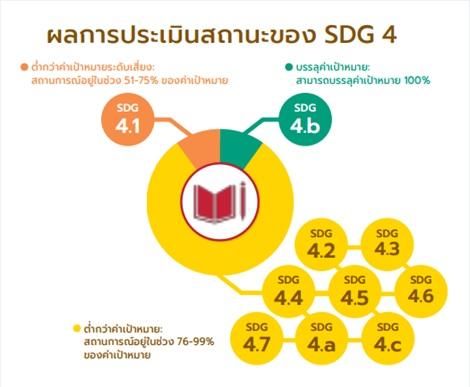
The assessment of Thailand’s SDG 4 progress between 2016-2020 found that it remains below target levels, with success rates ranging from 76-99% of target values,
indicating a yellow status.
The overall status of SDG 4 is yellow because there are as many as 9 sub-targets out of 10 total sub-targets that are below target levels.
There are 8 sub-targets with implementation status below target levels in the range of 76-99% (SDG 4.2, 4.3, 4.4, 4.5, 4.6, 4.7, 4.a, and 4.c), indicated in yellow. Sub-targets below target levels at risk level, indicated in orange, have status below target levels in the range of 51-75%, numbering 1 sub-target: SDG 4.1 – Ensure that all boys and girls complete free, equitable, and quality primary and secondary education leading to relevant and effective learning outcomes by 2030.
Strategy and International Cooperation Coordination Division
National Economic and Social Development Council
Related Documents