


Amid the increasingly severe climate crisis, groups with direct experience and knowledge of living in harmony with nature are being neglected in decision-making processes, even though these issues directly impact their own way of life.
Indigenous peoples, who were once relegated to being mere observers, are beginning to emerge in new roles as leaders of change in international policy forums. This social phenomenon reflects the structural transformation that is taking place. This article invites exploration of the changing role of indigenous peoples through movements in major global forums, tracking developments in various important conventions, legal reforms in many countries that are beginning to open space for traditional wisdom, as well as approaches to strengthening indigenous peoples in the Thai context.
The Role of Indigenous Peoples: Transition from Observers to Leaders of Change
Amid the intensifying climate crisis, the world is reconsidering knowledge and wisdom that has long been neglected, particularly from indigenous peoples who have deep relationships with nature. Although indigenous peoples comprise only 6% of the world’s population, they care for up to 80% of biodiversity areas. However, they are excluded from decision-making processes on issues that directly affect their lives and territories.
The relationship between indigenous peoples and land is not merely about ownership rights, but is the foundation of life, culture, and spirituality. Knowledge accumulated over many generations is not only a way of life, but also an important mechanism for maintaining ecosystem balance sustainably. Expertise in natural resource management arising from direct experience and close observation enables indigenous peoples to have practices that effectively align with biodiversity conservation.
The 6th report of the United Nations on the State of the World’s Indigenous Peoples (State of the World’s Indigenous Peoples, Volume VI, Climate Crisis) confirms the important role of indigenous peoples at the forefront of environmental protection. However, this recognition is not yet reflected in the level of genuine policy participation. This power inequality points to deficiencies in global mechanisms for effectively managing the climate crisis.

Image source: CBC (2017)
The statement by Aluki Kotierk, President of the 24th Session of the UN Permanent Forum on Indigenous Issues, reflects the existing injustice. The fact that those with direct experience become mere observers reinforces top-down power structures that are inconsistent with the complexity of the problem. While the world rushes to address global warming, those directly affected have limited participation in policy. This both violates rights and blocks opportunities to develop sustainable solutions.
The interesting question is how much space do global decision-making mechanisms open for voices from the margins, and why are ecosystem guardians still not truly recognized? These questions challenge the traditional development paradigm that focuses only on economic growth while neglecting social and environmental dimensions. Change is therefore not merely increasing the number of indigenous peoples’ participation, but qualitative transformation in their role from observers to policy makers, which may be key to restoring the balance of a world facing climate crisis.
Indigenous Peoples Are Negotiating for Seats in Global Policy Forums
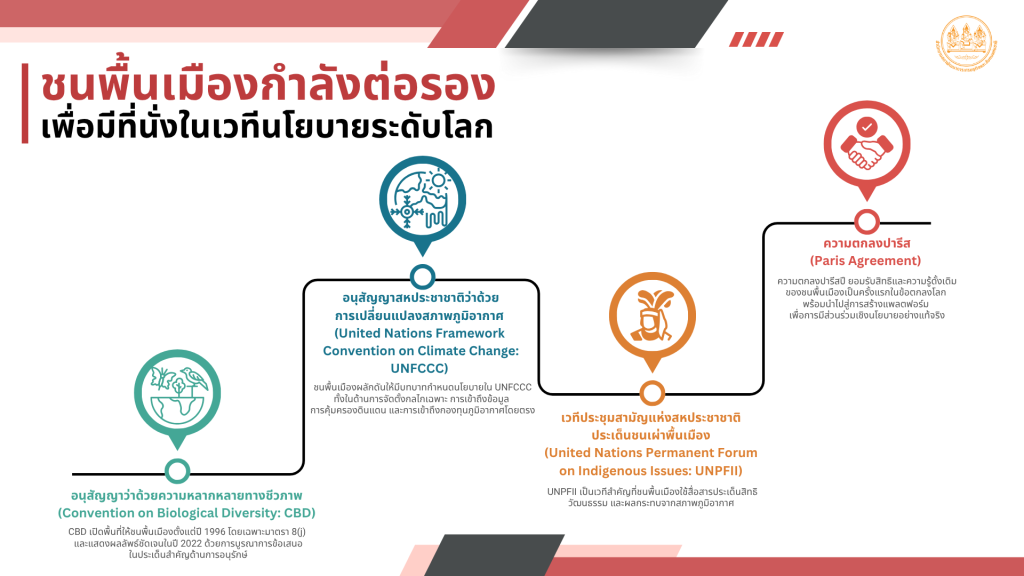
Although indigenous peoples are limited to being mere observers in many international forums, indigenous peoples continue to fight for the right to participate in determining policies that directly affect their way of life and territories. The UN Declaration on the Rights of Indigenous Peoples emphasizes “the right to self-determination, participation in state affairs, and the right to negotiate” as indigenous peoples attempt to create their own space and voice in several important forums, as follows:
1. Convention on Biological Diversity
(Convention on Biological Diversity: CBD)
Opened space for indigenous peoples to participate since 1996, particularly Article 8(j) which emphasizes respect for and maintenance of local knowledge. The success of the Kunming-Montreal Global Biodiversity Framework in 2022 reflects the integration of indigenous peoples’ proposals on participatory conservation area management, the principle of free, prior and informed consent, as well as access to financial mechanisms.
2. United Nations Framework Convention on Climate Change
(United Nations Framework Convention on Climate Change: UNFCCC)
Indigenous peoples have attempted to elevate their role from observers to key participants in policy through establishing specialized working groups, creating positions in the secretariat, and supporting information, capacity building, as well as protection of territorial areas and climate impact assistance funds that indigenous peoples can access directly.
3. United Nations Permanent Forum on Indigenous Issues
(United Nations Permanent Forum on Indigenous Issues: UNPFII)
An important space where indigenous peoples reflect economic, social, cultural and human rights issues through reports and monitoring of issues such as land rights, education, health, and climate impacts.
4. Paris Agreement
The COP21 meeting in 2015 was an important milestone where indigenous peoples succeeded in pushing for their rights to be mentioned in the preamble and recognizing the value of traditional knowledge in Article 7, which is an important database for climate change adaptation. This success resulted from the advocacy of the International Indigenous Peoples Forum on Climate Change (IIPFCC) comprising over 300 organizations, giving indigenous peoples increased influence in international negotiations and leading to the establishment of the Local Communities and Indigenous Peoples Platform for sharing knowledge, capacity development, and promoting genuine participation in policy making.
Laws in Many Countries Are Beginning to Open Pathways for Indigenous Peoples to Play Roles in Environmental Management
Laws in many countries are beginning to open pathways for indigenous peoples to play important roles in environmental management, particularly in natural resource and environmental management issues. The concept of viewing indigenous peoples as policy co-determiners is gaining increasing recognition, with Latin American countries leading notable changes.
Bolivia The 2012 Framework Law of Mother Earth and Integral Development for Living Well recognizes indigenous concepts and promotes cross-cultural knowledge exchange, creating regional forums that elevate the voices of traditional communities from being viewed as alternatives to becoming key to sustainable development.
Peru introduced the 2018 Framework Law on Climate Change that emphasizes recognition of local wisdom in addressing the climate crisis. This law recognizes indigenous peoples’ rights to benefit from greenhouse gas reduction projects and creates participation mechanisms through roundtables to address climate-induced migration.
Chile is the latest interesting case with the 2022 Framework Law on Climate Change that emphasizes serious consultation with indigenous peoples and elevating participation to concrete form.
As the world moves toward recognizing the role of indigenous peoples as sustainable ecosystem guardians, laws in many countries that integrate indigenous wisdom as important mechanisms not only help expand cooperation frameworks but also challenge existing power structures that exclude voices from marginalized groups. If implemented seriously, the role of indigenous peoples will become the heart of transition to a more just and sustainable future.
Thailand Begins to Move to Listen to Indigenous Voices at the Policy Level
Thailand is beginning to show awareness in listening to indigenous voices at the policy level, being one of 143 countries worldwide that signed in support of the UN Declaration on the Rights of Indigenous Peoples, reflecting Thailand’s transition in recognizing and respecting the rights of traditional communities that were once neglected. Many indigenous peoples have faced problems of land rights loss, restricted access to resources, and human rights violations. However, they continue to maintain their cultural identity, language, and local wisdom strongly. This knowledge is not only a community resource but also a valuable national treasure, particularly in sustainable natural resource management as stipulated in the 2017 Constitution, Articles 27 and 70, which provide guarantees for equality and protection of ethnic group lifestyles, and also established the Indigenous Peoples Council of Thailand in 2014 to serve as a forum connecting communities, government agencies, and civil society, promoting indigenous peoples’ participation in determining policies related to their lives and territories. Additionally, Thailand has legal-level advocacy, particularly proposing the “Draft Act on Protection and Promotion of Ethnic Group Lifestyles B.E. ….” to recognize the rights of approximately 6 million ethnic population scattered throughout the country with diverse and different cultures, including highland ethnic groups, forest groups, lowland groups, and coastal or island groups.
The promotion of this law responds to 3 important issues: (1) To protect cultural rights by protecting all Thai ethnic groups from violations of their rights to choose to live according to customs and culture, as well as protecting access to basic rights as state citizens (2) To promote ethnic group potential by promoting capabilities, creating participation mechanisms for all ethnic groups to become partners in sustainable national development, and (3) To create equality based on fair equality principles by promoting dignified coexistence, reducing inequality according to sustainable development approaches.
This draft law is therefore an important step in creating guarantees that indigenous peoples and ethnic groups will be able to live with dignity and equality, in terms of civil rights, occupation, access to state services, as well as maintaining their cultural ways of life, consistent with international commitments that Thailand has endorsed. The consideration process of the draft act continues under Senate monitoring through relevant committees to ensure this law can truly respond to the reality of diverse Thai society.
11 Approaches to Strengthening Indigenous Peoples
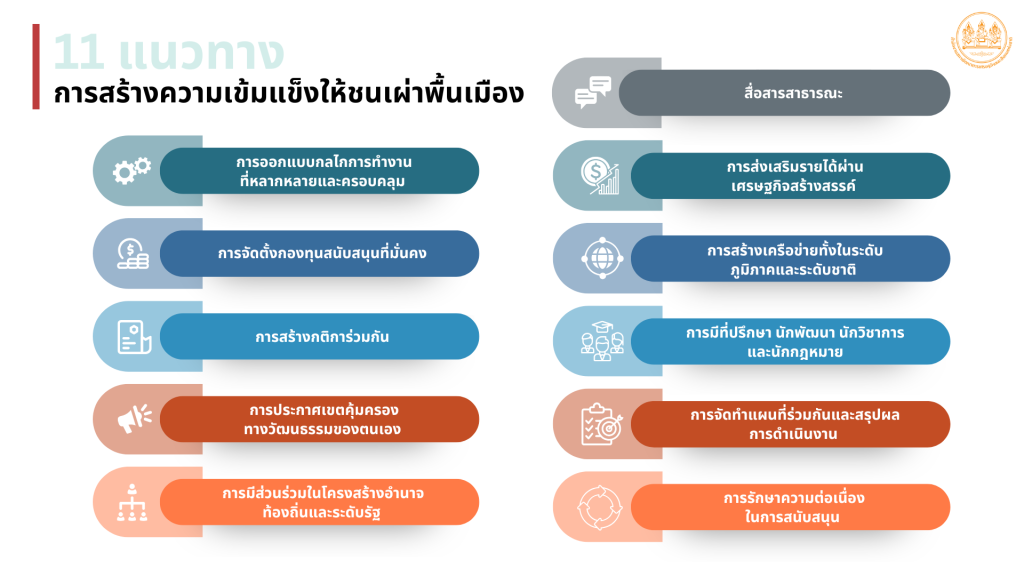
In an era when the world faces challenges of cultural diversity, the National Human Rights Commission has drawn lessons from working with indigenous peoples, presenting a practical framework of 11 approaches aimed at systematically transforming power structures and strengthening community capabilities, as follows:
- Designing diverse and comprehensive working mechanisms that open space for all population groups from youth, women to the elderly to have roles in decision-making processes to determine policies that reflect the needs of all sectors.
- Establishing stable support funds to help communities manage resources efficiently, reducing dependence on external funding sources that come with conditions inconsistent with local contexts.
- Creating common agreements that reflect shared values, vision, and goals to work in unity and reduce internal conflicts.
- Declaring their own cultural protection zones to protect historically and culturally important areas, prevent external encroachment, and strengthen pride in community identity.
- Participating in local and state power structures so that indigenous voices are heard and rights and interests are protected through important positions such as local administrative organizations or community leadership positions.
- Public communication to change social attitudes through presenting stories and ways of life of indigenous peoples, helping reduce prejudice and create alliances.
- Promoting income through creative economy by extending local wisdom to create sustainable income while conserving and reviving disappearing cultural heritage.
- Creating networks at both regional and national levels to increase bargaining power, exchange experiences, and push macro-level policies that are conducive to indigenous development.
- Having advisors, developers, academics, and lawyers to fill knowledge and skill gaps, help interpret laws, plan strategies, and develop complex projects.
- Joint mapping and summarizing operational results is an important process for collecting spatial data and community knowledge for planning, monitoring, and transferring to future generations.
- Maintaining continuity in support because changing social structures and strengthening capabilities is a time-consuming process. Stable and continuous support helps communities develop without interruption.
Integrating all 11 approaches will lead to structural changes that enable communities to truly determine their own future, based on respect for differences and cultural diversity.
Voices That Cannot Be Silenced in Climate Change
This article invites exploration of the overlooked voices of indigenous peoples in the fight against climate crisis, who despite having important roles in nature conservation, have been excluded from the process of determining the world’s future for a long time. We have seen the transition of indigenous peoples from observers to leaders of change in international forums, laws, through negotiation, creating their own voice spaces, and laying new foundations for cooperation that integrates traditional wisdom with contemporary policies. This article therefore not only reveals challenges and hopes but also invites everyone to ask straightforwardly whether we are truly open to listening to them yet in a world where sustainability cannot occur without justice in joint policy making.
Strategy and International Cooperation Coordination Division
National Economic and Social Development Council
References
CBC. (2017). Inuit leaders applaud landmark Supreme Court ruling. Retrieved from https://www.cbc.ca/news/canada/north/inuit-leaders-supreme-court-reaction-clyde-river-1.4223429
United Nations. (2025). Indigenous Peoples sidelined in global climate fight, UN warns. Retrieved from https://news.un.org/en/story/2025/04/1162601
United Nations. (2025). State of the World’s Indigenous Peoples, Volume VI, Climate Crisis. Retrieved from https://social.desa.un.org/publications/state-of-the-worlds-indigenous-peoples-volume-vi-climate-crisis
United Nations. (2025). Challenges faced by Indigenous Peoples, ‘an affront to dignity and justice’. Retrieved from https://news.un.org/en/story/2025/04/1162446
Sawanee Raksawong. (2568). “Watching…Senate Pass Draft Law on Protection and Promotion of Ethnic Group Lifestyles”. Retrieved from https://www.senate.go.th/view/386/News/Highlight/288/TH-TH
Office of the National Human Rights Commission. (2020). August 9 International Day of the World’s Indigenous Peoples. Retrieved from https://www.facebook.com/photo.php?fbid=1614450208714694&id=165027406990322&set=a.165030680323328
Office of the National Human Rights Commission. (2567). “Count Us as People” Demands for Advancing Rights of Ethnic Groups and Indigenous Peoples in Asia, NHRC Thailand Reflects 11 Main Approaches to Making Rights Real, Proposes Reviving Global Agenda “Monitoring Protection and Promotion of Human Rights of Ethnic Groups and Indigenous Peoples”. Retrieved from https://www.nhrc.or.th/index.php/th/NHRC-News-and-Important-Events/9017
Related Documents