

When discussing the impacts of climate change, the first image that comes to mind for many people might be islands threatened by rising seas. However, from another perspective, “highland communities” are equally affected. This article will explore highland areas from a new dimension—not just as mountain ridges or geographically elevated areas, but as strategic zones for water resources, food security, and local culture that are facing rapid changes, from droughts and floods to structural inequality and the vulnerability of border areas. This article not only opens new perspectives on highland areas both globally and in Thailand, but also reveals humanity’s shared challenges along with restoration approaches that are becoming new hope for communities in highland areas.
The Meaning of Highland Areas at Global and National Levels
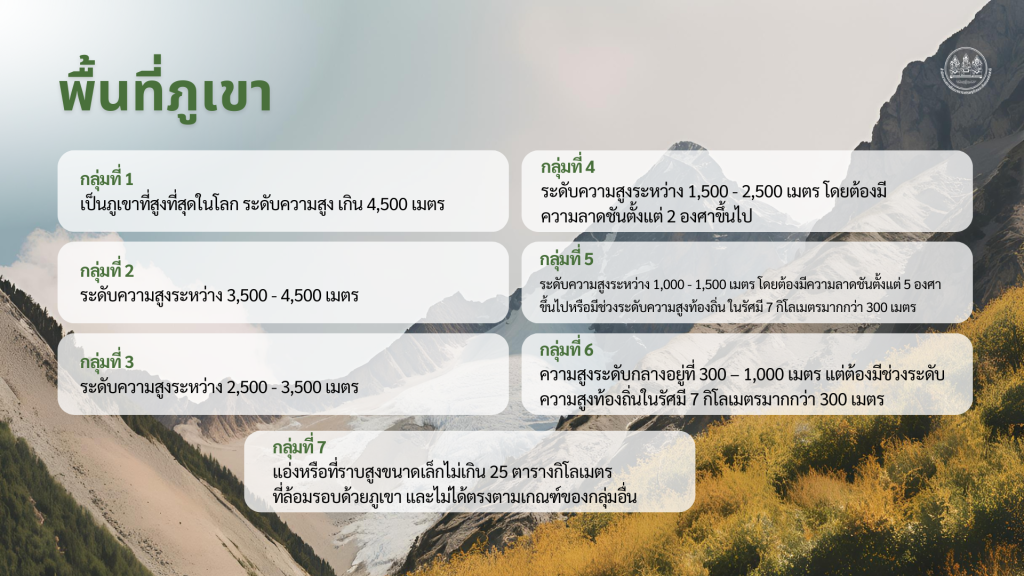
Highland areas do not merely refer to mountains, but are important components of the global ecosystem with diversity in both geographical and social dimensions. The United Nations Environment Programme (UNEP) has classified mountain areas worldwide into 7 main groups based on elevation above mean sea level and topographical characteristics, as follows:
| Group 1 consists of the world’s highest mountains, with elevations exceeding 4,500 meters | Group 4 has elevations between 1,500 – 2,500 meters with slopes of 2 degrees or more |
| Group 2 has elevations between 3,500 – 4,500 meters | Group 5 has elevations between 1,000 – 1,500 meters with slopes of 5 degrees or more, or local elevation ranges within a 7-kilometer radius exceeding 300 meters |
| Group 3 has elevations between 2,500 – 3,500 meters | Group 6 has medium elevations of 300 – 1,000 meters, but must have local elevation ranges within a 7-kilometer radius exceeding 300 meters |
| Group 7 consists of small basins or plateaus not exceeding 25 square kilometers, surrounded by mountains and not meeting the criteria of other groups | |
For Thailand, the term “highland area” has specific legal and developmental meaning according to the Royal Decree Establishing the Highland Research and Development Institute (Public Organization) B.E. 2548, which defines it as areas that are mountainous or have elevations of 500 meters or more above sea level, or are within zones designated by the committee.
Therefore, Thailand’s highland areas may appear to be merely local contexts, but they are part of the global mountain system that is important to the global ecosystem. From steep terrain to biodiversity living in limited areas, these areas play important roles in maintaining water balance, biodiversity, and cultural dimensions rooted in the way of life of ethnic groups in highland areas.
Highland Areas: Global Vulnerability and Thailand’s Challenges
Although highland areas may seem distant, they are strategic points important to the world in terms of natural resources, food security, and quality of life for people worldwide and in Thailand. However, mountains today face more complex and challenging crises than ever before, including climate change, biodiversity loss, soil erosion and degradation. QU Dongyu, Director-General of the Food and Agriculture Organization of the United Nations (FAO), warned that mountain ecosystems are facing pressure from all sides, and these issues are no longer just matters for local communities, but are the responsibility of the entire world.
1. Water from Mountains: A Resource Running Out
Freshwater from mountains was once the source of life, but is now rapidly declining. More than 2 billion people worldwide depend on water from glacial streams and highland waterways for survival, whether for drinking, household use, agriculture, or livestock. Water sources that once flowed continuously are beginning to dry up faster due to climate change. Sustainable highland development is therefore no longer just an environmental issue, but is at the heart of maintaining food security, increasing agricultural productivity, and improving people’s quality of life. All of these are interconnected with the security of upstream water sources that not only sustain billions of lives but also drive the global economy in the long term.
2. Poverty in Highland Areas of Thailand
Looking back before 1969, the lives of people in highland areas of Thailand were filled with hardship. They practiced subsistence agriculture under challenging environmental conditions. Despite assistance efforts through the Royal Project Foundation, poverty remained deeply rooted. The average household income in highland areas was only 193,038 baht per year and 23% still had income below the poverty line. In Royal Project Special Areas specifically, it was found that 73% of the population remained poor and 69% continuously lacked adequate food.
3. Borders, Mountains, and Opium: Still Fragile Security in Thailand
Although opium cultivation in Thailand has decreased in recent years, the silent threat remains. During 2017-2018, 508 opium cultivation plots covering 433.73 rai were found, a 23% decrease from the previous year. However, in Royal Project Special Areas, illegal opium cultivation was still found in 297 plots covering 252.78 rai. The problem persists because if control measures are not strong enough, opium cultivation may return, with high raw opium prices and local demand serving as significant incentives.
4. Forest Degradation, Water Changes, Soil Collapse: Natural Resource Crisis in Thailand’s Highland Areas
Natural resources in highland areas are continuously deteriorating. Land use beyond ecosystem limits has caused Thailand’s forest area between 2008-2013 to decrease by an average of 1 million rai per year, particularly in the northern region, which is an important watershed for the country in the Nan, Ping, and Salween river basins. Subsequent problems include floods, droughts, and soil erosion, especially in sloped agricultural areas or mountains. Complexity increases when some farmers still use large amounts of chemicals, causing contamination in soil and water, affecting producers, consumers, and downstream communities.
Despite being high above sea level, highland areas are overlooked on the global stage
Highland areas worldwide play important roles as sources of freshwater, food, and habitats for diverse species. However, on the global stage, the voices of people living in highland areas are often drowned out by major global issues, particularly climate change.
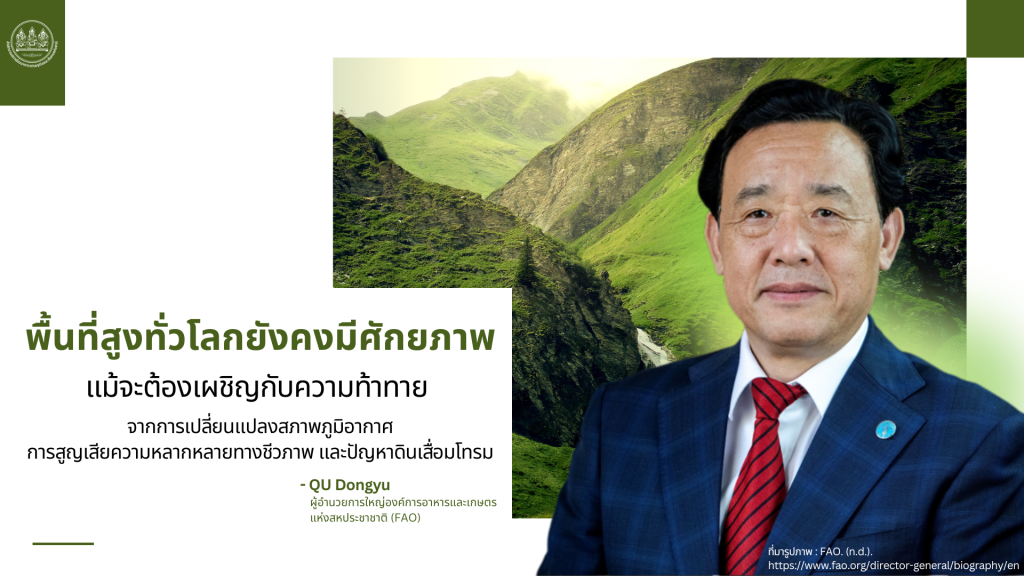
QU Dongyu, FAO Director-General, stated during the Global Mountain Dialogue for Sustainable Development meeting held in Kyrgyzstan that highland areas worldwide still have potential despite facing challenges from climate change, biodiversity loss, and soil degradation problems. He also emphasized that millions of people in mountains are finding it increasingly difficult to access clean water, food, and basic resources, reflecting vulnerability that is intensifying. Although these problems are challenging, opportunities for transitioning to sustainability still exist, particularly through promoting “climate-resilient development” that uses local strengths such as organic food production, local textiles, and ecotourism as tools to create a sustainable future.
Recovery Through Sustainable Agriculture and Conservation Tourism
While many areas are facing impacts from global warming and environmental degradation, many mountain communities are using the crisis as a starting point for transformation, whether through organic farming, sustainable textile production, or opening homes to welcome environmentally conscious tourists. These initiatives not only stimulate local economies but also create long-term security for communities.
One important mechanism that is transforming the lives of highland communities is the Mountain Partnership Products (MPP) labeling project, operated under FAO support. This project focuses on promoting agricultural products and handicrafts from mountains, such as coffee, honey, and high-quality local textiles, through a certification system that emphasizes production sources, fairness in production processes, and the cultural value of each piece.
The MPP label is not just a mark of quality, but a bridge connecting small producers in remote areas with global markets, helping to increase income fairly, expand trade opportunities, and support practices that are environmentally and community-friendly. In some areas, results are becoming clear, particularly in Kyrgyzstan, which has become an example of implementing sustainable development approaches in practice. These projects are creating change for more than 50,000 small producers living in remote mountains.
Driving Mountain Futures: Five-Year Action Plan for Highland Development
Amid the vulnerability of mountain ecosystems and pressure from climate crisis, the world needs clear and strong cooperation frameworks to concretely protect communities living in highland areas. In late 2022, the United Nations General Assembly endorsed the “Five-Year Action Plan for Mountain Development”, effective from 2023-2027, aimed at promoting international community awareness of mountain country problems. To ensure systematic, efficient implementation that addresses mountain-specific challenges, a special task force was established, comprising representatives from the Kyrgyz government, World Bank, Organization for Security and Co-operation in Europe (OSCE), 17 UN agencies, and 5 regional organizations, jointly developing a Global Framework with 5 key directions, officially announced at the 78th UN General Assembly session on September 10, 2023, as follows:
- Enhancing regional and international processes to support mountain development
- Strengthening policies, governance mechanisms, and institutions
- Promoting research, innovation, and data collection
- Increasing awareness and communication about mountain issues, challenges, and solutions
- Increasing sustainable public and private investment
In practice, the task force has proposed 4 collaborative approaches to drive the plan toward clear and sustainable results, as follows:
| Approach 1 Scale up nature-based solutions to reduce climate risks and promote adaptation and mitigation in mountain areas |
| Approach 2 Improve access to sustainable services and infrastructure for mountain communities |
| Approach 3 Promote international cooperation, security, and multi-level governance in highland areas |
| Approach 4 Build capacity of mountain communities and reduce inequality, with special attention to women, youth, indigenous peoples, and local communities |
This action plan is not merely a conceptual framework but is being translated into actual projects at national and regional levels, aimed at creating a secure, sustainable, and equitable future for mountain communities worldwide.
Highland Development in Thailand
Highland development approaches in Thailand are entering a new era under the National Sustainable Highland Development Policy 2023-2027, established to create systematic resource management and improve the quality of life for people in highland areas in a directed and continuous manner, covering economic, social, environmental, and technological dimensions to ensure comprehensive and long-term sustainable development.
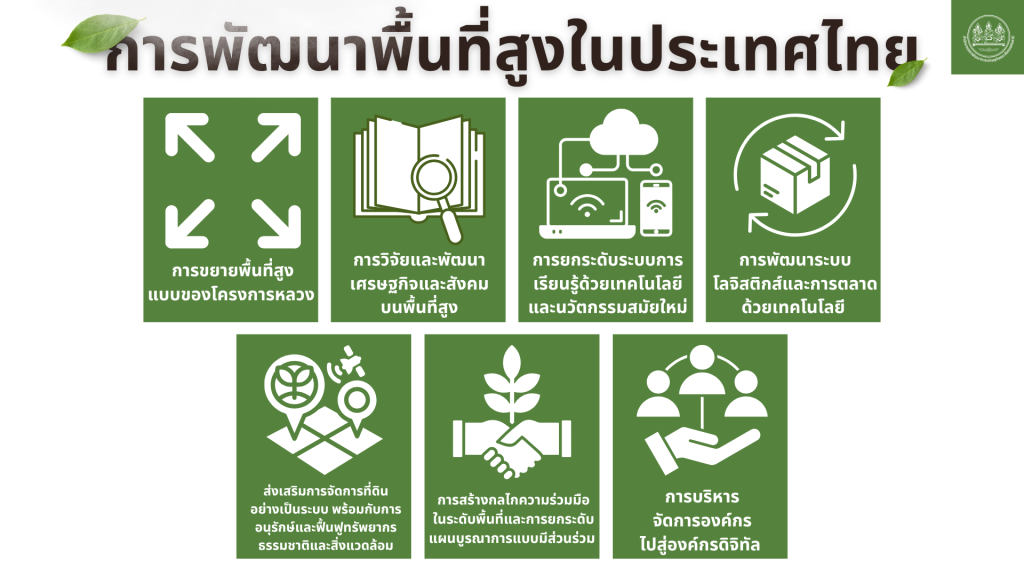
The core of this policy lies in 7 main approaches designed to align with the conditions and contexts of highland communities nationwide, starting with expanding Royal Project-style highland areas, which is a proven model for improving community quality of life, followed by research and development of highland economics and society to create knowledge bases appropriate for local environmental conditions, along with upgrading learning systems with modern technology and innovation to broaden educational opportunities for the population.
Another important approach is developing logistics and marketing systems with technology to enhance the competitiveness of highland products and services, leading to more stable economic opportunities. Simultaneously, there is promotion of systematic land management along with conservation and restoration of natural resources and environment, which forms the foundation for long-term sustainable development. Additionally, the policy emphasizes creating cooperation mechanisms at the area level and upgrading participatory integrated plans to ensure operations have power from all sectors, concluding with establishing important foundations for the future through organizational management toward digital organizations that are flexible and ready to adapt to changes in the new world.
All of this represents the overall picture of advancing “highland development” sustainably in this new decade, with a vision that not only recognizes the importance of “areas” but also sees “people” in those areas as the true heart of change.
Highland areas may be distant but are never far from change
Throughout this article, we have seen that highland areas may seem far from sight, but are not far from the impacts of today’s world, including climate change, food insecurity, and long-rooted social inequality. What happens in highland areas is therefore not just about any particular group, but reflects a system that everyone is involved in. Understanding and listening to voices from highland areas more is not merely understanding geography, but recognizing that the future of highland areas is connected to the security of the entire world, serving as the starting point for sustainable change, both for communities and for this world.
Strategy and International Cooperation Coordination Division
National Economic and Social Development Council
References
FAO. (2023). Five Years of Action for the Development of Mountain Regions. Retrieved from https://openknowledge.fao.org/server/api/core/bitstreams/f73b95cd-bce5-4829-add1-def6868e5233/content
FAO. (2025). FAO Director-General: Mountain regions have great potential despite climate, biodiversity and land degradation threats. Retrieved from https://www.fao.org/newsroom/detail/fao-director-general–mountain-regions-have-great-potential-despite-climate-biodiversity-and-land-degradation-threats/en
FAO. (n.d.). Director-General QU Dongyu. Retrieved from https://www.fao.org/director-general/biography/en
United Nations. (2025). Climate change: How mountain communities are scaling new heights. Retrieved from https://news.un.org/en/story/2025/04/1162556
Royal Project Foundation. (n.d.). Royal Project Model. Retrieved from https://royalproject.org/page/model/
Highland Research and Development Institute. (2023). 5-Year Action Plan for Sustainable Highland Development (2023-2027). Retrieved from https://www.royalparkrajapruek.org/F5YearsHRDISustainableDevelopmentActionPlan
Highland Research and Development Institute. (n.d.). Introduction to HRDI. Retrieved from https://www.hrdi.or.th/About/Introduce
Related Documents