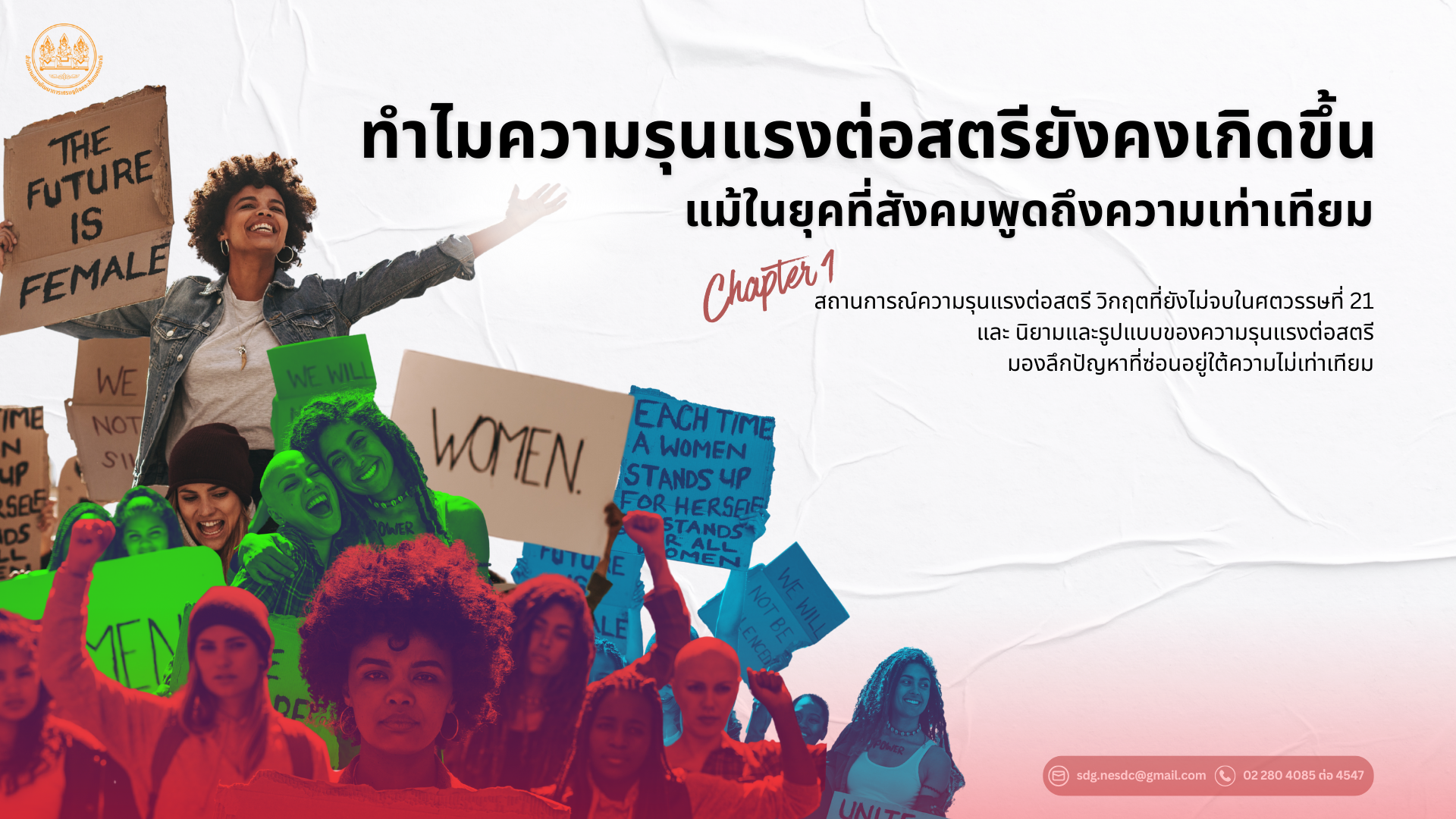
Amid the growing global movement calling for gender equality and efforts to drive change through various laws and policies, we continue to see ongoing news of violence against women, whether physical assault, sexual harassment, psychological abuse, or various forms of discrimination. These incidents occur in public spaces, workplaces, and even within families. The contradiction between campaigns for equality and the reality that occurs reflects that social change cannot happen merely through policy declarations or legislation alone. Eliminating violence against women completely requires fundamental changes at the root level, including thoughts, beliefs, and behaviors of people in society.
This article will explore the origins of violence against women in various dimensions while pointing out that ending this problem is not just “women’s responsibility” but is a challenge for everyone in society to work together to break the cycle of violence and create a society that is truly safe and respectful of the human dignity of all.
- The Situation of Violence Against Women: An Unending Crisis in the 21st Century
Although the world has entered the 21st century with efforts to promote gender equality, 1 in 3 women worldwide still face physical or sexual violence. This figure not only reflects the failure to protect women’s rights but also points to a complex crisis deeply rooted in cultural, economic, and political structures.
When figures reflect shocking truths Data from the World Health Organization (WHO) reveals that approximately 800 women and girls die every day from preventable complications during pregnancy and childbirth, while 38% of murders of women worldwide are committed by intimate partners. These figures are not just statistics but represent the real lives of women who face violence in every dimension of their lives.
COVID-19 as an Accelerator of the Violence Crisis The COVID-19 pandemic revealed the fragility of women’s protection systems. Lockdown measures aimed at protecting people from the epidemic became a double-edged sword that forced women to be trapped in dangerous situations, having to stay home with perpetrators of violence. Many countries reported that the number of women seeking help from protection centers doubled.
Inequality in Power Structures In the political arena, which should be a model of equality, women comprise only 26% of parliamentarians worldwide and only 3 in 10 senior executive positions are held by women. These figures reflect the imbalanced power in society.
Overlapping Risks for Vulnerable Groups Women with disabilities and elderly women face increased risks including being controlled through withholding medication, life-saving equipment, and financial abuse. This involves deliberately keeping necessary medications away from women with disabilities or the elderly, controlling medication use to create superior power, damaging equipment, hiding canes or wheelchairs to limit mobility, as well as denying access to bank accounts, embezzling pensions or assistance money, etc. Data from the World Health Organization (WHO) reports that women with disabilities are more likely to experience intimate partner violence than women in general.
- Definitions and Forms of Violence Against Women: A Deep Look at Problems Hidden Beneath Inequality
Understanding the definitions, characteristics, and forms of violence against women is the first step toward solving the problem, because every action has a chain effect on health, economy, and the future of society as a whole.
The United Nations defines “violence against women” as any act based on gender that results in or may result in harm to women in multiple dimensions, including physical, sexual, psychological, and economic, encompassing threats, coercion, and deprivation of freedom in all areas, whether public or private spaces.
Violence against women affects women’s lives on multiple levels, including physical, psychological, and economic aspects. The characteristics of violence against women can be categorized as follows:
- Physical Violence (Physical Violence) which is an act that directly affects the body, causing pain or injury, such as beating, pushing, or harming the body in various forms. This type of violence is often the most visible because it leaves physical traces.
- Sexual Violence (Sexual Violence) encompasses acts that violate sexual rights
without consent, from sexual harassment and assault to rape, including sexual exploitation. - Psychological Violence (Psychological Violence) is harm that affects mental and emotional states through various acts such as threats, humiliation, making one feel worthless, or controlling behavior beyond boundaries. Although it may not leave physical traces, the impact can be severe and long-lasting.
- Economic Violence (Economic Violence) is control through financial
and resource dimensions, such as limiting access to financial resources, controlling income, or coercion regarding work, which affects life security and self-reliance.
In today’s society, we see phenomena or behavioral expressions of violence against women that occur in society, which women must face in daily life. Forms of violence against women can be categorized as follows:
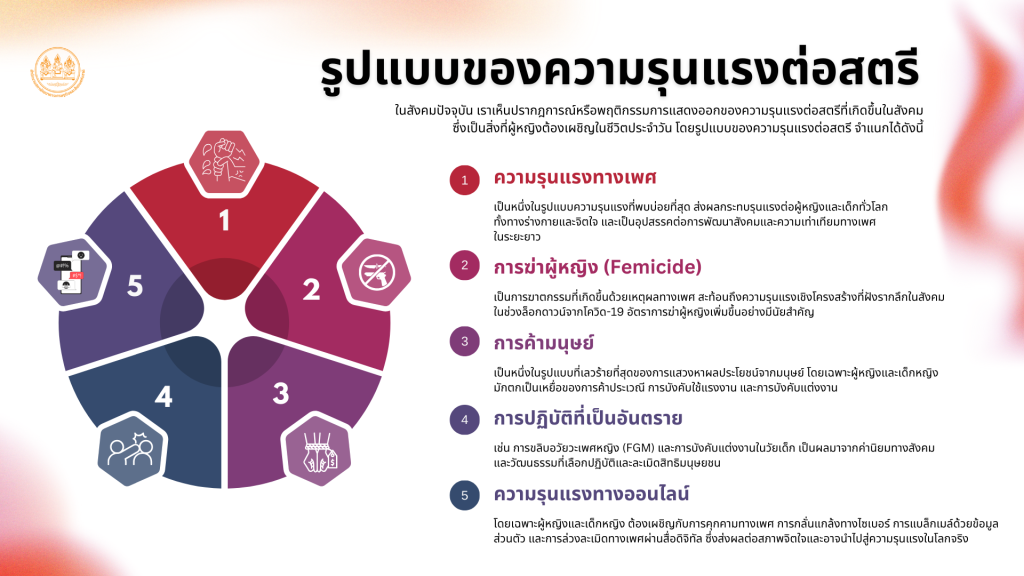
- Sexual Violence
This is one of the most common forms of violence, severely affecting women and children worldwide. It not only creates physical and psychological pain but also serves as a barrier to social development and gender equality in the long term. The rate of sexual violence occurrence shows that 30% of women worldwide have experienced physical or sexual violence from intimate partners or others, meaning over 736 million women face experiences of sexual violence. Additionally, 6% of women worldwide report having been sexually abused by non-partners.
Impact on Women’s Health 42% of women abused by intimate partners suffer physical injuries including bruises, broken bones, or serious injuries. Sexual violence increases the risk of sexually transmitted diseases, with a 1.5 times higher chance of contracting sexually transmitted infections. Some cases have increased risk of HIV infection. Beyond physical health problems, sexual violence also causes mental health problems such as depression, PTSD, and anxiety, which may affect long-term life functioning.
Sexual Violence in the Workplace and Society 35% of women in some countries may experience this from colleagues, supervisors, or clients. A UN survey indicates that more than 15 million people
were forced to have sexual intercourse, with the majority being girls aged 15-19 years. Additionally, more than 27% of women aged 15-49 years have been abused by intimate partners in the form of physical or sexual violence.
Sexual Violence in the Context of War and Conflict When sexual violence is used as a “weapon” in war zones, such as wartime rape, sexual violence against prisoners of war, women and girls in conflict areas often become victims of rape, sexual abuse, and sexual exploitation. These are used to demoralize and destroy women’s dignity.
- Femicide
This is murder that occurs for gender-based reasons, especially when women are killed by intimate partners or family members. It is a problem that occurs worldwide and reflects structural violence deeply embedded in society. Femicide by intimate partners is a significant factor that puts women at life-threatening risk, with 38% of female homicides worldwide committed by intimate partners or former partners, meaning nearly 4 in 10 homicide cases involving women result from domestic violence.
Impact of COVID-19 that increased femicide rates During lockdowns and quarantine measures, women were forced to stay home with violent partners, resulting in significantly higher female homicide rates. The United Nations called this situation the “Shadow Pandemic” reflecting the violence that increased silently within households.
Femicide in Families According to a 2022 report by the United Nations Office on Drugs and Crime (UNODC), approximately 137 women are killed daily by intimate partners or family members, meaning every hour at least 6 women lose their lives to domestic violence.
- Human Trafficking
This is one of the worst forms of human exploitation, particularly women and girls often become victims of sex trafficking, forced labor, and forced marriage. This problem intensifies during crises such as wars, conflicts, and natural disasters, making women and girls vulnerable and at risk of exploitation.
Proportion of Human Trafficking Victims According to a 2020 report by the United Nations Office on Drugs and Crime (UNODC), 72% of human trafficking victims are women and girls. Among all victims, 77% are exploited sexually including forced prostitution, pornography production, and sexual abuse. The International Labour Organization (ILO) estimates that at least 4.8 million people are forced into prostitution. Among these victims, 99% are women and girls.
- Harmful Practices
These result from social and cultural values that discriminate and violate human rights, including female genital mutilation (FGM) and forced child marriage, affecting physical and mental health. Female Genital Mutilation (FGM) According to a UNICEF (2023) report, 200 million people in 31 countries, particularly in Africa, the Middle East, and parts of Asia, have undergone female genital mutilation, typically occurring to girls aged 5-15 years, believed to preserve women’s purity or prepare them for marriage. Female genital mutilation has no medical benefits but causes severe complications. Some girls die from genital mutilation due to excessive bleeding or infection.
Child Marriage and Forced Marriage According to UNICEF reports, 12 million girls are forced into marriage before age 18 every year. Currently, 650 million people are still alive who were forced into child marriage. This results in being more controlled and lacking freedom in life compared to women who marry as adults. They may have complications from pregnancy in childhood, causing higher mortality rates for both babies and mothers. They have higher risks of domestic violence and sexual abuse.
- Online Violence
Particularly women and girls face sexual harassment, cyberbullying, blackmail with personal information, and sexual abuse through digital media, which not only affects mental health but may also lead to violence in the real world. The rate of online violence against girls and young women: According to a Plan International (2021) report, 58% of girls and young women have experienced online harassment.
The most common forms of online violence include sending sexually threatening messages, sharing personal information or private images without consent, and sexual abuse through social media. Women who experience online abuse often face anxiety, depression, PTSD, and chronic stress.
Violence against women remains a challenge for societies worldwide, even in an era where gender equality is widely discussed. The situation of violence against women continues to be a complex crisis deeply rooted in cultural, economic, and political structures. Understanding the definitions, characteristics, and forms of violence against women is an important first step in solving the problem because the impact of violence has wide-ranging effects on physical and mental health, economic status, and the development potential of society as a whole.
Ending violence against women is not only a human rights issue but also a crucial condition for sustainable and just social development. Cooperation from all sectors of society will help us eliminate this cycle of violence and lead to creating a safe and equal future for everyone.
In Chapter 2, we will take everyone to explore the roots of violence against women in detail, delving deep into the causes and important factors that must be monitored, while exploring why wounds inflicted on one woman can spread and become a crisis affecting the entire social system. The next chapter will help create comprehensive understanding of the complexity of this issue.
Strategy and International Cooperation Coordination Division
National Economic and Social Development Council
References
Hfocus. (2020). Department of Medical Services reveals 4 approaches to prevent violence against children and women. Retrieved from https://www.hfocus.org/content/2020/11/20506
UN Women. (2024). FAQs: Types of violence against women and girls. Retrieved from https://www.unwomen.org/en/articles/faqs/faqs-types-of-violence-against-women-and-girls
United Nations. (2025). World News in Brief: WHO chief asks US to reconsider withdrawal, gender parity remains distant goal, call for rethink on Nordic alcohol law change. Retrieved from https://news.un.org/en/story/2025/02/1159711
World Health Organization (WHO). (2020). Coronavirus disease (COVID-19): Violence against women. Retrieved from https://www.who.int/news-room/questions-and-answers/item/coronavirus-disease-covid-19-violence-against-women
World Health Organization (WHO). (2024). WHO calls for greater attention to violence against women with disabilities and older women. Retrieved from https://www.who.int/news/item/27-03-2024-who-calls-for-greater-attention-to-violence-against-women-with-disabilities-and-older-women
World Health Organization (WHO). (n.d.). Violence against women. Retrieved from https://www.who.int/health-topics/violence-against-women#tab=tab_1
Chalasai Kanmin. (2019). Domestic Violence: Problems and Prevention Approaches. Retrieved from https://rsucon.rsu.ac.th/files/proceedings/nation2019/NA19-136.pdf
Thai Health Promotion Foundation. (2014). 5 Practices to Prevent Violence Against Women. Retrieved from https://www.thaihealth.or.th/?p=231270
Related Documents