


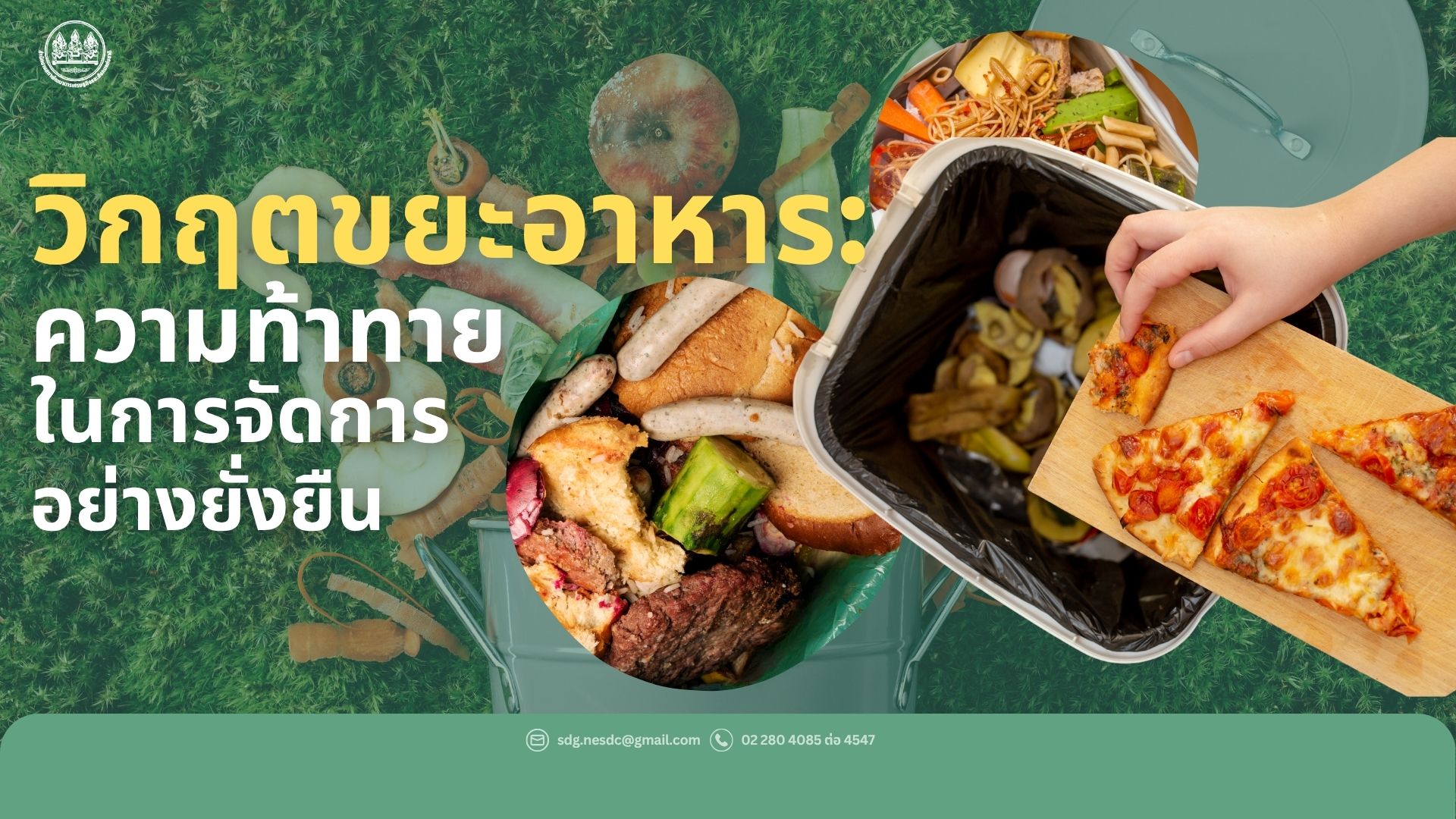
More than one-third of food produced for consumption becomes waste, while 3.1 billion people worldwide cannot access food resources. Food scarcity continues to increase as the global community faces pandemics, wars, climate change, and economic, social, and political volatility. The amount of food waste in each country varies according to production factors, supply chain management, and consumer behavior, leading the global community to identify “food waste” as a critical and complex issue requiring urgent action.
Food Waste refers to food discarded at the end of the supply chain by retailers, food service providers, and consumers for various reasons, such as excess food, uneaten meals, expired canned goods, vegetable and fruit garnish scraps, as well as spoiled and expired food resulting from improper management, excessive purchasing, and disposal of edible food due to misunderstanding product labels.
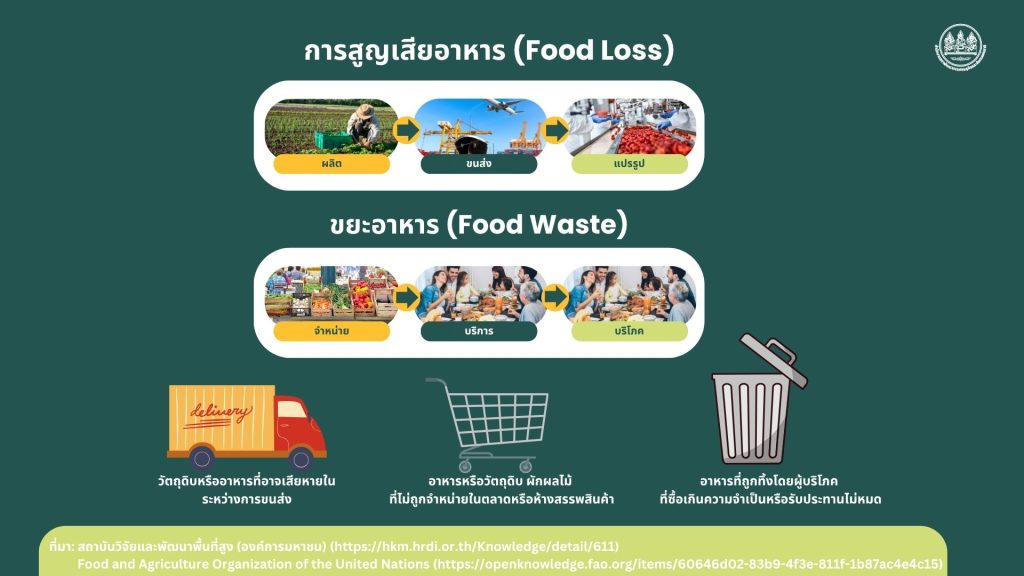
Source: Highland Research and Development Institute (Public Organization) (https://hkm.hrdi.or.th/Knowledge/detail/611)
Food and Agriculture Organization of the United Nations (https://openknowledge.fao.org/items/60646d02-83b9-4f3e-811f-1b87ac4e4c15)
Food Waste: Loss of Natural Resources and Social and Economic Value
The continuously growing global population increases consumer food demand, reflecting the food scarcity situation on Earth. Some countries have easy access to food resources, resulting in large amounts of food waste, while others still struggle to access food resources for consumption. This shows that our world actually has sufficient resources to produce food for everyone on Earth, but most of the food produced is discarded as “food waste” due to improper management.
The overall economic, environmental, and social costs of food loss and food waste to the global economy are estimated at $2.6 trillion USD, with economic value accounting for $1 trillion USD. The remainder represents environmental and social damage costs, including greenhouse gas (GHG) emissions, water scarcity, biodiversity loss, increased conflicts and habitat loss due to soil erosion, loss of minerals in agricultural land resulting in reduced agricultural productivity, and increased human exposure to pesticides affecting human health and well-being.
- Food Waste Leading to Natural Resource Loss
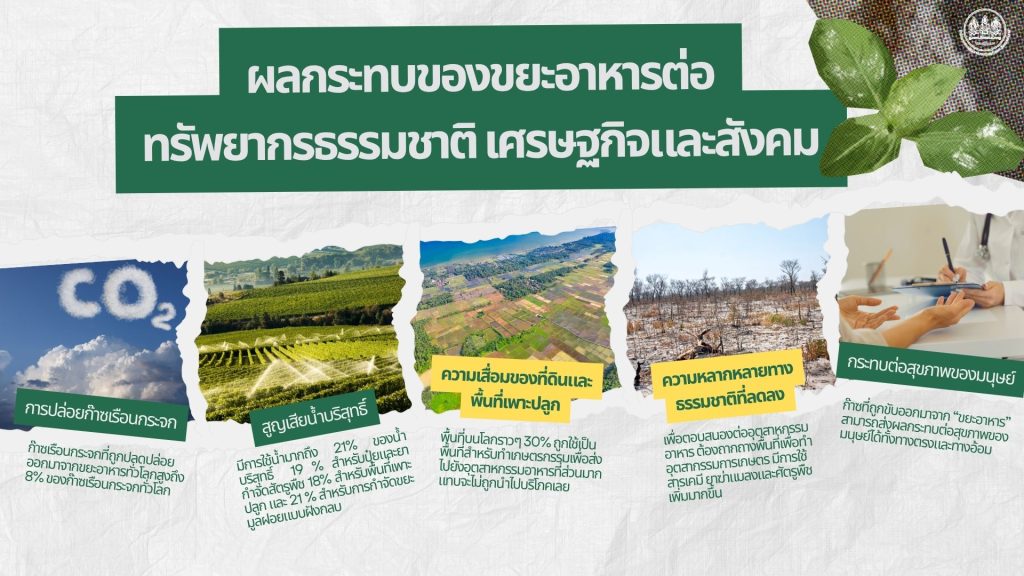
Food production at every stage, from cultivation and production to transportation, requires three main natural resources: energy, fuel, and water. Water is a natural resource used in every stage of food production, particularly in agriculture and irrigation, which uses 70% of the world’s freshwater. Massive amounts of freshwater are used in crop cultivation and livestock farming. However, different types of plants and animals require different amounts of water, with livestock requiring enormous amounts of water from raising to feed production processes. This results in meat production requiring large amounts of freshwater, with meat products often being the most discarded food.
The amount of “food waste” causes the loss of more than half of the world’s freshwater, valued at $172 million USD. It is estimated that we spend more than $220 million USD on production, transportation, and landfill processes for approximately 70 million tons of food waste. Food production that will become waste uses 21% of freshwater, 19% for fertilizers and pesticides, 18% for cultivation areas, and 21% for landfill waste disposal. Therefore, discarding 1 kilogram of meat is equivalent to wasting 50,000 liters of freshwater, and pouring out 1 glass of milk is like wasting 1,000 liters of freshwater. When considering global food transportation, the natural fuel used for transportation is also wasted unnecessarily.
- Food Waste: A Source of Greenhouse Gas Emissions
The processes from production, food processing, storage, to transportation throughout the entire food supply chain result in greenhouse gas emissions from discarded food worldwide reaching 8%, equivalent to emissions from the transportation sector, or 4 times more than global aviation emissions. In addition to wasting resources in various food production processes, when food is disposed of in landfills, natural decomposition processes generate additional greenhouse gases, such as carbon dioxide emissions exceeding 3.3 billion tons from global food waste annually.
- Food Waste: A Cause of Land and Agricultural Area Degradation
Land on Earth is primarily used in two ways: as areas for food production and areas for food waste disposal. Approximately 11.5 million hectares of land worldwide are used for agriculture in the food industry, causing soil resource degradation from crop cultivation and livestock farming. Each year, 28% of global agricultural land is used to produce food that is lost or wasted, resulting in lost opportunities to use land for other purposes.
- Impact of Food Waste on Biodiversity
Agricultural practices to meet industrial demands require forest clearing for agriculture to meet consumer needs. Additionally, agricultural and livestock products must meet market standards, leading to chemical use to make products conform to standards, and pesticide use developed to eliminate both insects and weeds simultaneously in large agricultural areas. These chemicals affect plants and animals outside agricultural areas. Excessive herbicide use severely impacts soil conditions and reduces plant diversity around agricultural areas, affecting animals that depend on these plants for survival, such as bees and other insects whose colony formation is disrupted. This impacts reduced plant pollination capabilities. Some chemicals also affect fish, amphibian, and bird habitats.
- Silent Threat: Food Waste Impact on Human Health
Gases emitted from “food waste” can impact human health both directly and indirectly. Food waste gas emissions containing hydrogen sulfide, ammonia, and volatile organic compounds can affect the endocrine system, respiratory system, nervous system, and human olfactory nerve system. Symptom severity depends on gas concentration, ranging from mild lung irritation to cancer and death, or affecting water quality with improper pH levels that promote bacterial or pathogen growth and dissolve metals and toxins in water, potentially impacting public health long-term. Additionally, governments may bear costs for future public health problems.
Current Global and Thai “Food Waste” Situation
According to the Food Waste Index Report prepared by the UN Environment Programme (UNEP) for 2024, global average food waste increased to 79 kilograms per person per year, valued at over 100 billion baht annually (from 74 kilograms per person per year compared to the latest 2021 assessment). Household waste per person exceeds the annual average, or more than twice the general average of 62 kilograms per person per year. Edible food is wasted at retail, food service, and household levels by 19%. It is estimated that global food is lost in the supply chain before harvest and retail by approximately 13%.
Thailand’s current “food waste” situation according to the Food Waste Index Report prepared by the UN Environment Programme (UNEP) for 2024 shows Thailand has an average of 86 kilograms per person per year (from 79 kilograms per person per year compared to the latest 2021 assessment), higher than the global average and at the same level as neighboring countries. This represents a challenging situation for addressing food waste toward achieving SDG 12.3, which aims to halve global food waste at retail and consumer levels and reduce food loss throughout production and supply chains, including post-harvest losses, by 2030.
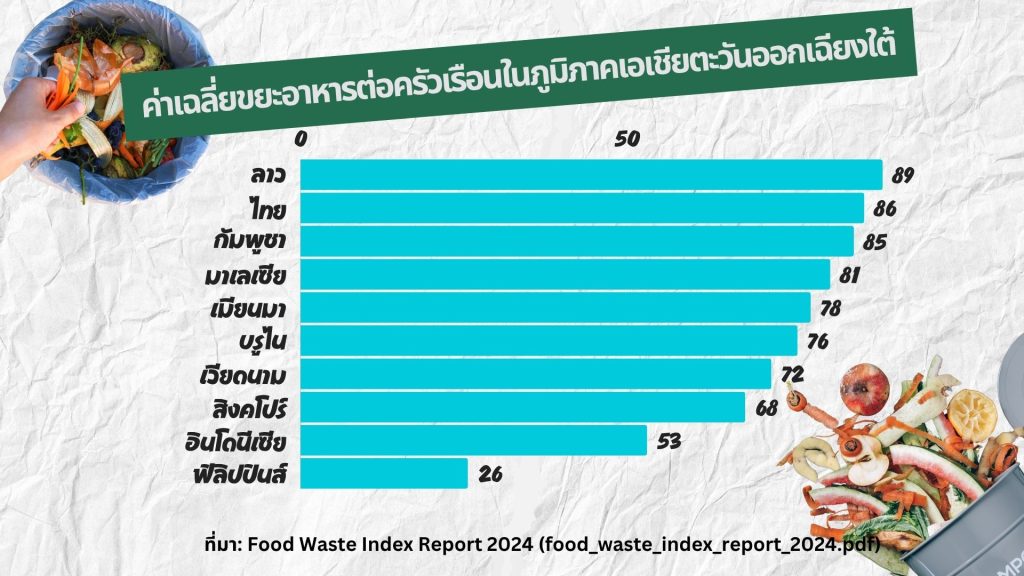
Data source: Food Waste Index Report 2024
International Lessons: Toward Thailand’s Sustainable Food Waste Management
United Arab Emirates: Converting food waste into fertilizer for soil quality improvement in agriculture. Much of Dubai’s food waste comes from agriculture, restaurants, and hotels. Since 2021, a project has been developed to convert approximately 1 million kilograms of food waste from landfills into fertilizer for soil improvement, reducing carbon dioxide emissions to the atmosphere by more than 1,000 tons. Normally, Dubai relies on importing more than 90% of soil and fertilizer for agriculture from other countries. Currently, food waste serves as a good nutrient source for the country’s fertilizer production using natural processes taking only 8-12 weeks.
Switzerland: A non-profit organization in Geneva established a food sharing cabinet or public refrigerator project to store food nearing spoilage, allowing passersby to select vegetables, fruits, bread products, or other perishable but not yet spoiled food at no cost. Similar projects have emerged in many other countries, such as Austria and Germany, creating international policy movements that have prevented more than 83 million tons of food from becoming “food waste”.
Australia: Reselling agricultural products, vegetables, and fruits that do not meet market standards, are misshapen, or have blemishes in boxes called “imperfect boxes” at prices 10-40% lower than market prices. Established by Farmers Pick company in cooperation with local farmers. Australia has approximately 7.6 million tons of food waste annually. Bringing blemished or misshapen agricultural products back for consumption helps reduce greenhouse gas emissions and decrease natural resource and biodiversity loss.
Saudi Arabia: A country with desert climate conditions requiring massive food imports to meet domestic demand. Currently, Saudi Arabia has turned to hydroponic agriculture using water as the main component, where water can be recycled and reused, reducing agricultural product imports so citizens can consume fresh agricultural products. This business innovation model was established by small farm groups that produce and export agricultural products. When customers need products, farms can harvest immediately and deliver to consumers within 45 minutes, reducing food waste by up to 40%.
Japan has “The Basic Plan for Establishing a Recycling-Based Society” policy to promote recycling and transform national production and consumption toward sustainability. Japanese local governments have seriously implemented this policy, such as Nagoya city collecting household food waste for a small fee of approximately 100-200 yen per household per month to use as capital for making compost for community farmers to grow organic vegetables and redistribute organic vegetables back to the community. This policy implementation has resulted in Japan’s food waste recycling rate exceeding 80% of the country’s total food waste.
South Korea has implemented strict waste management laws with clear penalties for non-compliance. Additionally, the South Korean government has collaborated with educational institutions to research and develop smart waste bins that can weigh and calculate costs, collecting fees through national ID cards. These smart waste bins have reduced food waste by up to 95% in 2018, making Seoul the world’s best recycling city. South Korean local governments have used legal authority to set food waste disposal fee rates based on weight or volume, making citizens aware of increasing food waste amounts and developing consciousness to reduce, separate, and recycle waste.
Conclusion: Learning from International Experiences for Thailand’s Sustainable Food Waste Management
Given Thailand’s food waste situation trends that continued to rise in 2024, as we still lack quality waste tracking systems, data collection, and innovation or knowledge to sustainably address food waste problems. However, currently Thailand’s Pollution Control Department, Ministry of Natural Resources and Environment has prepared the Food Waste Management Roadmap (2023-2030) to serve as a framework and direction for preventing and solving the country’s food waste management problems, and the Food Waste Management Action Plan Phase 1 (2023-2027) to drive operations through cooperation of all sectors including government, private sector, and citizens. Solving Thailand’s food waste problem is very challenging in a country with geographical location and climate conducive to agricultural and food industries, with diverse natural resources, making Thailand one of the important strategic points in Asia that produces and exports large amounts of food. Additionally, Thai culture that is always associated with food, with promotion of many Thai cities as food tourism destinations, requires creating awareness of increasing food waste amounts in society.
For Thailand to achieve sustainable development goals in solving food waste problems toward SDG 12.3, which aims to halve global food waste at retail and consumer levels and reduce food loss throughout production and supply chains, including post-harvest losses by 2030, lessons from various countries require cooperation from multiple sectors: government, private sector, local government organizations, academics, researchers, along with strong laws, clear policies and guidelines that will partly determine practical directions, and most importantly, creating incentives and consciousness among the nation’s people. The global community has only 5 years remaining, representing a challenge requiring collaborative action and finding approaches to achieve sustainable development goals by 2030 for the continued well-being of humanity.
Strategy and International Cooperation Coordination Division
National Economic and Social Development Council
References
Biodiversity and Agriculture. (2024). Retrieved from https://foodprint.org/issues/biodiversity-and-agriculture/
Chen Liu, Caixia Mao, Pongsun Bunditsakulchai, So Sasaki, Yasuhiko Hotta (2020). Food waste in Bangkok: Current situation, trends and key challenges. Resources, Conservation and Recycling. Retrieved from https://www.sciencedirect.com/science/article/abs/pii/S0921344920301002
David Elliott, Johnny Wood. (2025). 8 innovative solutions for fighting food waste. Retrieved from https://www.weforum.org/stories/2025/04/innovations-to-reduce-food-waste/#:~:text=Hydroponic%20agriculture,in%20the%20harshest%20of%20climates.
Jamey Keaten. Free food fridges take off in parts of Europe in eco-friendly bid to fight waste. Retrieved from https://apnews.com/article/food-waste-switzerland-germany-geneva-austria-refrigerators-environment-fc8484f267f1403a4b76db8b20541f9a
Jangira Lewis. (2022). How Does Food Waste Affect the Environment?. Retrieved from https://earth.org/how-does-food-waste-affect-the-environment/
Paulina Rudziak, Evans Batung, Isaac Luginaah. (2024). The effects of gases from food waste on human health: A systematic review. PLOS ONE. Retrieved from https://pmc.ncbi.nlm.nih.gov/articles/PMC10971579/
SD Thailand. (2024). Thailand ranks 77th globally in food waste generation, averaging 86 kilograms per person per year, increased from the previous year and higher than the global average. Retrieved from https://www.sdthailand.com/2024/04/kasikorn-research-food-waste-index-2024/#:~:text=SKY23%20April%202024,ในการประเมินครั้งล่าสุด
United Nations Environment Programme. (2024). Food Waste Index Report 2024. Think Eat Save: Tracking Progress to Halve Global Food Waste . Retrieved from https://wedocs.unep.org/20.500.11822/45230
Khadkanat Chuenwong-arun and Naphatradanai. (2022). Food Waste and Food Loss. Retrieved from https://ngthai.com/science/40756/food-waste-food-loss/
Department of Health Laboratory Center. Physical Water Quality and Health Impacts. Retrieved from https://phld.anamai.moph.go.th/th/chemical-water- quality/download/?did=66253&id=72914&reload=
Thailand Development Research Institute (TDRI). Food Waste: Close to Home but Bigger Than We Think. Retrieved from https://tdri.or.th/foodwaste/
Thai Health Promotion Foundation (ThaiHealth). Food Waste, Surplus Food: How to Manage in the Thai Way. Retrieved from https://resourcecenter.thaihealth.or.th/files/66/thaihealth%20watch_ขยะอาหาร%20อาหารส่วนเกิน.pdf
Office of Natural Resources and Environmental Policy and Planning. (2024). Thais discard 86 kg of food waste per person per year, exceeding the global average. Retrieved from https://mgronline.com/greeninnovation/detail/9670000113622
Onsupa Saiphet and Kharika Kantha. A Review of Public Policy for Food Waste Management. Retrieved from https://so05.tci-thaijo.org/index.php/sjss/article/view/251495/173896
Related Documents