


From Farm to Closet
The concept of sustainable fashion or slow fashion is creating changes
in the popularity of fast fashion, causing it to decline. Fast fashion has production processes primarily based on industrial manufacturing, filled with extravagance and generating massive amounts of waste from the fashion industry, accompanied by labor exploitation and significant environmental impacts. From Farm to Closet is a concept of sustainable fashion or slow fashion – new brands that reject industrial fashion that mass-produces goods as an approach for sustainable clothing. It emphasizes the entire lifecycle of clothing from raw materials, production, distribution, wearing, to disposal, for the benefit of the environment, society, and all stakeholders in the fashion industry.
Impact of the Fashion Industry
Environmental Impact
The fashion industry is considered one of the most polluting industries and one of the least regulated businesses, causing the rapid growth of the fast fashion sector to consume enormous natural resources that impact the environment, releasing greenhouse gases and production processes that result in significant wastewater from the clothing industry. Although most fibers produced are synthetic, the increased use of synthetic materials results in greater environmental pollution. Currently, synthetic fiber production accounts for 1.35% of global oil consumption. According to a United Nations study in 2017, it is estimated that by 2030, the fashion industry will use land for cotton cultivation, forests for plant fibers, and grasslands for livestock, increasing by more than 35%, totaling approximately 115 million hectares, which is nearly the size of South Africa.
The production of raw materials for textiles poses risks of land impact, such as land degradation,
soil erosion, overgrazing leading to grassland deterioration, desertification, deforestation, freshwater scarcity, waste pollution, biodiversity loss, carbon emissions, and climate change. The Aral Sea is an example of environmental impact from cotton cultivation to meet the uncontrolled textile and clothing industry. The Aral Sea was the world’s 4th largest lake. Since 2000, this lake has lost more than 90% of its water area due to unsustainable agriculture from cotton cultivation. The drying of the Aral Sea has impacted the surrounding areas, causing salt, sand, and dust storms, and wastewater has destroyed soil, reducing crop yields, increasing soil salinity, becoming desert, losing biodiversity and changing livelihoods, and losing one of the most important fishing sources. Another example is the Atacama Desert which is filled with illegally dumped fashion industry waste. Chile is one of the top ten countries importing second-hand clothing. In 2022, approximately 131,574 tons of second-hand clothing were imported to Chile. Most clothing cannot be recycled, with only some portions having value. About 70% of these textiles are illegally dumped in the desert or buried.
Impact on Traditional Local Community Lifestyles
The rapidly changing fashion industry causes loss of connection with traditional culture, as local cultures are homogenized into a single global culture following trends, causing local artisan styles or craftsmanship to be suppressed by Western fashion influences, leading to the assimilation of local artisan cultural identity. Small producers are pushed into markets by large multinational companies, forcing people to adapt to global market demands.
Impact on Labor
With the fast fashion industry emphasizing speed in producing goods according to current trends, it requires a large workforce for production. Although the growth of the fast fashion industry has been well received by current popular trends, most workers have poor working conditions and work hard. For example, some workers in Bangladesh work up to 60 hours per week, but wages do not increase accordingly. Only 2% of workers receive reasonable wages. Additionally, most workers in these factories live near waterways, where water contains dangerous contaminants from clothing production processes, resulting in poor physical health as well.
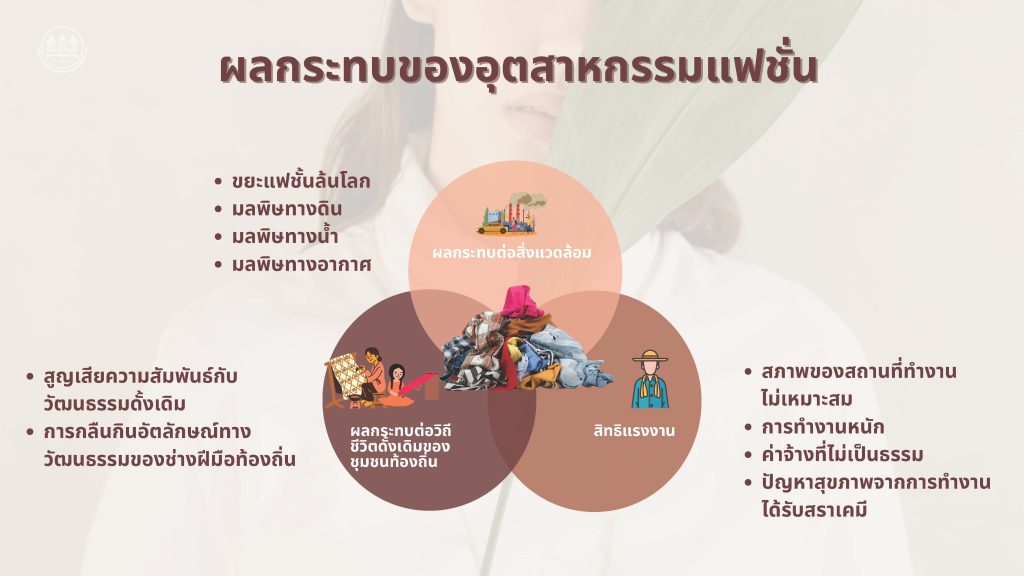
Note: Diagram analyzed and content compiled by the author
Transitioning to Sustainable Fashion Industry
Case Study: From Farm to Closet Indonesia’s SukkhaCitta brand is an example
of using the Farm to Closet concept in collaboration with local farmers and artisans from
Java, Bali, Timor-Leste, and Honduras. The price of each garment reflects the labor of local artisans who weave each piece. Every garment in the “From Farm to Closet” collection is made from 100% natural fibers, including plant dyes using regenerative farming methods. Cotton fibers are hand-spun and hand-woven, and decorated by indigenous artisans using hand-drawn wax techniques called Batik. SukkhaCitta’s founder believes that if buyers understand the value of the products they pay for, buyers will realize that cheap clothing has much higher costs. SukkhaCitta is the first fashion company in Indonesia to receive B Corp[1] certification, which demonstrates business operations committed to transparency and social and environmental responsibility. Additionally, the brand’s stance is not to adhere to traditional seasonal fashion or rush artisan work or overuse natural resources. If products are in high demand but various factors are not conducive, the company will allow those products to go out of stock. Furthermore, the brand guarantees that products can be repaired or re-dyed throughout their lifespan to extend product life.

[1] B Lab UK, a charity established in 2015, initiated the B Corp Certification standard. Businesses that achieve B Corp Certification are businesses that meet the highest standards of verified social and environmental performance, have transparency and accountability, and have legal responsibility to balance profit and organizational mission.
Thailand’s Adaptation Approaches for Sustainable Fashion Consumption
Currently, the fast fashion industry has played a significant role for consumers and producers in Thailand. Thailand produces and imports approximately 110.8 million ready-made garments per year. With the growth of importing cheaper goods from foreign countries and continuous updates of modern fashion trends, this impacts natural resources and continuously increasing waste volumes. With cheaper clothing prices and substandard quality causing significant waste increases, there is a lack of awareness of product value. How can Thailand encourage people to consume fashion sustainably, considering the environment alongside local people’s lifestyles?
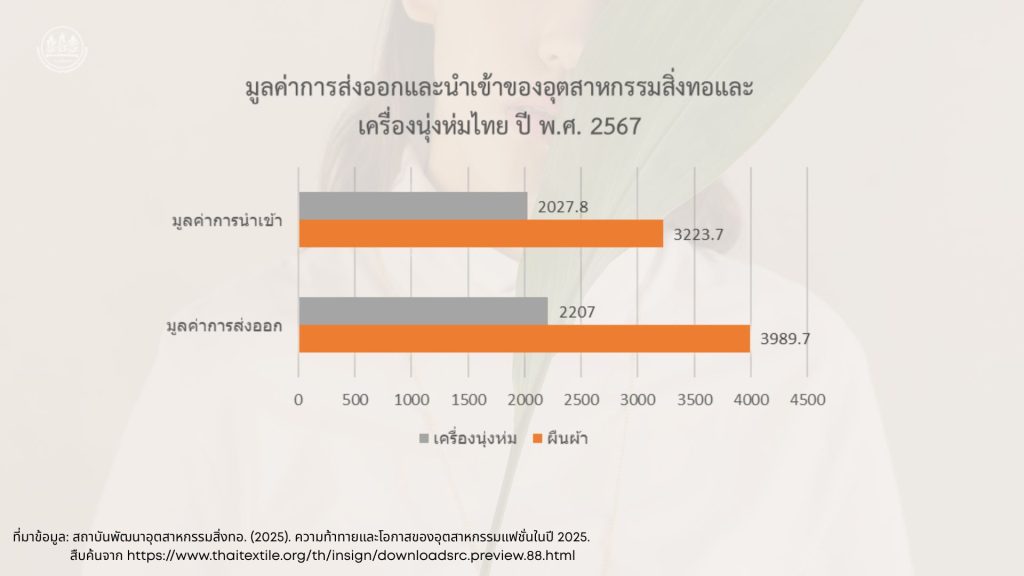
Data source: Textile Industry Development Institute
Although the overall export of textiles and apparel in 2024 was valued at $6,196.7 million, an increase of 2.7% compared to the previous year, while the overall import in 2024 was valued at $5,251.5 million, an increase of 3.6%, particularly the (cumulative) import of apparel valued at $2,027.8 million, an increase of 8.8%, reflecting Thailand’s continuous dependence on clothing imports from foreign countries, especially China, which exports raw materials, yarn, and clothing at cheaper prices compared to other countries. It is difficult to overcome this limitation. Additionally, intense competition in the fashion industry sector that creates the fast fashion industry, emphasizing creative forms but not emphasizing durability, limited resource access, and limitations in accessing global markets due to foreign brands being large companies with investment capital for advertising various products and services, are reasons that have caused Thailand’s fashion industry market to decline significantly. Thailand should therefore turn attention to production in the sustainable fashion industry by creating value for products instead of mass production, focusing on product durability, and not competing in the fast fashion industry.
As Thailand has implemented support for the fashion industry driven by Soft Power policy, which aims to create identity and distinctiveness, emphasizing Thai identity blended with traditional wisdom, culture, and local identity, along with presenting sustainability through production processes, whether using natural fibers, environmentally friendly production processes, modern design while maintaining Thai identity, combined with advertising and image creation to create value for the fashion industry. Therefore, driving operations under such policies, combined with adaptation by focusing on producing environmentally friendly clothing or focusing on extending and developing the Farm to Closet concept concretely will help Thailand overcome the sluggish period of the fashion market.
Conclusion
Currently, fashion clothing is changing rapidly. People can choose as they wish through processes that require borrowing many natural resources, most of which are returned to nature in the form of waste. Additionally, it involves exploitation of some textile industry workers who do not receive fair compensation and have inappropriate welfare for living. Local people’s lifestyles change according to trends for survival, losing local identity. The Farm to Closet concept can help reduce fashion’s impact on the environment and society from production to consumption stages. The government should support local artists and small producers in creating works using traditional local culture and materials, support regenerative agriculture in fiber cultivation stages, use natural dyes, use local labor for income distribution to communities, along with promoting advertising to create awareness and control substandard fashion products. Although fashion clothing produced according to the Farm to Closet concept may be more expensive than general fashion clothing due to limited local production resources and the use of highly skilled local labor or artists, these clothes are made with meticulous production and are therefore durable, resulting in long service life, which can reduce textile waste. Small-batch clothing production also creates value for clothing, making wearers truly aware of the value of the clothing they wear. Sustainable clothing consumption is therefore consuming clothing with production processes completed locally, with transparent processes, and without labor exploitation, considering buyers, the environment, and local communities.
Strategy and International Cooperation Coordination Division
National Economic and Social Development Council
References
Claudia Kalb. (2025). Why the future of fashion is ‘farm to closet’. Retrieved from https://www.nationalgeographic.com/environment/article/fast-slow-fashion-clothes-sustainable
Jasmine Chinasamy. (2019). Fast Fashion: The Villain Industry: Fashion on Sirens. Retrieved from https://www.greenpeace.org/thailand/story/9381/fast-facts-about-fast-fashion/
Jiratchaya Chaichumkhun. (2021). Wear the Same Shirt, Keep Clothes Long-lasting, Get to Know Slow Fashion: The Opposite Concept of Fast Fashion. Retrieved from https://thematter.co/social/slow-fashion-concept/133408
Krungsri. (n.d.). What is Sustainable Fashion? Eco-friendly Fashion Trend: New Clothes, Beautiful and Earth-friendly! Retrieved from https://www.krungsricard.com/th/article/%E0%B9%80%E0%B8%AA%E0%B8%B7%E0%B9%89%
E0%B8%AD%E0%B8%9C%E0%B9%89%E0%B8%B2%E0%B8%A3%E0%B8%B1%E0%B8%81
%E0%B9%82%E0%B8%A5%E0%B8%81
Post Today. (2024). City & Garbage “Atacama” Global Sacrifice Zone, Fast Fashion Stop Here First. Retrieved from https://www.posttoday.com/smart-city/709039
Rebecca Jiménez. (2024). Fashion and land Unravelling the Environmental Impact of Fibres. UNCCD Publication. Retrieved from https://www.unccd.int/sites/default/files/2024-12/UNCCD-Fashion%26LAND-FINAL%20online%20publication_final_single%20pages.pdf
SME Go Inter. (2022). The ‘Sustainable Fashion’ Trend in Japan is Coming: Business Opportunities Thai SMEs Must Seize. Retrieved from https://www.bangkokbanksme.com/en/5inter-sustainable-fashion
Subharthi Da, Santu Karmakar, Timilehin Olasoji Olubiyi, Santosh Kumar Behera. (2025). The Social and Environmental Impact of Fast Fashion. IGI Global Scientific Publishing. Retrieved from https://www.researchgate.net/publication/390862344_The_Social_and_Environmental_Impact_of_Fast_Fashion
Techsauce. (2023). Fast Fashion: The Villain, Quick Come Quick Go but Leaves Traces, Full of Harmful Effects on the World. Retrieved from https://techsauce.co/sustainable-focus/fast-fashion-and-sustainable-choice
Thairath Money. (2024). 40% of Thai People Wear Clothes Once and Throw Away: Fast Fashion Easy Boredom, Addicted to Influencer Lifestyle Excessively.
Retrieved from https://www.thairath.co.th/money/business_marketing/marketing_trends/2810621
Thai PBS. (2024). “Innovation” – The Way Out for Thai Textile Industry After Being Hit by “China” in the Market. Retrieved from https://www.thaipbs.or.th/news/content/345803
Department of International Trade Promotion. (n.d.). The Trend of Eco-friendly Fashion Industry “Sustainable Fashion” in Japan.
Retrieved from https://www.ditp.go.th/contents_attach/775384/775384.pdf
Department of Industrial Promotion. (2025). “DIP Ready” Energizes Thai Clothing and Apparel Industry, Creates “Fashion Hero Brand” and Supports Soft Power Fashion, Hopes to Elevate Thai Brands to International Level Sustainably According to Minister Ekanat’s Policy, Expected to Create Value of Over 100 Million Baht. Retrieved from https://www.dip.go.th/th/category/activity-news/2025-05-23-21-47-26
Textile Industry Development Institute. (2024). How the European Union’s Textile Strategy Will Transform the Fashion Industry, (49). Retrieved from https://www.thaitextile.org/upload/file/th-dl-4643d7cf9317cfa569420dcd06028b00.pdf
Textile Industry Development Institute. (2024). Driving Thai Fashion Industry with Communication Strategy and Cooperation Under Soft Power, (50). Retrieved from https://www.thaitextile.org/upload/file/th-dl-7068f5c7fb43d165180107a27beb6020.pdf
Textile Industry Development Institute. (2025). Challenges and Opportunities of the Fashion Industry in 2025, (53). Retrieved from https://www.thaitextile.org/th/insign/downloadsrc.preview.88.html
Related Documents