


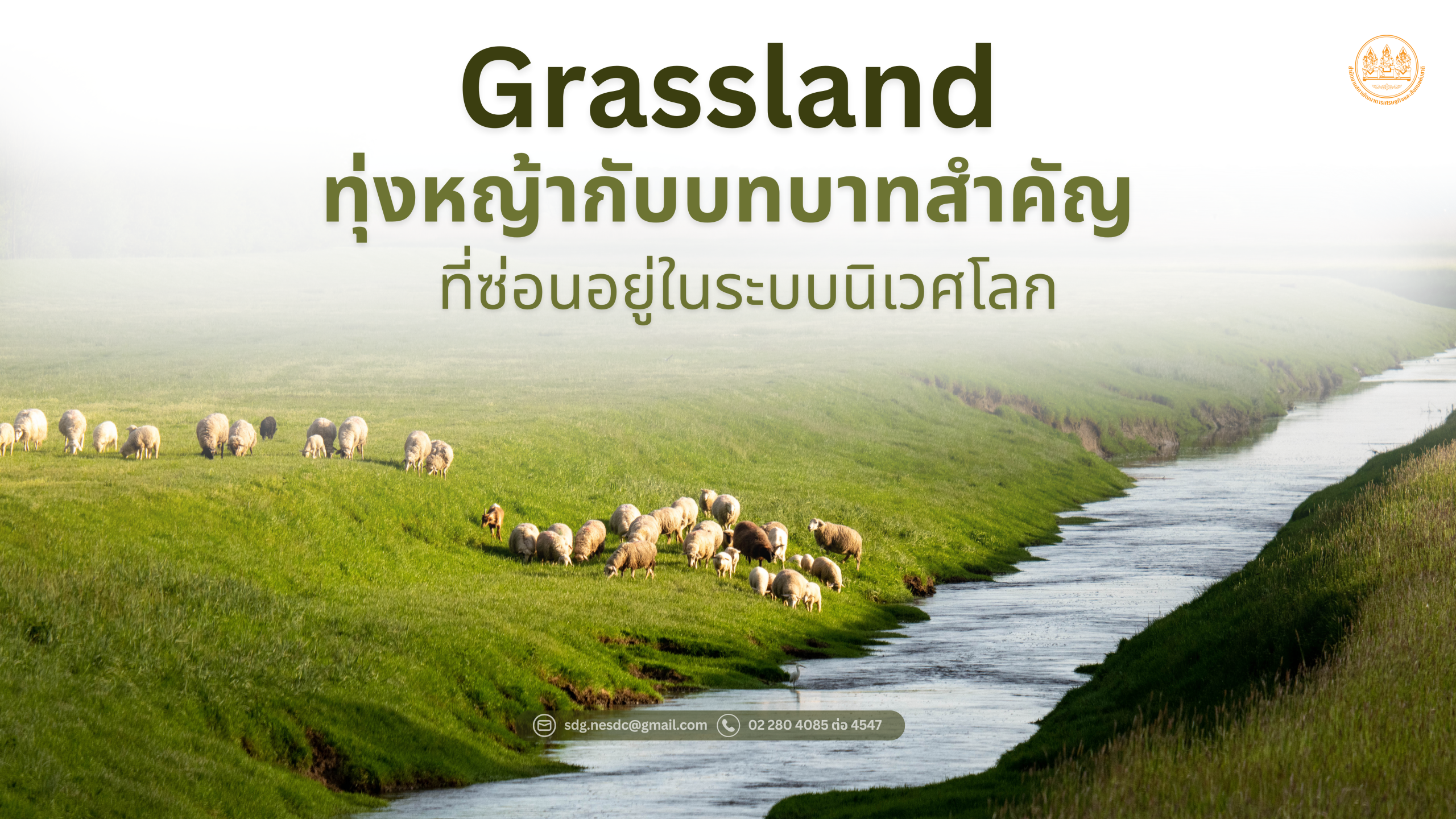
Each type of ecosystem has a specific role in maintaining global balance. Among the diversity of ecosystems, “grasslands” cover vast areas and play crucial environmental, social, and economic roles. Despite being less discussed compared to forests or wetlands, grasslands are deeply connected to human life and ecosystems worldwide. This article presents an overview of grasslands, emphasizing their important roles across multiple dimensions, to demonstrate that grasslands are not merely natural landscapes, but indispensable components of global sustainability.
Grasslands are ecosystems with more diversity than meets the eye.
To the ordinary eye, grasslands may appear as flat lands covered with green herbaceous plants, but in reality, these vast areas are among the world’s most complex and diverse ecosystems. Grasslands are ecosystems that support high levels of biodiversity, including plant species, animals, and microorganisms, and can adapt and be utilized in various forms according to climate conditions and vegetation characteristics in each region, making grasslands impossible to define in just one way.
From the prairie grasslands of North America to the savanna grasslands of Africa, all demonstrate the diversity of grasslands worldwide. These grasslands have specific names that differ according to local characteristics, such as Prairies in North America, Pampas in South America, Steppes in Europe and Asia, Savannas in Africa, and Rangelands in Australia. The diversity of names reflects different geography and cultures, but what remains the same is the importance of these areas to the survival of countless living organisms. However, grasslands are facing a crisis that is often overlooked. Grassland degradation is not merely a local environmental problem, but a global challenge. If grasslands continue to be destroyed, the world will lose crucial mechanisms for achieving biodiversity and sustainable development goals.
Professor Richard Bardgett states that grassland degradation is a critical global problem that must be addressed if we are to achieve key objectives in biodiversity programs, such as the Aichi Biodiversity Targets under the Convention on Biological Diversity (CBD), as well as the United Nations Sustainable Development Goals (SDGs), which encompass the restoration and sustainable use of terrestrial ecosystems, addressing hunger and poverty, and mitigating the impacts of climate change.

Image source: British Ecological Society (2019)
Grasslands are not merely landscapes waiting for the wind to blow through, but crucial mechanisms that maintain the balance of life on Earth. Preserving grasslands therefore means maintaining biodiversity and creating long-term security for humanity and our planet.
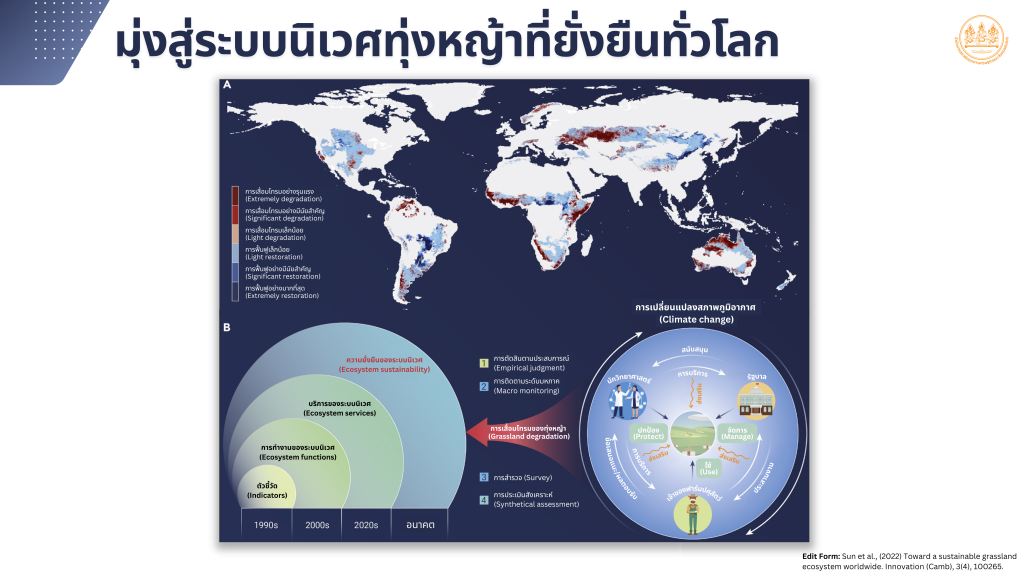
Source: Sun et al., (2022)
The Role of Grasslands as Often Overlooked Carbon Storage Sources
Grasslands are ecosystems with the ability to store carbon underground in a stable and sustainable manner. With the deep, dense, and resilient root systems of these plants, up to 90% of carbon is stored underground in the form of soil organic carbon, which is more stable and persistent than above-ground carbon. The depth of root systems also helps grasslands withstand environmental pressures such as wildfires and droughts better than forests. Several recent research studies have shown that grasslands may store more carbon than previously estimated, which means the carbon storage potential of grasslands worldwide may have been greatly overlooked.
Although grasslands may store less carbon per unit area than forests, due to their global coverage, grasslands are equally important terrestrial carbon storage sources. Currently, grasslands account for as much as 34% of global terrestrial carbon, while forests store approximately 39%. This small difference reflects the spatial role of grasslands in maintaining global carbon balance that cannot be overlooked.
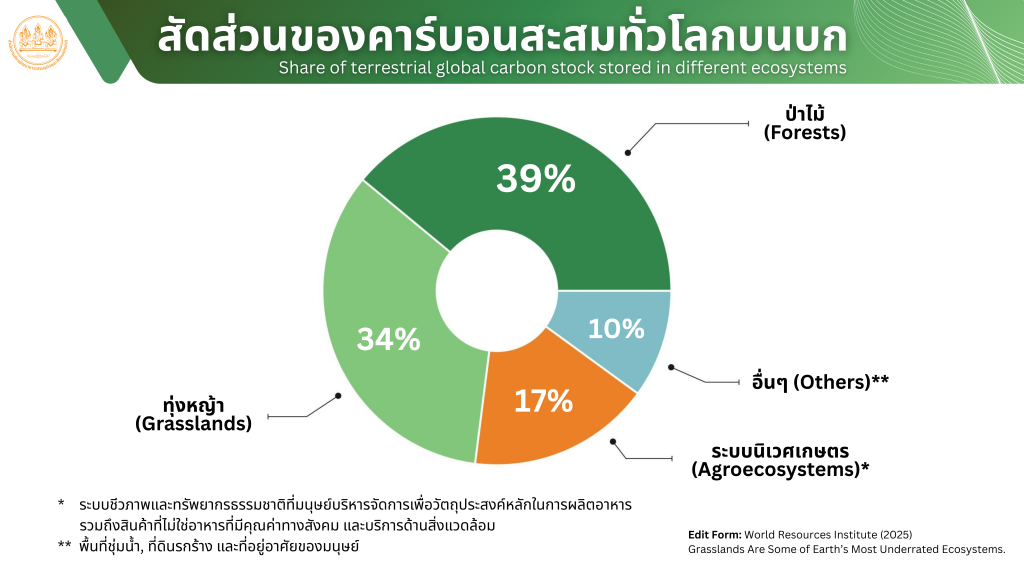
Source: World Resources Institute (2025)
Proper grassland management can clearly increase carbon storage potential. One approach that has gained attention is integrating trees into livestock areas, or “agroforestry systems”, which directly affects increasing the amount of carbon accumulated in soil, especially in tropical areas where soil is degraded or has low productivity. Implementing this approach helps accelerate soil restoration and continuously increase carbon accumulation. At the same time, maintaining grasslands in their natural open state is equally important, because native vegetation that has adapted directly to grassland ecosystems plays a key role in stable underground carbon storage. Both approaches reflect that grasslands are not merely secondary areas to forests, but are important pathways for addressing climate problems that use nature as the primary tool for restoring global balance.
The Role of Grasslands as Home to Life and Biodiversity
Grasslands are not merely open spaces in nature, but homes to countless lives. These areas support diverse plant and animal species, from large mammals to small animals living underground. The diversity that occurs is not randomly distributed, but occurs in patterns within tightly interconnected ecosystems. Some species cannot be found in forests or wetlands, but depend directly on grasslands for survival.
Grassland areas, woodlands, and savanna grasslands cover nearly 1 in 3 of the world’s important biodiversity areas, or more than 6.8 million square kilometers. Some temperate grasslands have such high density of life that nearly 90 species of plants and animals can be found per square meter, making them among the world’s most abundant ecosystems.
Many large mammal species that are symbols of each region depend directly on grasslands, whether bison in North American grasslands, elephants and giraffes in Africa, or wild horses remaining in Eurasian grasslands, as well as various grassland birds, including prairie dogs, all of which need the open environment of grasslands for breeding and nesting. Additionally, grasslands are home to many reptiles, amphibians, and small underground animals, which play important roles in food chains and help maintain overall ecosystem balance.
Grasslands and Their Ecological Role in Sustainable Water and Soil Restoration
From controlling water flow and reducing soil erosion to restoring nutrients, grasslands are ecosystems that play important roles in maintaining natural water balance. With deep and dense plant root systems, grasslands can help rainwater infiltrate underground well, replenish groundwater sources, reduce flood risks in lowland areas, and significantly mitigate drought impacts.
Beyond water management, grasslands also play important roles in maintaining soil quality, as plant root systems and soil microorganisms help enhance nutrient abundance and reduce soil erosion. This is particularly important in the context where the world is facing the problem of losing nearly half of its topsoil over the past 150 years. This capability helps grasslands become ecosystems that are resilient to environmental pressures and support sustainable agriculture in the long term.
The role of grasslands is not limited to water and soil systems, but also includes supporting pollinators such as bees and butterflies, which directly affect agricultural productivity worldwide. Approximately 35% of food crops consumed by humans depend on pollination by these animals. Therefore, conserving grasslands to maintain their abundance not only helps preserve biodiversity, but also guarantees global food security.
The Economic Role of Grasslands That Sustain Over a Billion Lives
Despite being overlooked in many parts of the world, grasslands serve as the economic foundation for countless people. More than 1 billion people worldwide still depend on grasslands as a source of livelihood, whether through livestock farming, food production, or various forms of land use. Not only are they connected to people’s livelihoods, but grasslands also play roles in the economic structures of many countries, especially regions where livestock and agricultural systems remain key mechanisms for generating income and food security.
The economic value from livestock production and other services related to grasslands is estimated at up to $20.8 trillion USD per year. This figure exceeds the Gross Domestic Product (GDP) of every country in the world, except only the United States and China. Grasslands are therefore not just open fields, but the world’s important animal protein production systems, especially in developing countries where marine food sources are limited. Livestock farming in grasslands has become the heart of food security in many regions.
The groups that benefit most from grasslands are often those with the fewest resources. Approximately 1 billion people worldwide, most of whom live below the poverty line, must rely on livestock farming as their main channel for survival and income generation. Particularly in Africa, where nomadic livestock farming and the use of savanna grassland areas play economic roles at the national level, with some countries having Gross Domestic Product (GDP) that depends on these activities by 5-25%. Grasslands are therefore not merely natural ecosystems, but economic networks that connect countless people to the land.
The Role of Grasslands in Addressing Climate Crisis and Sustainable Development
Although grasslands may not be the first image of important ecosystems, they are actually strategic areas with global roles. From carbon storage and supporting biodiversity to sustaining people’s livelihoods sustainably, with careful management, grasslands will become important mechanisms that connect environmental, economic, and social goals together. In many parts of the world, grasslands serve as food production areas, community homes, and climate change protection zones. However, what is concerning is that these roles have not been fully recognized by policies or global resource allocation.
Currently, more than half of the world’s grasslands are facing degradation, from agricultural expansion, urbanization, invasive species, or livestock impacts. Climate change compounds this crisis, both in terms of increasing heat and uncertain weather conditions. Grassland degradation does not only mean the loss of natural resources, but also means releasing carbon that was previously accumulated in soil back into the atmosphere. Without proper management, grassland loss could result in global greenhouse gas emissions of approximately 4.25 billion tons by 2050, comparable to India’s annual emissions. This reflects that grasslands are not merely local ecosystems, but turning points of global crisis.
Despite being overlooked on the international conservation stage, grasslands are beginning to receive increased attention. The United Nations has declared 2026 as the International Year of Rangelands and Pastoralists. However, knowledge and awareness alone are no longer sufficient. Both public and private sectors need to adjust policies and investments to protect and restore grasslands at a level as serious as forests to achieve sustainable development goals by 2030, which includes not losing grassland areas, increasing protection, restoring degraded areas, and sustainable management. Grasslands must be truly recognized as the heart of environmental security.
Understanding Grasslands is the First Step Toward Sustainable Development
Despite being overlooked by policy and society in many parts of the world, when considered comprehensively, it is found that grasslands have systemic roles covering everything from environment and economy to human security. Preserving and restoring grasslands is therefore not merely nature conservation, but long-term investment for future global stability. When we seriously turn back to look at grasslands, we may discover answers to sustainability that have been hidden in these vast open spaces all along.
Strategy and International Cooperation Coordination Division
National Economic and Social Development Council
References
BirdLife International & Grasslands, Rangelands, Savannahs and Shrublands (GRaSS) Alliance. (2023). Valuing grasslands: Critical ecosystems for nature, climate and people. Retrieved from https://www.birdlife.org/wp-content/uploads/2023/12/Valuing-Grasslands-Report-Dec-2023.pdf
Briske, D. D., Huntsinger, L., Sayre, N. F., Scogings, P. F., Stafford-Smith, M., and Ulambayar, T. (2025). It’s time to assign nonforested, nonagricultural lands a global designation. Cambridge Prisms: Drylands, 2, e5. https://doi.org/10.1017/dry.2025.2
British Ecological Society. (2019). Welcome to #BES2019 in Belfast BES President Richard Bardgett opens our conference. Retrieved from https://shorturl.asia/6xBbR
Climate Impact Partners. (2025). Grasslands. Retrieved from https://www.climateimpact.com/explore-projects/nature-based-solutions-projects/grasslands/
Sun, J., Wang, Y., Piao, S., Liu, M., Han, G., Li, J., Liang, E., Lee, T. M., Liu, G., Wilkes, A., Liu, S., Zhao, W., Zhou, H., Yibeltal, M., Berihun, M. L., Browning, D., Fenta, A. A., Tsunekawa, A., Brown, J., … Tsubo, M. (2022). Toward a sustainable grassland ecosystem worldwide. Innovation (Camb), 3(4), 100265. https://doi.org/10.1016/j.xinn.2022.100265
The University of Manchester. (2021). Urgent need for new approach to combat global grassland degradation. Retrieved from https://www.manchester.ac.uk/about/news/urgent-need-for-new-approach-to-combat-global-grassland-degradation/
World Resources Institute. (2025). Grasslands Are Some of Earth’s Most Underrated Ecosystems. Retrieved from https://www.wri.org/insights/grassland-benefits.
Related Documents