
Human trafficking is not a new problem, but what has changed is the methods, forms, and scope of crimes that have become increasingly complex. The networks operating behind them are not moving in a scattered manner but operate with more structured and systematic frameworks, reflecting the challenge that has been silently expanding and is difficult to address with traditional measures. This article invites exploration of how systematic human trafficking has become today, who are the groups that become victims, and how we can cope with this complexity by referencing the 2024 UNODC Global Report on Trafficking in Persons and the campaign for World Day Against Trafficking in Persons, which not only presents statistical data but demonstrates the structure of crime embedded in the economy, society, and gaps in systems that are still not comprehensively managed.
As the world changes faster, criminal groups can also adapt their strategies quickly, both in terms of methods, channels, and technologies used. Prevention and suppression efforts must therefore not remain static, because if we do not understand the underlying systems, responses will remain slow and off-target. Seeing the underlying structure is thus the starting point for truly protecting human rights.
World Day Against Trafficking in Persons 2025 with the campaign to stop systematically operated human trafficking
On July 30 of every year, which is World Day Against Trafficking in Persons, Thailand joins as part of a global campaign to remind of the severity of this problem and promote awareness and participation from all sectors in sustainable solutions. In 2025, the main theme of the anti-human trafficking campaign day is “Human trafficking is organized crime – End the exploitation” (Human trafficking is Organized Crime – End the Exploitation), which emphasizes that this problem is not merely the actions of any one individual, but is a process with clear structure, planning, systematic operations conducted by networks established like business organizations, making prevention and suppression increasingly complex.
Data from the United Nations Office on Drugs and Crime indicates that human trafficking remains a global problem that continues to intensify. Between 2020 and 2023, there were more than 200,000 people worldwide identified as victims, which is only a small portion compared to the estimated number of affected individuals who have not yet been reported. The complexity of this problem arises from criminal groups using methods from migration flows, gaps in legal and economic systems, to the use of digital platforms to facilitate the process of luring and forcing victims to become tools for exploitation through forced labor, sexual exploitation to forcing participation in illegal activities such as online fraud and drug smuggling. To counter networks that adapt and develop rapidly, there must be robust measures including law enforcement, proactive investigation, and international cooperation, including the adoption of new technologies. Moreover, support for human trafficking survivors must be based on principles that place victims at the center by establishing protection and support systems that allow them to truly access the justice process.
The global human trafficking situation reflects ongoing vulnerability and inequality
From the report The 2024 UNODC Global Report on Trafficking in Persons by the United Nations Office on Drugs and Crime, prepared under the framework of the UN Global Plan of Action to Combat Trafficking in Persons that began in 2010, this report is the 8th edition presenting an overview of human trafficking situations at global, regional, and national levels, covering 156 countries with analysis of trends in case detection and prosecution between 2019-2023. The content of this report points to concerning trends in many areas while reflecting the challenges of justice mechanisms that cannot keep up with increasingly complex forms of crime.
Human trafficking victims increase again after the pandemic
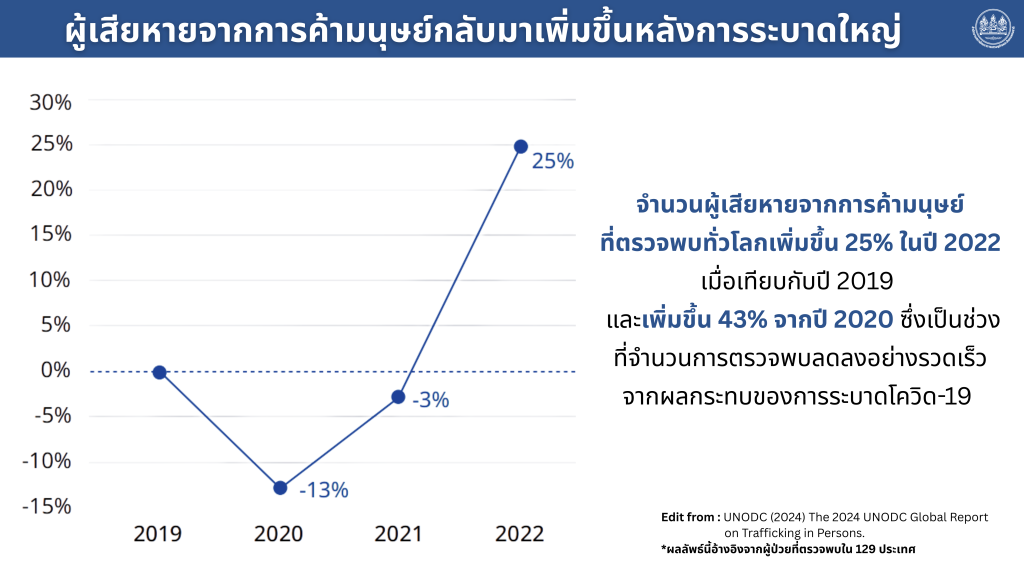
The number of human trafficking victims detected globally increased by 25% in 2022 compared to 2019 and increased by 43% from 2020, which was a period when detection numbers dropped sharply due to the impact of COVID-19. The continuous upward trend in 2023 remains evident, particularly in sub-Saharan Africa, North America, and Western Europe, while South America, Eastern Europe, Central Asia, East Asia, and the Middle East still have detection levels below pre-COVID levels.
Source: UNODC (2024)
Women and girls remain the most vulnerable groups
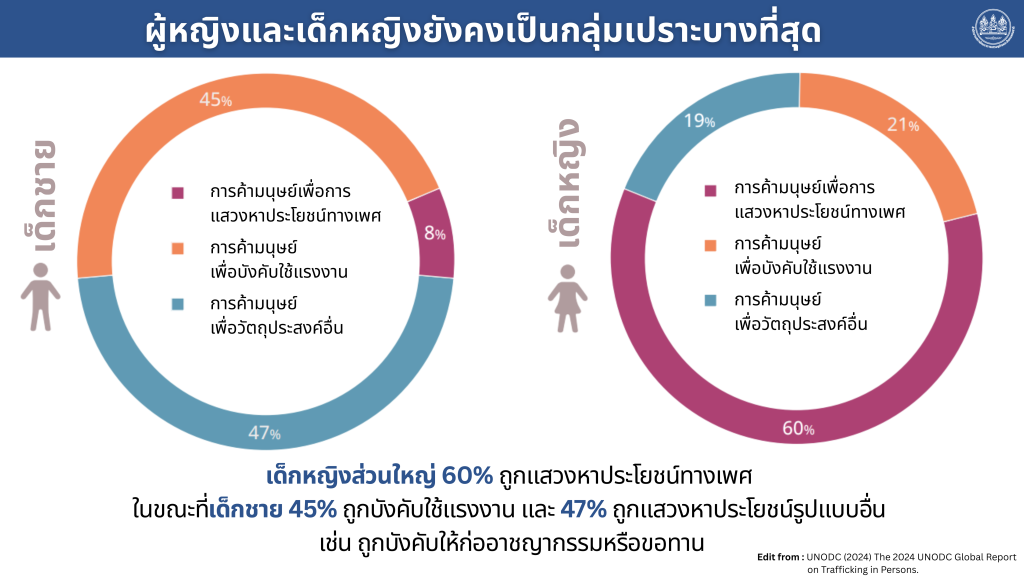
Detection of child victims increased by 31% in 2022 compared to 2019, particularly among girls, which increased by 38%. This situation is evident across various regions including the Americas, Europe, East Asia, and North Africa. Children without caregivers or separated from caregivers are at high risk. Most girls, 60% are sexually exploited, while 45% of boys are subjected to forced labor and 47% are exploited in other forms such as being forced to commit crimes or beg.
Additionally, it was found that in 2022, women and girls accounted for 61% of victims detected globally, specifically adult women 39% and girls 22%. Many of these female victims are forced into sexual exploitation, but a significant number are also subjected to labor, particularly domestic work, including being forced into marriage or committing crimes.
Source: UNODC (2024)
Forced labor becomes the main form of human trafficking
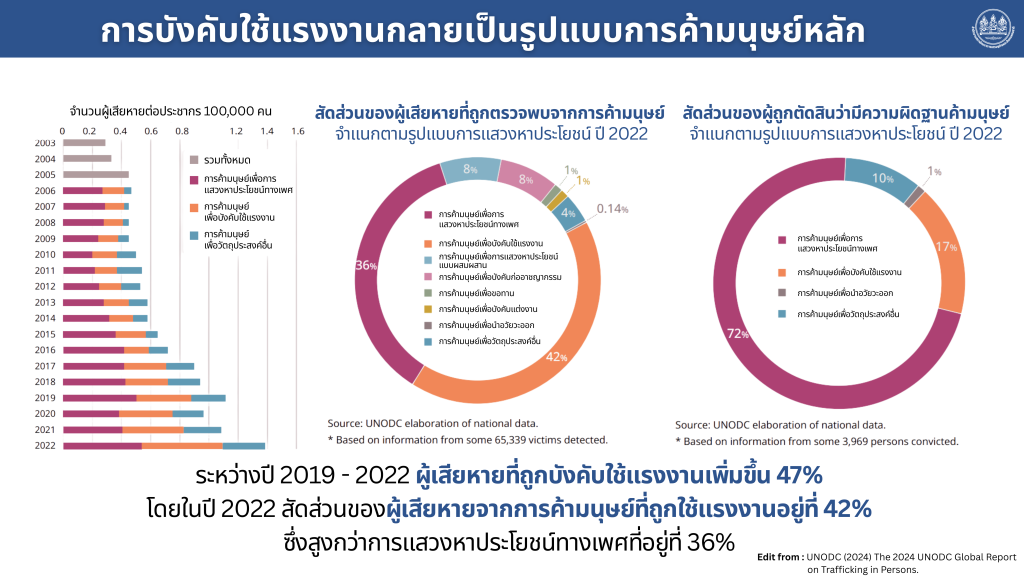
Between 2019-2022, victims of forced labor increased by 47%. In 2022, the proportion of human trafficking victims subjected to labor was 42%, higher than sexual exploitation at 36%, which was previously the main form. Although this trend has changed, global prosecutions still prioritize sexual cases more, with only 17% of convictions in 2022 related to forced labor compared to 72% related to sexual exploitation. Delays and complexity in the justice process remain significant obstacles.
Source: UNODC (2024)
Criminal networks are the main players in human trafficking
From analysis of 942 court cases involving 3,121 perpetrators, 74% were structured criminal networks operating like businesses or having structures rooted in local communities, while unorganized criminal groups accounted for only 26%, reflecting that this crime is usually carried out by systematically managed groups.
Africa is a major source region for transnational human trafficking
In 2022, human trafficking victims of 162 nationalities were detected in 128 countries, with 31% being Africans, making Africa the most important source region for cross-border human trafficking, with most sent to Europe and the Middle East. Meanwhile, victims from East Asia and South Asia appear in all regions, reflecting the global interconnectedness of this process.
Vulnerability from conflicts
and climate change exacerbates problems in Africa
Displacement from war, conflicts, and climate change are accelerating factors that put African populations at greater risk of human trafficking. Although many countries on this continent continue their efforts through legislation and prosecution, law enforcement remains limited to individual perpetrators and does not reach the level of transnational networks that are the main drivers.
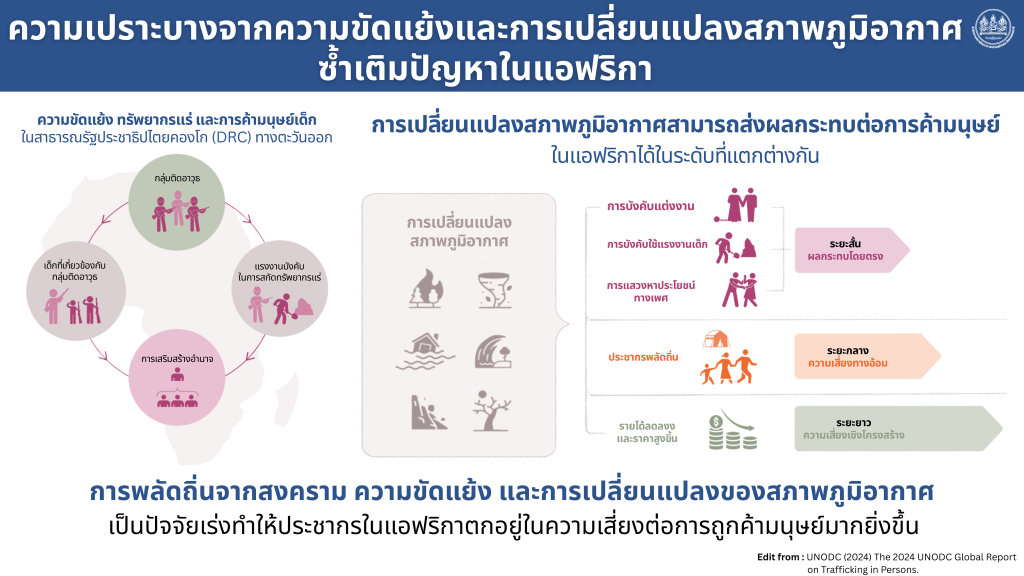
Source: UNODC (2024)
This report reflects the latest overview of the global human trafficking situation facing pressure from pandemics, geopolitics, and economic changes, showing continuously increasing statistics of human trafficking victims in many regions and pointing to disparities in law enforcement, justice processes that cannot respond in time, and forms of crime that have developed beyond what state mechanisms can control in time.
Overall, human trafficking remains a crime that feeds on the structure of global vulnerability. The increase in victims among children, women, and workers does not occur by chance but reflects the interaction between power, economy, and widespread insecurity that has been deeply embedded in the system for a long time. This report thus serves more than data compilation but as a reminder that human trafficking is not merely a legal problem but a test of morality, justice, and the collective will of humanity.
When efforts must continue, structural reform to end human trafficking in Thailand
In 2024, Thailand continues to be ranked in Tier 2 for the third consecutive year according to the ranking in the Trafficking in Persons Report: TIP Report 2024 by the U.S. State Department. Although it has not yet been able to move up to Tier 1, the report content reflects Thailand’s significantly increased efforts to improve and accelerate prevention and suppression measures for human trafficking to be more effective. In the past year, Thailand has had several interesting developments, such as increasing the number of investigations and prosecutions of perpetrators, identifying more victims from forced labor and human trafficking operations, prosecuting involved government officials, and increasing compensation for victims through court orders. All of these demonstrate a system that is beginning to strengthen in practice. Additionally, there has been the establishment of 13 victim shelters nationwide to accommodate and protect those affected by human trafficking crimes.
However, the Trafficking in Persons Report 2024 still reflects structural limitations and gaps in law enforcement that Thailand needs to urgently improve, particularly regarding victim interview processes that are not yet sufficiently effective, resulting in many human trafficking victims not being identified or entering appropriate protection processes.
A key issue clearly identified in the report is the failure to identify and protect victims of online fraud operations in neighboring countries who are often forced to commit complex forms of crimes. Some of these victims are Thai citizens and a significant number are foreigners who entered the country without legal status. Although these individuals show signs of potentially being human trafficking victims, many government officials fail to correctly identify their status. Instead, many are detained in immigration detention centers and prosecuted as perpetrators, despite these actions being a direct result of being exploited.
Another significant obstacle is legal requirements that foreign victims must stay in shelters throughout the case proceedings, which becomes pressure that causes many victims to choose not to report incidents or refuse to be witnesses in the justice process, resulting in law enforcement lacking necessary witness evidence.
At the local level, government services for victims still have clear disparities in both quality and access, reflecting the need to accelerate the development of mechanisms with uniform standards nationwide. At the same time, problems of corruption and complicity of some officials, particularly in border areas, remain significant obstacles and hinder the goal of sustainably eliminating human trafficking.
The report also suggests approaches that Thailand should consider adopting to enhance anti-human trafficking efforts to be more effective by advancing in areas that are still weaknesses, particularly proactive investigation and prosecution of government officials involved in human trafficking operations with appropriate punishment, including long-term imprisonment, to deter structural-level crimes.
One issue that needs urgent action is identifying and protecting victims who transit through the country after being subjected to forced labor in online fraud operations. The recommendations therefore point out that Thailand should end such practices and ensure that victims will not be punished for crimes committed as a result of being trafficked.
- At the policy level, National Referral Mechanism (National Referral Mechanism: NRM) and Reflection Period (Reflection Period) should be systematically implemented in all provinces, along with opening functional victim screening centers. Screening and assistance should be based on “victim-centered” principles and consider psychological trauma at every step, which should include representatives from civil society organizations in multidisciplinary teams.
- In practice, the report also emphasizes that Thailand should use technology to reduce exploitation channels, such as electronic wage payment and prohibiting mid-sea labor transfers, while standardizing screening forms between the Ministry of Labour and the Ministry of Social Development and Human Security and training frontline officers to understand their comprehensive use.
Additionally, there should be increased use of interpreters in shelters and courts and freedom for victims to enter and leave shelters, especially adults, while providing continuous access to communication tools. Shelters themselves must be developed to have individualized care approaches that truly consider mental health, including supporting non-governmental organizations to have greater roles in establishing shelters, particularly in remote areas.
Finally, the report emphasizes that Thailand must seriously investigate labor rights violations and systematically refer suspected human trafficking cases between agencies to close law enforcement gaps, while raising awareness among officials to recognize signs of human trafficking that may be hidden behind the word “labor”.
Thailand is at a turning point in addressing systemic problems. Although being in Tier 2 is not yet the ultimate goal, it reflects an important beginning that motivates government agencies, private sector, and civil society to drive operations to align with the complexity of problems and respond to the changing context of transnational crime. The transition from reactive efforts to proactive driving is a crucial turning point that will enable Thailand to not only achieve results in international ranking terms but also guarantee human dignity and a justice system that leaves no one behind.
Message from the Prime Minister and Thailand’s commitment to combating human trafficking
On the occasion of World Day Against Trafficking in Persons 2025, Thailand’s Prime Minister delivered a statement emphasizing the severity of human trafficking as a threat to human rights, economy, and national security. The Thai government recognizes the necessity of driving concrete policies and has declared the prevention and suppression of human trafficking as a “national agenda”. The Cabinet resolution designated June 5 of every year as Anti-Human Trafficking Campaign Day to demonstrate Thai society’s united stance in ending exploitation based on others’ suffering.
In the Prime Minister’s message, the commitment was expressed to elevate anti-human trafficking operations in all dimensions, including emphasizing the roles of government, public, non-governmental development organizations and international organizations, as well as volunteers in working together as networks to protect victims and uproot crimes hidden in the form of human trafficking operations. The essence of the country’s leader’s statement this time is not merely emphasizing problems but declaring Thailand’s commitment to seriously moving forward in combating human trafficking in all dimensions.
In 2025, the Ministry of Social Development and Human Security, as the national coordinating agency for Thailand’s human trafficking prevention and suppression operations, organized the Anti-Human Trafficking Campaign Day under the concept “Together We Can Stop Human Trafficking”, reflecting the commitment to creating joint force among all sectors including government agencies, public sector, private organizations, and international organizations to completely stop this serious crime (Zero Tolerance) from Thailand.
This year’s activities included an academic forum on “Technology-Facilitated Human Trafficking” that opened space for knowledge exchange about using technology as a tool in human trafficking, which is a problem that has become increasingly complex in the digital age, while pointing to comprehensive and timely response approaches. There was also an opportunity for Thai society to honor exemplary individuals and organizations dedicated to human trafficking prevention and suppression work, to inspire expansion and create strong examples at the local level.
Another highlight of the event was an exhibition presenting work according to the 3P approach: Prevention, Protection of victims, and Prosecution of perpetrators, reflecting Thailand’s systematic progress in terms of policy, integrated working mechanisms, and international cooperation.
This year also highlighted cybercrime issues related to human trafficking, particularly social media fraud schemes that have resulted in many victims falling prey to human trafficking operations in neighboring countries. For this reason, the Ministry of Social Development and Human Security emphasized the importance of adapting working methods to keep pace with modern threats and proactive work using “multidisciplinary team” mechanisms for screening, sorting, and appropriately caring for victims. This year’s campaign not only focused on symbolic communication but also emphasized creating deep understanding among the public by inviting them to see that human trafficking is not just one person’s problem but a problem of society as a whole that requires joint force in monitoring and preventing all forms of exploitation.
Under this commitment, the Anti-Human Trafficking Campaign Day 2025 is not just an annual activity but another mechanism that helps remind of everyone’s shared mission to jointly protect human dignity and jointly create a society truly free from human trafficking.
Conclusion: Moving forward without leaving anyone behind, ending human trafficking sustainably
Ending human trafficking today cannot be limited to merely managing crime in punitive terms but must advance to designing systems capable of preventing, protecting, and responding to the complexity of crimes that constantly adapt. The complexity of current human trafficking networks has challenged the capabilities of state mechanisms and justice processes that need improvement at policy, structural, and operational levels.
Although Thailand has made progress in many areas recently, there remain significant challenges that reflect structures requiring review, particularly regarding interviewing and identifying victims of human trafficking operations, which cannot yet cover the reality of new contexts such as cases of people deceived into illegal work abroad who are not recognized as victims, despite these illegal acts arising directly from exploitation. While law enforcement in many cases still does not align with the reality of human trafficking victims, making assistance measures lack understanding and not address urgent needs. The urgent necessity lies in adjusting mindset and mechanisms to focus on “victim-centered” approaches from screening, protection, to entering the justice process, and opening opportunities for civil society participation in monitoring or joint operations to make the entire process more just.
The development of effective mechanisms must also not neglect long-term investment in frontline officer quality, using technology to keep pace with new forms of exploitation, systematically communicating information between agencies, and reducing forced control of victims under conditions that create feelings of being perpetrators rather than those affected. This includes providing freedom for victims to access basic services, communication tools, and care that considers psychological well-being.
Inter-agency cooperation becomes meaningless without shared goals in eliminating structures that reproduce exploitation. The Trafficking in Persons Report 2024 provides clear recommendations on points Thailand must urgently implement to confidently advance from Tier 2 to Tier 1: pushing national referral mechanisms to achieve real results in all areas, creating reliable screening systems, and prosecuting perpetrators without exception, even government officials.
When problems do not arise in isolation, responses must not proceed in isolation either. Data connectivity, inter-agency cooperation, and raising standards of victim protection are key factors that will make mechanisms effective and leave no one behind. Amid social, economic, and technological transitions, flexible measures and systems based on human rights principles are important foundations of systems ready to prevent, protect, and truly respect the dignity of all human beings.
Strategy and International Cooperation Coordination Division
National Economic and Social Development Council
References
Compassion International. (2024). World Day Against Trafficking in Persons. Retrieved from https://www.compassion.com/world-days/world-day-against-trafficking-in-persons.htm
United Nations Office on Drugs and Crime. (2024). The 2024 UNODC Global Report on Trafficking in Persons. Retrieved from https://www.unodc.org/unodc/data-and-analysis/glotip.html
United Nations Office on Drugs and Crime. (2025). World Day Against Trafficking in Persons. Retrieved from https://www.unodc.org/unodc/en/endht/index.html
Ministry of Social Development and Human Security, Anti-Human Trafficking Division. (2025). Message from Ms. Paetongtarn Shinawatra, Prime Minister, on the occasion of Anti-Human Trafficking Campaign Day 2025, June 5, 2025. Retrieved from https://e-aht.com/startup#gallery99-1
Ministry of Social Development and Human Security, Anti-Human Trafficking Division. (2025). Trafficking in Persons Report 2024. Retrieved from https://e-aht.com/startup#gallery4-1
U.S. Embassy and Consulates in Thailand. (2024). Trafficking in Persons Report 2024: Thailand. Retrieved from https://th.usembassy.gov/th/our-relationship-th/official-reports-th/2024-trafficking-persons-report-thailand-th/
Office of the Prime Minister’s Secretary-General. (2025). “MSDHS” campaigns against human trafficking, mobilizing networks, uniting all sectors to eliminate human trafficking in Thailand. Retrieved from https://www.thaigov.go.th/news/contents/details/97172
Office of the Prime Minister’s Secretary-General. (2568). “Warawut” reveals June 5, 2025 Anti-Human Trafficking Campaign Day, this year MSDHS organizes big event at IMPACT Muang Thong Thani. Retrieved from https://www.thaigov.go.th/news/contents/details/96557
Thai Chamber of Commerce and Board of Trade of Thailand. (2024). Human Trafficking Situation Report TIP Report 2024. Retrieved from https://www.thaichamber.org/news/view/87/2960/รายงานสถานการณ์การค้ามนุษย์-tip-report-2024–
Related Documents