
Having strong and complete physical and mental health is a crucial foundation for national development as it enables citizens to utilize their full potential. Therefore, the global community has agreed to make promoting good health and well-being for people of all ages one of the Sustainable Development Goals (SDGs) to be achieved by 2030. Goal 3 is set to ensure healthy lives and promote well-being for all at all ages, focusing on building knowledge for proper healthcare, creating modern, quality, and comprehensive public health service systems, as well as preparing for effective responses to public health emergencies from communicable and non-communicable diseases, emerging diseases, accidents, and disasters.
Thailand’s public health system is considered very strong, reflected by progress in various dimensions, such as the continuously declining maternal mortality rate per live birth, which as of April 2020 stood at 20.24 per 100,000 population, down from 26.6 per 100,000 population in 2016. Similarly, the neonatal mortality rate has shown a declining trend, standing at 3.1 per 1,000 live births in 2019, down from 3.5 per 1,000 live births in 2016. The number of new HIV infections per 1,000 uninfected population has continuously decreased, standing at 0.10 in 2018, down from 0.13 in 2016.
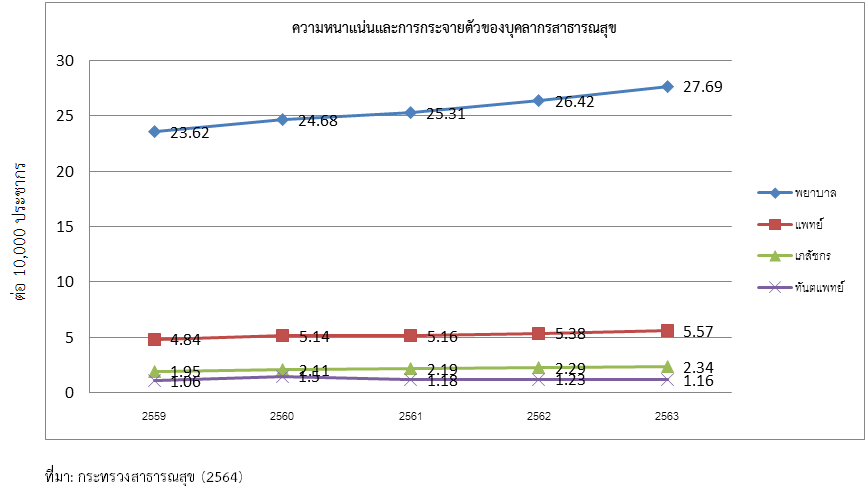
Furthermore, the density and distribution of Thailand’s public health personnel show an upward trend. In 2020, physician density increased to 5.57 per 10,000 population from 4.84 per 10,000 population in 2016, consistent with data showing increased density and distribution of dentists, nurses, and pharmacists, with details shown in the table below.
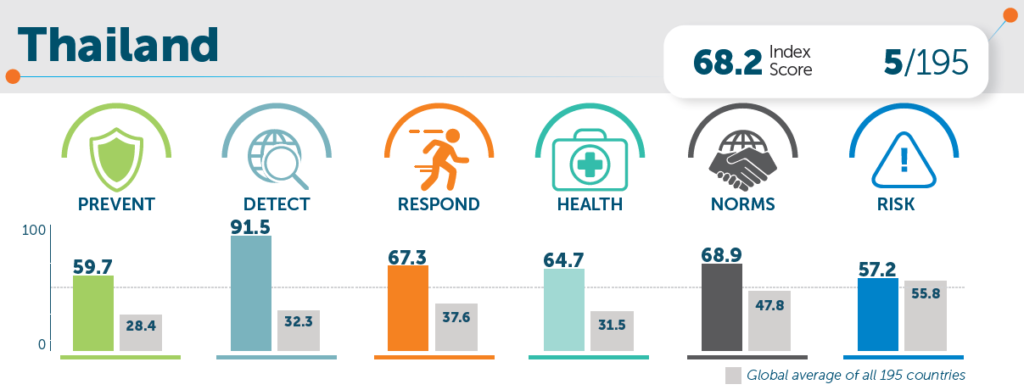
For this reason, Thailand has been recognized as having a strong public health system. In 2021, the Global Health Security Index ranking, which assesses countries’ preparedness to respond to epidemics and is compiled by the Nuclear Threat Initiative (NTI), Johns Hopkins Center for Health Security (JHU), and Economist Impact, ranked Thailand 5th out of 195 countries with a score of 68.2 out of 100, higher than the global average of 38.9. Thailand scored highest in disease detection and reporting at 91.5 out of 100, making it the only ASEAN country in the top 10, comparable to developed countries such as the United States, Australia, Finland, and Canada.
However, Thailand continues to face health risks in various dimensions, including the increasing number of deaths from non-communicable diseases such as cancer, cardiovascular disease, diabetes, and mental health disorders, partly caused by changing economic, social, and environmental factors affecting consumption behavior and lifestyle. Road traffic fatalities remain the highest in ASEAN and among the highest globally. Deaths and illnesses from agricultural chemicals, water contamination, and PM2.5 dust persist due to insufficient enforcement of laws and integration between relevant agencies to reduce and control pollution emissions, as well as limited knowledge in self-protection from agricultural chemicals, which remains a constraint in reducing the number of patients from direct chemical exposure.
Government agencies and various organizations have collaborated to drive policy initiatives and implement area-level operations to comprehensively address health problems, such as developing referral systems and integrating non-communicable disease databases to comprehensively link areas in response to the Universal Coverage for Emergency Patients (UCEP) policy, developing the Road Safety Master Plan 2018-2021 emphasizing comprehensive management of road users, vehicles, routes, and environment, as well as empowering provincial governors to control and eliminate all forms of pollution from the source at the area level.
Nevertheless, for Thailand to achieve the SDGs, particularly Goal 3, all parties must participate in addressing the country’s health problems through self-care, adjusting lifestyle behaviors for balance, reducing, limiting, and quitting alcohol consumption and smoking, as well as strictly following traffic rules. Government and relevant sectors need to comprehensively raise public health awareness and strictly enforce relevant laws and regulations.
Additionally, all sectors should prioritize developing public health systems to ensure vulnerable populations receive more comprehensive and equitable care, including applying technology to create road safety, developing comprehensive and accessible public transportation, and joining forces between agencies to prevent health problems and create sustainable good health for Thai people of all ages.
SDG 3 Issues Requiring Urgent Action

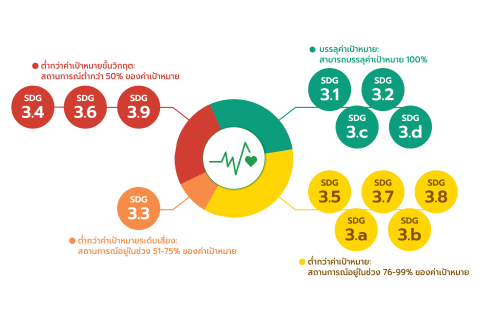
The assessment of Thailand’s SDG 3 progress between 2016-2020 found that it remains below the risk-level target, with a success rate of only 50-74% of the target value, indicated by orange status.
The overall SDG 3 status is orange due to having as many as 9 sub-targets below target levels out of 13 total sub-targets.
There are 5 sub-targets with implementation status below target in the range of 76-99% (SDG 3.5, 3.7, 3.8, 3.a, and 3.b) shown in yellow, 1 sub-target below the risk-level target shown in orange with status below target in the range of 51-75% (SDG 3.3), and 3 sub-targets below the critical level target shown in red with status below 50% of the target, which are issues requiring urgent action, comprising:
- SDG 3.4 Reducing deaths from non-communicable diseases, which continues to show increased mortality rates from cardiovascular disease, cancer, diabetes, chronic respiratory diseases, as well as deaths from suicide, partly caused by changing economic, social, and environmental factors affecting consumption behavior and lifestyle.
- SDG 3.6 Reducing road traffic deaths, where the number of deaths from such incidents remains higher than the set target, with main causes being drunk driving and non-compliance with traffic rules.
- SDG 3.9 Reducing deaths from hazardous chemicals, pollution, and contamination of air, water, and soil, where the number of deaths from such causes remains at a high level, with pollution and chemical contamination in the environment from industrial and agricultural sectors.
Strategy and International Cooperation Coordination Division
National Economic and Social Development Council
Related Documents