

Exploring Thailand’s Inequality Situation
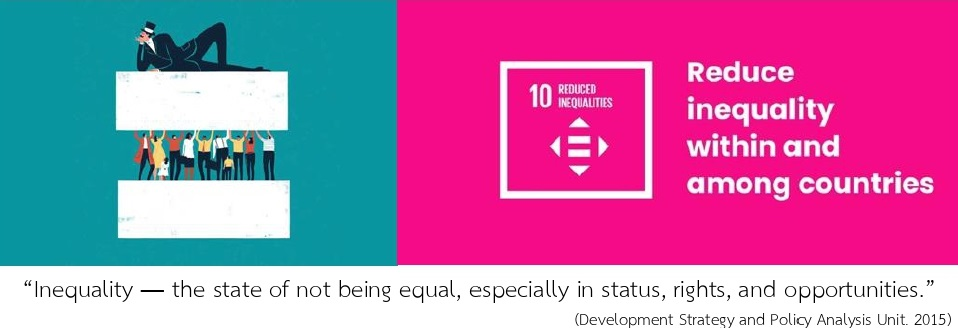
Inequality refers to the state of disparity in various aspects [1], including status, rights, and opportunities, or in a more specific economic sense, which often refers to income inequality, or in a broader sense, inequality in living contexts. Inequality in other definitions includes rights or legal aspects.
Thailand’s inequality problem is found in multiple dimensions [2], including income inequality between the poorest and wealthiest groups, with an income difference of nearly 16 times. While low-income earners need to incur increasing debt for their livelihood, high-income groups who do not need to incur debt have greater opportunities to accumulate wealth, resulting in inequality in asset ownership. The top 10% income group holds nearly one-third of the country’s assets, indicating wealth inequality. Thailand also experiences spatial inequality from economic growth and concentration in Bangkok and its vicinity, which differs from rural areas or other non-urban areas in terms of economic value and population, consequently affecting resource allocation and quality of public infrastructure. This reflects inequality in access to quality public services. Additionally, Thailand faces business inequality, where small and medium enterprises, which account for over 99% of all businesses and employ over 70% of total employment in the country, contribute only 34.6% of the gross domestic product [3]. Meanwhile, technological advancement may lead to digital inequality, as low-income groups often lack equipment readiness, digital skills, and capital to access internet systems, which will further limit their opportunities to participate in and benefit from new economic activities.
The causes of inequality in Thai society are multifaceted [4]. First, the economic structure with uneven income distribution and concentrated benefits, resulting from policies emphasizing quantitative economic growth, particularly hoping for results from economic expansion in the export-oriented manufacturing sector, which tends to favor capital owners more than labor. Additionally, Thailand has a high proportion of informal workers who lack social security and limited access to social welfare, totaling 19.6 million people or 52% of the 37.7 million employed [5]. Second, the centralized public administration structure affects access to basic public services for people in remote areas, such as education, skill development, public health, and various infrastructure. Quality public services are mostly concentrated in Bangkok Metropolitan Area and its vicinity, as well as major regional cities. Third, the justice process remains a limitation for low-income groups due to costs involved in accessing the justice process, lengthy case proceedings resulting in high accumulated costs, and strict adherence to bureaucratic procedures requiring complete documentation and use of language that is difficult to understand.
Goal 10: Reduce inequality within and among countries aims to focus on income growth for the bottom 40% of the poorest population, ensuring everyone can access economic, social, and political opportunities without discrimination, eliminating policies and policy outcomes that lead to inequality by using fiscal policy, wages, and social protection as tools to reduce inequality [6].
The assessment of Thailand’s progress toward achieving Sustainable Development Goal 10 from the Thailand SDGs Progress Report for the first five years (2016-2020) [7] by the National Economic and Social Development Council (NESDC) found that it remains below target levels for 6 out of 10 sub-targets. There are 4 sub-targets with implementation status below target levels (76-99%), including SDG 10.2, 10.3, 10.4
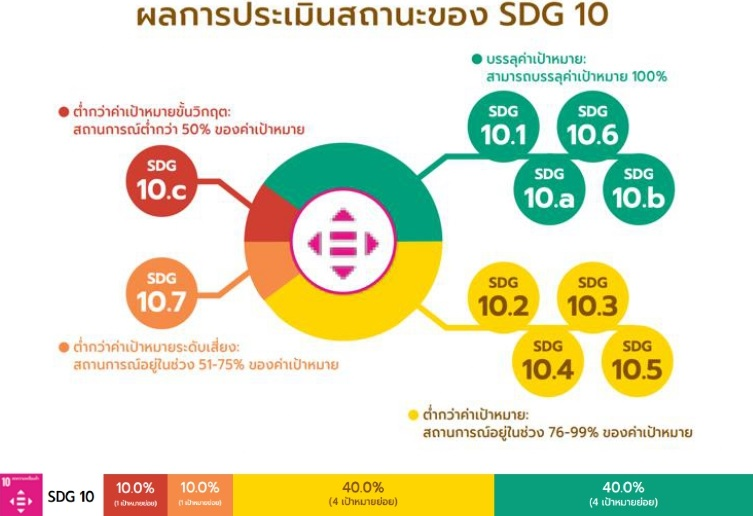
and 10.5 (shown in yellow). There is 1 sub-target with implementation status below target at risk level (51-75%), namely SDG 10.7 (shown in orange), and 1 sub-target with implementation status below target at critical level (below 50%), namely 10.c
- SDG 10.7: Facilitate orderly, safe, regular and responsible migration and mobility of people, including through the implementation of planned and well-managed migration policies. Although Thailand has developed more policies and laws to facilitate foreign workers in recent years, gaps in law enforcement and regulation implementation remain, resulting in Thailand still experiencing problems with illegal labor migration. Additionally, the COVID-19 pandemic has had economic impacts on employment, with both Thai and migrant workers at risk of termination and reduced re-employment rates. Some migrant workers had to return to their home countries during severe situations. However, although employment conditions have shown improvement trends recently, employment conditions may have changed, with increased use of technology to replace labor, except for 3D jobs – dirty jobs, dangerous jobs, and demanding or difficult jobs – which still rely on migrant workers as before.
- SDG 10.c: Reduce migrant remittance costs to less than 3% and eliminate international payment corridors with costs higher than 5% by 2030. Many Thai migrant workers working abroad still enter and exit the country without permission, and some lack knowledge in accessing new low-cost financial services, resulting in workers choosing informal channels. Although these have higher fees than formal channels, they are more flexible and accessible than operating through legal financial systems or institutions. Meanwhile, sending money back home through formal channels such as banks involves quite complicated procedures, requiring collection of large amounts of important information and documents, which may be barriers to service access for many migrant workers.
The Analysis Report on Poverty and Inequality Situation in Thailand 2021 [8] by the National Economic and Social Development Council (NESDC) found that Thailand’s income inequality situation in 2021 slightly increased from the previous year, which was the impact of the COVID-19 pandemic. The Gini coefficient for income in 2021 was 0.430, increased from 0.429 in 2019. One important observation is that Thailand’s inequality tends to increase after various crises.
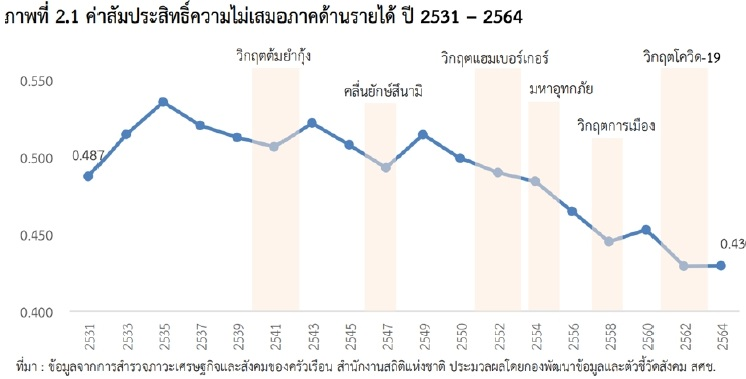
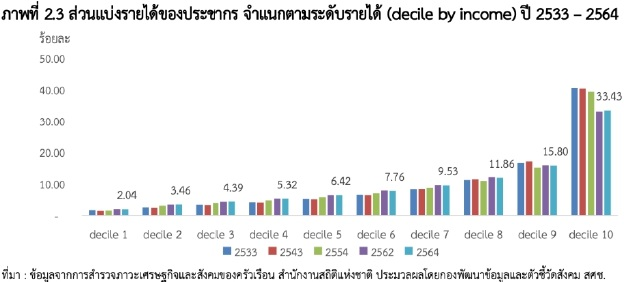
When considering income inequality by dividing the population into 100 groups by income level (percentile by income), it was found that over the past 30 years (1988-2021), the real income of people in high and low income groups (high and low percentiles) has tended to converge more. However, the difference in real income levels between the low-income population (1st-10th percentile) and the wealthiest (100th percentile) remains high. The real income of the 1st-10th percentile averages about 2,096 baht per person per month, while the real income of the 100th percentile is 89,784 baht per person per month, or 42.8 times higher. Therefore, although the growth rate is high (for low-income groups) and shows convergence trends, the country’s income inequality may not be able to decrease significantly because the rate of income increase among the wealthy, though not high, has a higher value than the increased income value among low-income groups, making the reduction of gaps between groups limited.
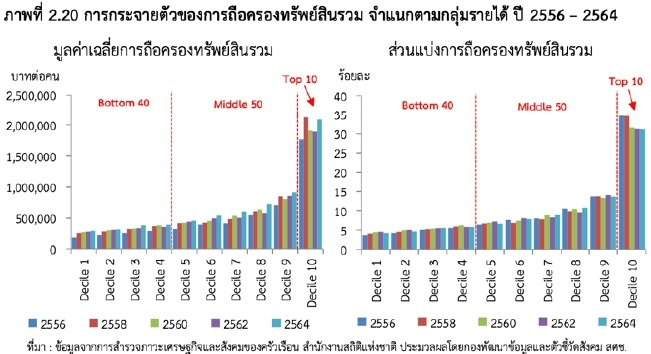
Additionally, when dividing the population into 10 income groups (decile by income), it was found that in 2021, the average total asset value of the population in all income groups increased from the previous year. The Middle 50 (deciles 5-9) had the highest growth rate of total asset value at 12.4%, while the Top 10 (decile 10) had the second highest growth rate at 10.5%, and the Bottom 40 (deciles 1-4) had a growth rate of 7.4%. Although the growth rate of average total asset value in the Middle 50 group is high and greater than the Top 10 group, which results in an overall improvement in asset ownership inequality trends, when considering the average total asset value of the Top 10 group, it shows a relatively high level of difference. In terms of total asset value share, the Top 10 group’s share slightly decreased to 31.2% of the country’s total assets. However, the Bottom 40 group’s share of total asset value decreased, unlike the Middle 50 group which increased significantly. This situation further widened the gap between the Bottom 40 and Top 10 groups in 2021.
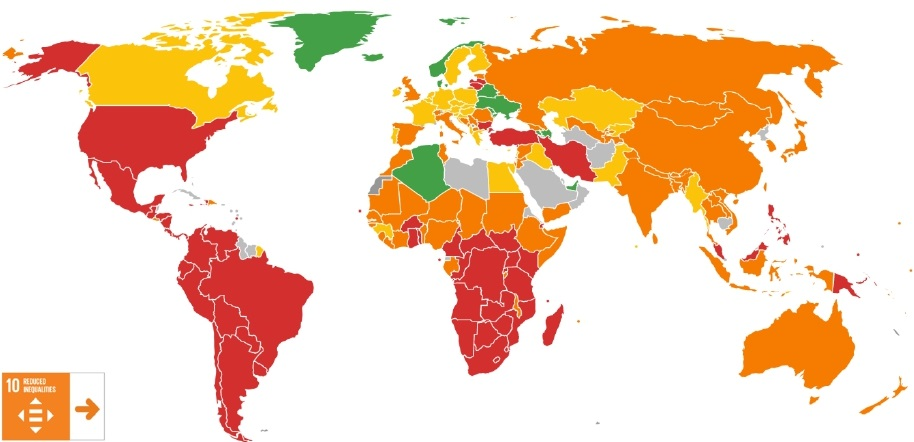
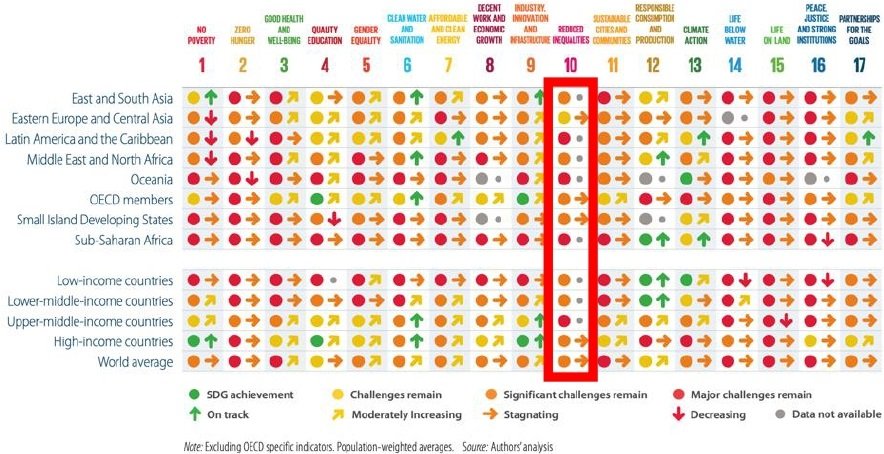
Regarding the global inequality situation from the Sustainable Development Report 2023 [9] by the United Nations Sustainable Development Solutions Network (SDSN), the assessment of Sustainable Development Goal 10 progress globally shows it remains under significant challenges (shown in orange) with insufficient progress trends. This situation does not occur only in developing or least developed countries; even OECD countries or high-income countries face similar conditions.
In conclusion, although efforts to address inequality and create social equity during the first five years of driving the Sustainable Development Goals (2016-2020) have resulted in better progress for Thailand, when faced with the impact of the COVID-19 pandemic that caused inequality problems in various dimensions to expand, it reflects the vulnerability of the economic structure to crises and the challenges in Thailand’s social structure that still exist. Therefore, the government should accelerate structural economic reforms using measures and regulatory improvements in various areas to achieve more equitable distribution of income and development benefits, such as tax collection system reform, upgrading essential social welfare for livelihood to create basic social security to improve the living standards of low-income groups with comprehensiveness and equality, as well as promoting the use of various social mechanisms to create collaborative power in driving operations to reduce inequality in Thai society, to achieve Sustainable Development Goal 10 together according to the principle of leaving no one behind, achieving concrete results going forward.
Strategy and International Cooperation Coordination Division
National Economic and Social Development Council
Related Documents