

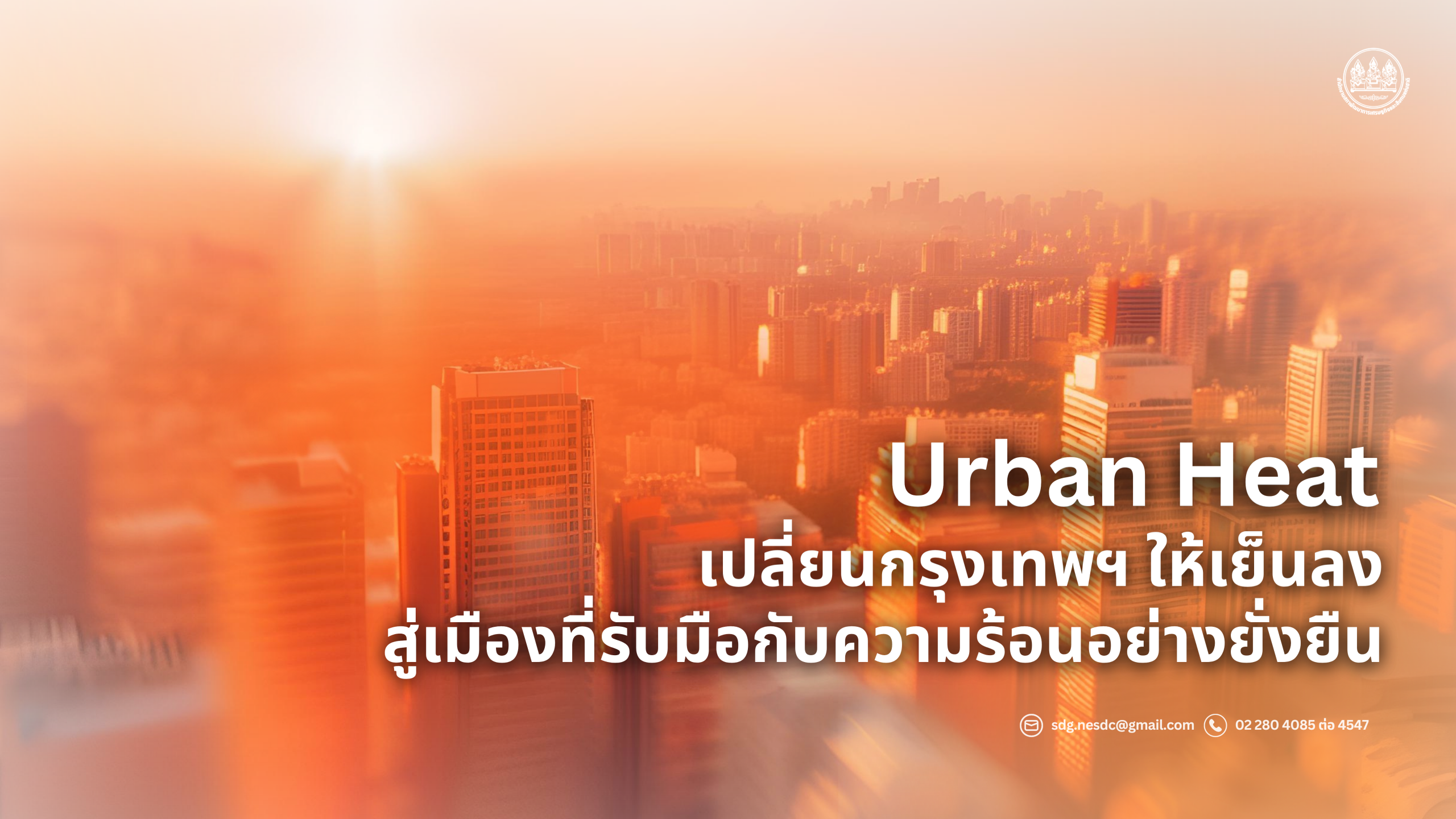
Amidst towering buildings and scorching concrete roads, Bangkok is facing the Urban Heat Island phenomenon, affecting health, economy, and quality of life for urban residents. The report “Shaping a Cooler Bangkok: Tackling Urban Heat for a More Livable City” by the World Bank in 2025 presents compelling data on causes, impacts, and approaches to reduce urban temperatures, making Bangkok more livable and capable of effectively responding to climate change. This article explores how we can cool down Bangkok to move toward a city that can sustainably manage heat.
What is Urban Heat Island and why should we care?
As global temperatures reached record highs in 2024, warning signs of global warming impacts became increasingly clear. One phenomenon directly affecting our daily lives is the “Urban Heat Island” (UHI). This phenomenon is making major cities worldwide heat up faster than ever, impacting health, economy, and people’s quality of life.
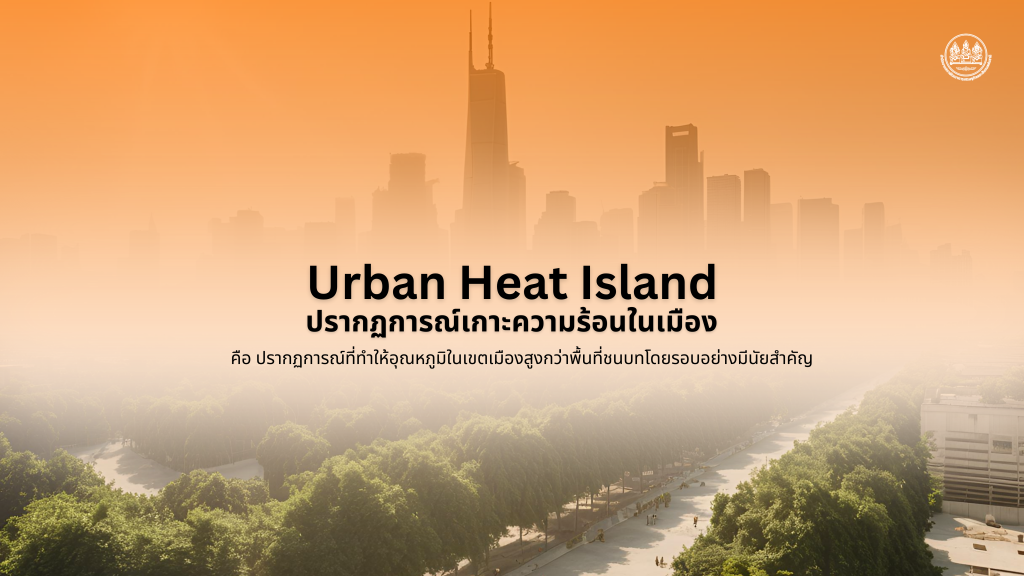
Urban Heat Island (UHI) is a phenomenon that causes temperatures in urban areas to be significantly higher than surrounding rural areas. The main cause stems from urban development that transforms natural surfaces into roads, concrete, and tall buildings, which absorb and retain more heat than green spaces. Additionally, extensive energy use, including vehicle emissions and factory exhaust, further increases urban temperatures. Particularly in densely populated vulnerable areas, temperatures are noticeably higher than surrounding rural areas.
Bangkok is one of the cities clearly affected by the Urban Heat Island phenomenon. Statistical data shows that Bangkok’s average annual temperature from 1960-2000 was 28-30 degrees Celsius, but by the end of this century, the figure may increase by another 2.5-4.5 degrees Celsius without greenhouse gas emission reductions. Studies using specialized climate models, such as the Weather Research and Forecasting model (WRF version 4.2), found that some areas of Bangkok have temperatures up to 6 degrees Celsius higher than surrounding rural areas, especially at night, directly affecting people’s rest quality and health.
Why does urban expansion increase heat?
Growing cities are making us hotter than ever. Urban expansion is not merely a symbol of prosperity but also brings significantly increased heat problems. When tall buildings, paved roads, and human activities replace green spaces, urban temperatures rise faster than surrounding areas. This phenomenon is not limited to major global cities but is clearly visible in Bangkok, a city facing increasingly severe heat each year.
How do cities become hotter? Urban growth causes reduced green spaces. Originally, trees and public parks naturally absorbed heat and released coolness, but as cities expand, these areas are replaced by tall buildings, paved roads, and concrete that accumulate heat, inevitably raising urban temperatures. Moreover, construction materials such as concrete and asphalt have properties that store heat during the day and release it at night, causing cities to remain sweltering throughout the night even after sunset. Additionally, continuous use of engines and air conditioning accelerates urban heating. Vehicle emissions and heat released from air conditioning create an endless heat cycle, making cities increasingly hot and affecting people’s long-term quality of life. Some areas of Bangkok are significantly hotter than others. Central districts such as Pathumwan, Bang Rak, and Ratchathewi have higher temperatures than suburban districts with more open spaces. This factor reflects the role of urban environment in heat accumulation. So how can we cool down cities? Solving this problem requires approaches of increasing green spaces, using heat-reflective materials, and designing cities that facilitate air circulation, all key to reducing heat impacts.
Impacts from Urban Heat that should not be overlooked
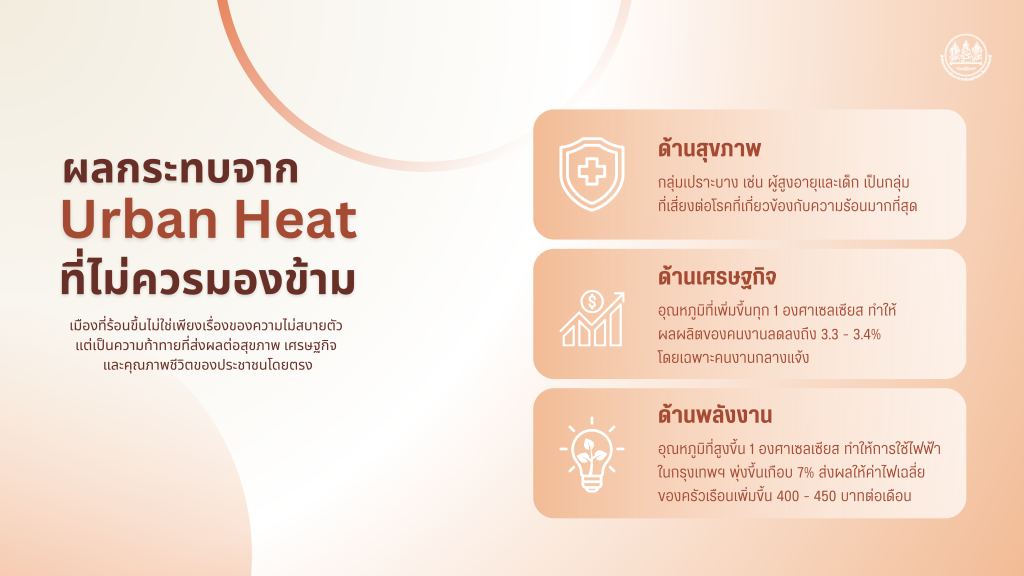
Heat can be fatal both directly and indirectly, not only causing heat stroke but also worsening symptoms of cardiovascular or respiratory diseases. In 2019 alone, urban heat caused 421-1,174 excess deaths in Bangkok, and if temperature increases by just 1 degree Celsius, it could surge to 2,333 deaths per year, comparable to road accident fatalities. If temperature increases by 2 degrees Celsius, losses could reach 3,814 deaths per year, demonstrating the increasingly severe dangers from climate change. Hotter cities are not just about discomfort but challenges that directly affect public health, economy, and quality of life.
Health impacts: Vulnerable groups such as elderly people and children under 15 years old, representing 9.3% and 8.2% of Bangkok’s population respectively, are most at risk for heat-related diseases. Additionally, low-income communities living in poorly ventilated areas face higher temperatures without options to avoid them, resulting in deteriorating health and reduced daily living capabilities.
Economic impacts: Hotter days don’t just create discomfort but also reduce labor productivity. Every 1 degree Celsius temperature increase reduces worker output by 3.3-3.4%, equivalent to income losses of 44.7 billion baht per year or 0.8% of Bangkok’s GDP. Outdoor workers such as construction laborers, street vendors, and motorcycle taxi drivers are most severely affected, while office workers also face reduced work capacity.
Energy impacts: A 1 degree Celsius temperature increase causes electricity consumption in Bangkok to surge nearly 7%, resulting in average household electricity bills increasing 400-450 baht per month, or nearly 29% higher. Low-income households are most severely affected as they must spend most of their money on electricity bills. Increased electricity consumption comes with an additional 2 million metric tons of carbon dioxide emissions per year, exacerbating climate problems that cause the heat crisis.
How to reduce urban temperatures? Effective solutions
Bangkok is facing continuously rising temperatures, challenging both quality of life and public health. To address urban heat problems through comprehensive and sustainable approaches: proactive long-term planning emphasizing green space expansion, increasing public parks such as 15-minute parks, and developing green buildings, which help concretely reduce heat accumulation, and emergency response measures during heat crises through a 4-level warning system, from monitoring phase, warning phase, critical phase, to extreme critical phase, with various measures ranging from public guidance to opening shelters.
Additionally, Bangkok has infrastructure and green projects demonstrating the city’s efforts to address heat, such as solar-powered bus stops that serve as comfortable cool waiting areas while promoting energy conservation, and the one million tree planting project that creates shaded areas, as well as promoting public-private partnerships such as urban forests. The combination of innovation, technology, and ecological urban design is key to Bangkok’s progress toward a city that can effectively and sustainably manage heat.
Bangkok’s current heat action plan is designed to correspond with temperature severity levels, divided into 5 phases: long-term measures, monitoring phase, warning phase, critical phase, and extreme critical phase, to enable effective response from preventive foundation-laying to emergency response in worst-case scenarios. This helps Bangkok systematically manage heat crises, reduce risks, and prepare the city for increasingly severe weather in the future.
| Phase | Objective | Measures | Agencies |
| 1. Long-term Measures (Year-long Measures) | Develop plans and approaches, raise awareness and monitor health risks related to heat | Provide community education, distribute protective equipment, and promote urban heat reduction strategies | Department of Climate Change and Environment Department of Health Department of Social Development and Welfare |
| 2. Monitoring Phase (Monitoring Phase) (27°C – 32.9°C) | Alert the public and at-risk groups about potential heat impacts | Daily heat index monitoring, advance warnings, and guidance on heat safety precautions | Department of Climate Change and Environment Department of Health Meteorological Department Public Relations Department |
| 3. Warning Phase (Warning Phase) (33°C – 41.9°C) | Issue warnings about heat risks and begin implementing response plans | Provide information or guidance to the public, activate shelters, and prepare emergency response units | Department of Climate Change and Environment Department of Health Public Relations Department District Offices Department of Disaster Prevention and Mitigation National Broadcasting and Telecommunications Commission |
| 4. Critical Phase (Critical Phase) (42°C – 51.9°C) | Implement emergency measures to protect public health | Emergency services ready limit outdoor activities, and provide water refill stations | Department of Health Department of Health Emergency Operations Center District Offices |
| 5. Extreme Phase (Extreme Phase) (above 52°C) | Enforce strict safety measures to prevent severe health impacts | Full emergency response, mandatory shelters, and continuous health monitoring | Department of Health Department of Health Emergency Operations Center District Offices |
Toward a Green City: Heat Management Approaches for Sustainable Bangkok
Bangkok is facing challenges in dealing with increasingly severe heat waves each year, forcing the city to confront heat dissipation in more crowded areas than ever before. Climate change impacts don’t just raise temperatures but also affect public health. Addressing this problem cannot be done in isolation but requires integrated and comprehensive approaches. The key is connecting “people, places, and institutions” to work together to build long-term heat resilience. Participation from all sectors will be crucial in transforming Bangkok into a cooler city capable of sustainably adapting to climate change.
1. Places
Creating sustainably cooler environments
One approach Bangkok wants to develop to address Urban Heat Islands is targeting “hotspots” through detailed heat mapping to identify areas most affected by heat. Integrating heat maps with urban planning will help efficiently allocate resources such as tree planting and reflective surface improvements, especially in high-density districts with low-income populations.
Expanding green and blue infrastructure such as tree areas, wetlands, and rooftop rain gardens will significantly help reduce urban temperatures. Canal conservation and supporting private sector green spaces also promote natural heat dissipation and long-term air quality improvement.
Additionally, integrating heat resilience concepts into urban planning and building regulations is key to creating cities capable of handling rising future temperatures. Requiring green roofs and heat-reflective materials in new buildings will help reduce urban heat accumulation, while encouraging private sector adoption of these measures through tax incentives will help accelerate adaptation and expand these approaches to projects throughout the city.
2. People
Building awareness and heat protection readiness
Vulnerable populations such as elderly people, children, and outdoor workers require special care. Building awareness through targeted public campaigns using various media such as billboards, social media, and multilingual media will help increase heat safety knowledge and promote participation among all population groups.
Expanding early warning systems using various channels such as SMS, public radio, and loudspeakers will help ensure timely alerts reach everyone, especially those without smartphones or internet access.
Another important measure is establishing shelters and water refill stations in public places such as schools, libraries, and temples, helping people escape extreme heat, as well as expanding public water refill stations in key locations to prevent dehydration during high temperatures.
3. Institutions and Related Regulations
Strengthening sustainable governance
Building long-term heat resilience requires good coordination between agencies. Establishing inter-agency heat working groups and defining clear governance mechanisms will help ensure efficient policy implementation and resource allocation.
Strengthening regulations and policies to protect outdoor workers and establish heat reduction measures will be important foundations for urban heat management, helping Bangkok achieve goals of creating a green and sustainable city.
Finally, establishing a dedicated fund for urban heat response will be a crucial mechanism helping Bangkok have stable funding sources for implementing long-term measures to reduce impacts from rising temperatures. This fund will support proactive planning and enable strategy adjustments based on annual monitoring and evaluation results, ensuring various measures can effectively and sustainably respond to changing climate conditions.
The future of cities in an era of increasing heat
In a world where temperatures rise every year, future cities will not just be about building tall structures or adding traditional green spaces, but redesigning entire systems, from heat-reflective building materials to using artificial intelligence to efficiently predict heat spots. Some cities choose to move forward by changing infrastructure to accommodate climate change, while others try to coexist by adjusting social behaviors. If we view cities as living entities, surviving cities are those that adapt best, not necessarily the largest or most technologically advanced. The question is not just how we can cool cities down, but how we can transform cities into livable spaces even on the hottest days. The answer may lie in designing cities as part of nature rather than opposing it, using wind and water as heat mitigation tools more than relying on air conditioning, creating well-distributed shaded public spaces rather than placing hope in just a few large parks. Designing cities that integrate with nature will help cities become resilient to climate change and create better quality of life for citizens.
Strategy and International Cooperation Coordination Division
Office of the National Economic and Social Development Council
References
Environmental Protection Agency. (n.d.). Heat Island Effect. Retrieved from https://www.epa.gov/heatislands
World Bank. (2025). Shaping a Cooler Bangkok: Tackling Urban Heat for a More Livable City. Retrieved from https://www.worldbank.org/en/country/thailand/publication/shaping-a-cooler-bangkok-tackling-urban-heat-for-a-more-livable-city
World Bank. (2025). World Bank and Bangkok Metropolitan Administration Highlight Ways to Strengthen Resilience Amid Rising Heat Crisis. Retrieved from https://www.worldbank.org/th/news/press-release/2025/03/26/world-bank-and-bangkok-metropolitan-administration-highlight-ways-to-strengthen-resilience-amid-rising-heat-crisis
Related Documents