


In a world where the economy grows unequally, poverty is not merely a matter of fate but a result of fragile and inequitable structures that keep the majority of people trapped in the same cycle. Even when they have jobs, even when the economy recovers, stability remains elusive. The changes of the modern world therefore do not only signify progress, but also harbor uncertainty that affects people’s lives, especially vulnerable workers. This article invites exploration of why “poverty” persists in a society full of resources and technology and why escaping poverty is not a matter of “hard work” but understanding a system that was never designed for everyone.
Labor in an unstable world: inequality, opportunities, and employment challenges
In an era when the world faces rapid economic changes, income and opportunity inequality has become a major obstacle to inclusive development. Many countries around the world face the phenomenon where the rich get richer while the majority remain trapped in cycles of poverty, especially in the context of developing countries. Those born into poor families tend to have a high likelihood of remaining in poverty throughout their lives and passing this condition on to their children and grandchildren, resulting in inequality becoming a deeply entrenched structure.
Even during certain periods when many countries have been able to reduce poverty in the short term, it has often been only a temporary result of economic stimulus measures, such as government spending during the COVID-19 crisis. However, when this temporary support ends, vulnerable populations face even more severe instability than before. Nearly 2 out of 3 of the world’s population live in countries where inequality is increasing, particularly in low-income countries that lack resources to care for their citizens during crises.
Data from Oxfam International in 2024 indicates that the richest 1% of the world’s population owns more wealth than the remaining 95% combined, and in some countries such as the United States, India, and China, the top 1% of wealthy individuals have a combined income accounting for more than 20% of the entire country’s income. These figures clearly show that the current economic system obviously benefits a small minority while the majority lack the power to access basic opportunities.
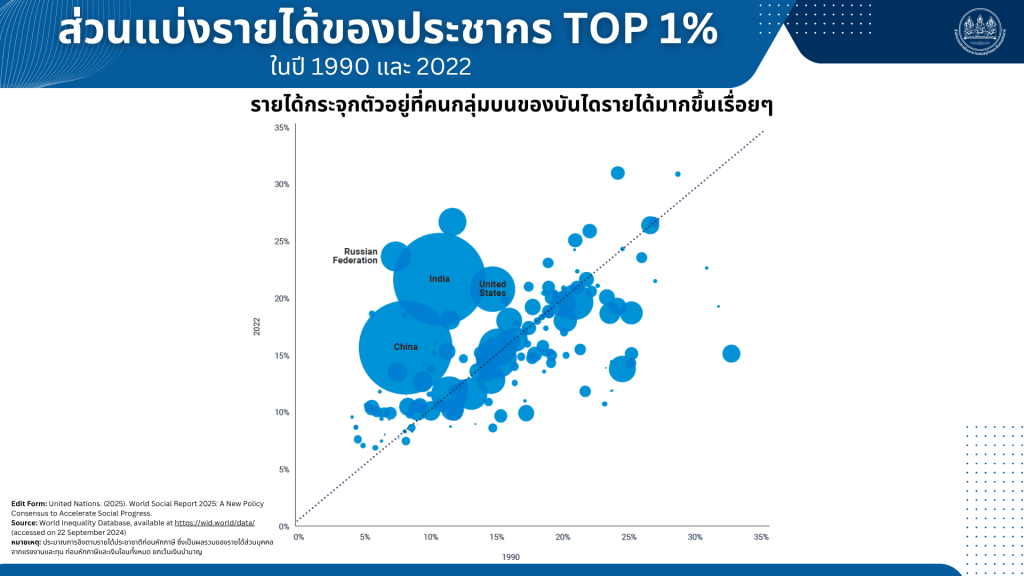
Source: United Nations (2025)
An economy that grows, but people feel insecure. Although technological development and innovation have improved quality of life in many dimensions, such as access to food, health, and education, measuring results through income or GDP alone cannot reflect the true state of well-being. Currently, 60% of the world’s population is still dissatisfied with life, and over 12% face suffering from economic and social factors.
One of the key factors undermining people’s security is income insufficient for dignified living. Although some people may escape extreme poverty, they remain in vulnerable low-income groups. Over 690 million people worldwide still live below the extreme poverty line with income less than $2.15 USD per day, and there are more than 2.8 billion people with daily income of only $2.15 – $6.85 USD per day. All these people face constant insecurity, and if even a minor economic shock[1] occurs, such as a pandemic or climate crisis, it can push these groups back into poverty again.
A labor market that appears to be recovering but remains vulnerable. In 2023, global unemployment rates dropped to their lowest level in two decades at 5%. However, having employment does not always mean people have economic security. Many workers remain in unstable positions without protection and social security. Data from 2022 indicates that 1 in 5 employed people still live in moderate or extreme poverty, and equally concerning is that about 60% of workers worldwide worry they might lose their jobs and be unable to find new employment. This insecurity is not limited to low-skilled workers but also includes workers with good education and experience who should receive growth opportunities in the modern economy, yet face high competition and pressure from living costs.
The unstable lives of informal workers. In many regions, particularly in low to middle-income countries, the majority of workers remain in informal employment systems, meaning work without clear contracts, benefits, or any form of security. Despite efforts to reduce informal employment in the past, results have not been concrete. Many informal workers are self-employed individuals with low skills who are at high risk of moving to even more vulnerable positions, while workers in formal wage systems tend to maintain stability better. This situation is not limited to developing countries, as even high-income countries see unstable employment continuously increasing, especially in the Gig Economy[2], which while providing workers with flexibility, comes with instability in income, health, and long-term future.
Vulnerable worker groups and the erosion of social contracts. Female workers, youth, and workers outside the economic system are often overlooked in employment policies, even though these groups play important roles in driving society. A clear example is many female workers performing unpaid household and family care duties which are not counted as economic labor despite creating significant social value. Meanwhile, more than 20% of youth are not in employment, education, or training (NEET)[3], reflecting the system’s failure to connect this group with labor market opportunities. This situation is undermining public confidence in social contracts that should create equal opportunities.
The adaptation of workers in the modern world should not be viewed as solely the responsibility of workers alone. The state needs to review its role in creating security systems, new skills training, and equitable resource allocation so that people can survive and thrive in rapidly changing environments.
[1] Economic Shock refers to unexpected changes in fundamental macroeconomic variables that significantly impact economic performance indicators such as unemployment rates, consumption, and inflation rates.
[2] Gig Economy refers to an economic system arising from temporary work or contract-based jobs, often used to describe part-time employees or freelancers.
[3] Not in Education, Employment, or Training (NEET) refers to a group of people not in education, training, or employment systems.
Behind low unemployment figures lies instability in the modern labor market
Although policies in many countries attempt to bridge this gap, they still face significant obstacles such as low labor productivity levels resulting from structural limitations such as lack of capital, access to credit, or other economic resources, particularly among numerous small businesses that cannot comply with labor regulations despite wanting to. Policies in many countries therefore attempt to manage informal work not only to protect workers
but also to upgrade the economy simultaneously.
However, the relationship between informal work, labor productivity, and poverty is not a straight path but has complexity in both directions. On one hand, businesses with low productivity often cannot comply with labor laws due to lack of resources and support, and on the other hand, rural poverty prevents people from accessing formal jobs, leading them to turn to informal work instead, which cycles back to chronic poverty. This reflects that informal work is a result of structural problems, both low productivity and uneven development levels.
Changes in employment patterns are restructuring traditional frameworks. Overtime work, temporary work, and general contract work, including zero-hours contracts, are increasing and becoming new norms in many countries, particularly among youth in high-income countries. This situation is particularly evident in Europe, where workers aged 20-24 have temporary employment proportions reaching 41%, up from 29%. Additionally, workers aged 35-39 have temporary employment proportions increasing from 11% to 17%. This trend indicates declining employment security even during working ages previously considered the most stable period.
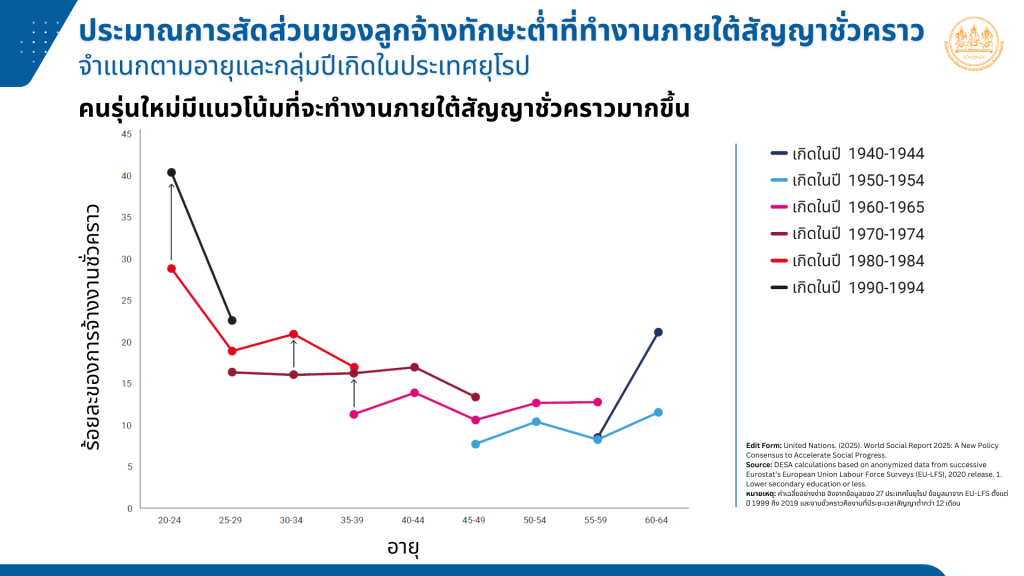
Source: United Nations (2025)
Escaping poverty is not a straight path but full of uncertainty. Although many countries have been able to reduce poverty rates, behind these figures are many people who continue to move in and out of poverty status constantly. That is, some periods they escape but later may fall back into poverty again. For example, in rural Bangladesh and Cambodia, many people were able to continuously improve their quality of life and escape poverty during 2011-2019 and 2008-2017 respectively, corresponding to economic growth and higher value-added employment. Meanwhile, in Nepal’s case, despite low employment rates, poverty was reduced after the civil war ended in 2006, with remittances from overseas workers being a key driver.
However, experiences from many countries reflect that escaping poverty is often only short-term, with only some groups able to persevere when facing personal or national crises. In Ethiopia and rural Zambia, more than 60% of samples remain trapped in chronic poverty.
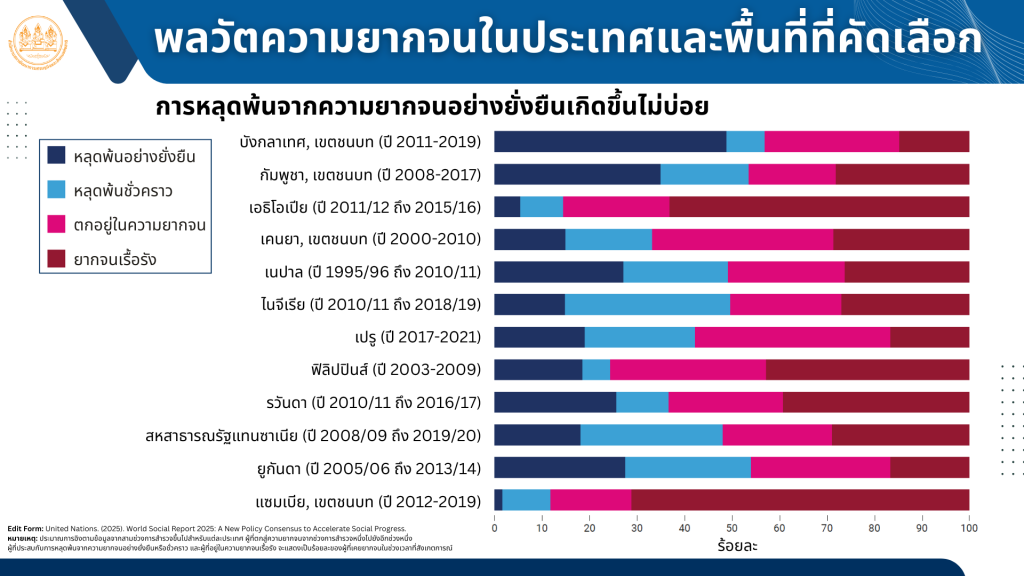
Source: United Nations (2025)
Climate change makes the poor more vulnerable and further from opportunities
Technological development and the green economy create new job opportunities in many sectors, but on the other hand, many workers face unemployment without any system to support this transition equitably and fairly. Uncertainty has therefore become a normal part of modern workers’ lives. But the most severe and unfair factor is the impact of climate change.
Although poor groups contribute very little to greenhouse gas emissions, they receive severe economic impacts. In 2019, the poorest 50% of the world’s population emitted only 12% of total greenhouse gases but faced income losses of up to 75% from climate impacts. This means poor people not only have fewer resources but also bear the costs of a crisis they did not create. The result is poverty that cannot be easily escaped and inequality passed from one generation to another. These changes also hinder global poverty reduction progress and increasingly widen the gap between high-income and low-income countries. Although many countries make efforts to promote equality and participation of vulnerable groups, without urgency, inequality will persist, and many people will be left behind, both in 2030 and for many decades ahead.
The cycle of economic insecurity, social inequality, and distrust in systems is threatening the world’s sustainable development goals, making problem-solving more difficult and creating challenges in building truly equal societies.
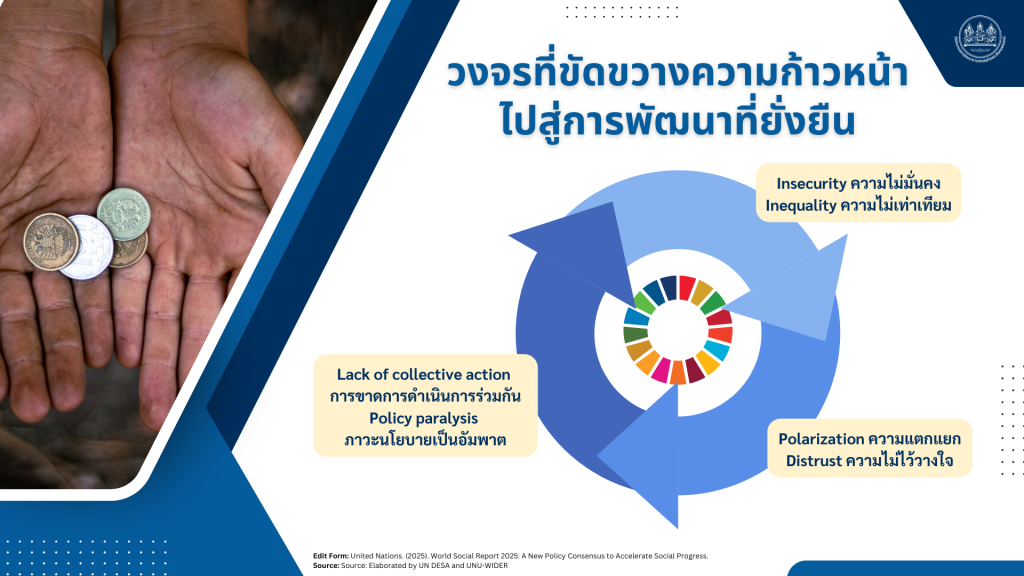
Source: United Nations (2025)
Thailand faces challenges when many youth drop out of development systems
In current Thai society, many youth are in a state of not studying, not working, and not training, known as NEET (Not in Employment, Education or Training). Latest data shows that more than 20% of Thai youth are in this status. This situation not only reflects youth vulnerability but also demonstrates structural gaps that economic and education systems cannot effectively connect opportunities for them. Although Thailand has a National Economic and Social Development Plan with clear goals for “people as the center of development”, the 13th Plan (2023-2027) emphasizes important issues such as Anchor 9: Reducing intergenerational poverty, and Anchor 12: Human development.
However, data from the National Economic and Social Development Office indicates that youth in the NEET group mostly come from families in the lowest 40% income level of the country, meaning poverty is not only the root cause but also an obstacle preventing education from being used as a social mobility ladder. The poorest children who do not attend school cannot easily climb up the quality of life ladder. If this problem is left to become chronic, intergenerational poverty will become more deeply rooted along with inequality more entrenched than before.
Despite attempts to analyze factors causing youth to become NEET through provincial-level statistical data, whether poverty, unemployment rates, or school enrollment, models cannot clearly identify which factors are significant main variables. This indicates that NEET problems are too complex and diverse to use the same policy approach nationwide effectively. When seeking solutions, society often discusses approaches of flexible education or lifelong learning, which although appearing in the latest development plan, practical implementation reveals that the main obstacle lies in designing accessible systems.
A more feasible solution is changing the state’s role from provider to supervisor and standard certifier while promoting private sector participation in organizing new learning systems, which may be more agile and efficient. To adjust systems to keep pace with reality, the most important thing is not solving with large-scale policies but having mechanisms at the local level that can “bring children back into the system” before they are lost. Solving this problem therefore involves not only education and labor systems but also impacts overall social structures. If youth can be successfully brought back into learning or skills training systems, society will benefit enormously in terms of reducing drug problems, youth violence, poverty, and opportunity inequality. Conversely, neglecting this youth group will become a long-term state burden, whether in welfare costs or wasted economic opportunities, and most importantly, society will lose human resources that should be developed to grow to full potential.
Thailand in the context of multidimensional poverty: when poverty is not just about money
Although Thailand has continuously reduced income poverty levels in recent years, in 2023 it was able to reduce the proportion of multidimensionally poor population to 6.13 million people or approximately 8.76% of the total population, representing a significant step toward approaching long-term goals. However, when examining deeper into various dimensions of people’s lives, poverty is not limited to money alone. Problems in health, education, and quality of life remain prominently visible. It was found that there are 4.78 million people classified as multidimensionally poor, accounting for 66.7% of all poor people, particularly problems in health and education, which remain significant obstacles to sustainable quality of life development. Figures indicate that 1.04 million people or 14.5% still lack access to necessary health services and 1.35 million people or 18.8% still lack appropriate educational opportunities, factors related to long-term poverty cycles, especially in rural and peripheral areas.
Additionally, there are over 24.3 million people or 34.7% classified as “at risk of multidimensional poverty,” meaning that without adequate support, this group may deteriorate into poverty at any time, particularly in northeastern and central regions that still have high structural inequality, whether in drinking water quality, access to capital sources, or stable social security.
Poverty problems are not equal in all areas and should not be solved with the same policies. The National Economic and Social Development Office has developed a “Multi-dimensional Poverty Index” (MPI) to monitor progress toward Sustainable Development Goal sub-target 1.2, aiming to reduce the population facing poverty in all forms by half by 2030, which represents an approach that goes beyond measuring poverty through income alone and focuses on analyzing overall quality of life.
Using the same problem-solving approach in all areas may not align with completely different contexts. For example, in the central region, financial security problems have high impact on multidimensional poverty, while southern border provinces face poverty complicated by multiple simultaneous factors. Meanwhile, the country still faces national-level challenges such as high household debt burdens and inequality in accessing healthcare services, particularly in remote areas. These problems all reflect that poverty in Thailand cannot be solved by looking only at household economics but must understand fragile support systems from the structural level.
Creating security in various dimensions remains a difficult challenge requiring new approaches. Although the state has goals to continuously help and assist low-income people, financial security remains the factor with the highest influence on multidimensional poverty. This vulnerability arises not only from insufficient income but also from lack of future security, such as pension systems that still reach few people, most workers in informal sectors lacking stable protection, or migrant workers who still lack clear status and do not receive equal protection.
Thailand must rethink goals and tools for poverty reduction
Approaches to reducing multidimensional poverty in the future need to adjust both in terms of goals, indicators, and data utilization. The MPI should be adjusted to more challenging criteria that reflect higher quality living standards, such as incorporating net income or household savings levels as additional components. At the same time, we must accelerate promoting MPI use as a tool to differentiate target groups for designing appropriate Policy Packages for facts in each area, and use this data to support budget allocation for local administrative organizations, focusing on supporting provinces with high poverty levels or slower poverty recovery than average. Reducing multidimensional poverty is therefore not just about numbers but about policy quality and the ability to understand people in each group more deeply.
Poverty is not just a result of insufficient income but a warning sign of systems that do not yet provide space for everyone to grow equally. When basic life factors such as health, education, or job security are still unevenly distributed, poverty becomes a trap difficult to escape. Although some figures may seem to improve at times, behind them are lives still vulnerable to even minor changes.
If we want a more sustainable future, the important question may not just be “how to help the poor” but what kind of system are we creating that makes some groups poor repeatedly from the start. Policy design must therefore begin by listening to voices of those in vulnerable structures and addressing inequality in specific, not generalized ways. Because ultimately, society will truly progress only when no one is left behind simply because systems do not provide support.
Strategy and International Cooperation Coordination Division
National Economic and Social Development Council
References
Bank of Thailand. (2022). Youth unemployment: Examining the COVID-19 era fresh graduate labor market. Retrieved from https://www.bot.or.th/th/research-and-publications/articles-and-publications/articles/regional-articles/reg-article-2022-05.html
National Economic and Social Development Office. (2025). Social Situation Report Q4/2024. Retrieved from https://www.nesdc.go.th/main.php?filename=socialoutlook_report
Phawanna Thanalertsoomboon. (2025). ‘The country’s most important asset is youth’ Reducing NEETs – Solving education for the future with Patima Chongcharoentanawat. Retrieved from https://www.the101.world/patima-chongcharoentanawat-interview/
Ditto Thailand. (2024). Gig Economy: Modern worker trends every organization should know. Retrieved from https://www.dittothailand.com/th/dittonews/what-is-gig-economy/
Investopedia. (2023). What Is an Economic Shock & Effects of Different Types. Retrieved from https://www.investopedia.com/terms/e/economic-shock.asp
The Potential. (2021). ‘NEET’ Failed people or products of the Thai education system: Interview with Asst. Prof. Dr. Rattiya Phulao. Retrieved from https://thepotential.org/social-issues/neet/
United Nations. (2025). Trust collapsing as job fears surge worldwide, warns UN. Retrieved from https://news.un.org/en/story/2025/04/1162561
United Nations. (2025). World Social Report 2025: A New Policy Consensus to Accelerate Social Progress. Retrieved from https://desapublications.un.org/sites/default/files/publications/2025-04/250422%20BLS25022%20UDS%20UN%20World%20Social%20Report%20WEB.pdf
Related Documents